Nano-sized light mill drives micro-sized disk (w/ Video)
July 5, 2010 by Lynn Yarris
Nano-sized light mill drives micro-sized disk (w/ Video)

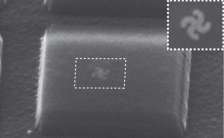
This STM image shows a gammadion gold light mill nanomotor embedded in a silica microdisk. Inset is a magnified top view of the light mill.

While those wonderful light sabers in the Star Wars films remain the figment of George Lucas' fertile imagination, light mills - rotary motors driven by light - that can power objects thousands of times greater in size are now fact. Researchers with the Lawrence Berkeley National Laboratory and the University of California Berkeley have created the first nano-sized light mill motor whose rotational speed and direction can be controlled by tuning the frequency of the incident light waves. It may not help conquer the Dark Side, but this new light mill does open the door to a broad range of valuable applications, including a new generation of nanoelectromechanical systems (NEMS), nanoscale solar light harvesters, and bots that can perform in vivo manipulations of DNA and other biological molecules.

“We have demonstrated a plasmonic motor only 100 nanometers in size that when illuminated with linearly polarized light can generate a torque sufficient to drive a micrometre-sized silica disk 4,000 times larger in volume,” says Xiang Zhang, a principal investigator with Berkeley Lab’s Materials Sciences Division and director of UC Berkeley’s Nano-scale Science and Engineering Center (SINAM), who led this research. “In addition to easily being able to control the rotational speed and direction of this motor, we can create coherent arrays of such motors, which results in greater torque and faster rotation of the microdisk.”

The success of this new light mill stems from the fact that the force exerted on matter by light can be enhanced in a metallic when the frequencies of the incident are resonant with the metal’s plasmons - surface waves that roll through a metal’s conduction . Zhang and his colleagues fashioned a gammadion-shaped light mill type of nanomotor out of gold that was structurally designed to maximize the interactions between light and matter. The metamaterial-style structure also induced orbital angular momentum on the light that in turn imposed a torque on the  nanomotor.

“The planar gammadion gold structures can be viewed as a combination of four small LC-circuits for which the resonant frequencies are determined by the geometry and dielectric properties of the metal,” says Zhang. “The imposed torque results solely from the gammadion structure’s symmetry and interaction with all incident light, including light which doesn’t carry angular momentum. Essentially we use design to encode angular momentum in the structure itself. Since the angular momentum of the light need not be pre-determined, the illuminating source can be a simple linearly polarized plane-wave or Gaussian beam.”

This video is not supported by your browser at this time.

Filmed through water, a silica microdisk embedded with a gold, gammadion-shaped light mill nanomotor rotates in one direction under illumination from laser light at 810 nanometers wavelength. When the wavelength is switched to 1,715 nanometers, the rotational direction is reversed. Torque is produced when the laser light frequencies resonate with the frequencie of the metal’s plasmons. (Movie courtesy of Zhang group)

The results of this research are reported in the journal Nature Nanotechnology in a paper titled, “ Light-driven nanoscale plasmonic motors.” Co-authoring the paper with Zhang were Ming Liu, Thomas Zentgraf, Yongmin Liu and Guy Bartal.

It has long been known that the photons in a beam of light carry both linear and angular momentum that can be transferred to a material object. Optical tweezers and traps, for example, are based on the direct transfer of linear momentum. In 1936, Princeton physicist Richard Beth demonstrated that angular momentum - in either its spin or orbital form - when altered by the scattering or absorption of light can produce a mechanical torque on an object. Previous attempts to harness this transfer of angular momentum for a rotary motor have been hampered by the weakness of the interaction between photons and matter.

“The typical motors had to be at least micrometres or even millimeters in size in order to generate a sufficient amount of torque,” says lead author Ming Liu, a PhD student in Zhang’s group. “We’ve shown that in a nanostructure like our gammadion gold light mill, torque is greatly enhanced by the coupling of the incident light to plasmonic waves. The power density of our motors is very high. As a bonus, the rotational direction is controllable, a counterintuitive fact based on what we learn from wind mills.”

The directional change, Liu explains, is made possible by the support of the four-armed gammadion structure for two major resonance modes - a wavelength of 810 nanometers, and a wavelength of 1,700 nanometers. When illuminated with a linearly polarized Gaussian beam of laser light at the shorter wavelength, the plasmonic motor rotated counterclockwise at a rate of 0.3 Hertz. When illuminated with a similar laser beam but at the larger wavelength, the nanomotor rotated at the same rate of speed but in a clockwise direction.
Nano-sized light mill drives micro-sized disk (w/ Video)
Enlarge

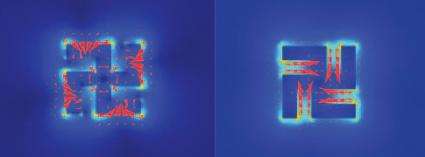
Optical forces induced on a light mill motor by an illumination wavelength of 810 nanometers (left) and 1,700 nanometers. At 810 nm wavelength, light impacts the outer side of the arms, inducing a counterclockwise torque on the motor. At 1,700 nm, light passes through the gaps and impacts the elbow of the motor, providing a clockwise torque. (Image courtesy of Zhang group)

“When multiple motors are integrated into one silica microdisk, the torques applied on the disk from the individual motors accumulate and the overall torque is increased,” Liu says. “For example, a silica disk embedded with four plasmonic nanomotors attains the same rotation speed with only half of the power applied as a disk embedded with a single motor.”

The nanoscale size of this new light mill makes it ideal for powering NEMS, where the premium is on size rather than efficiency. Generating relatively powerful torque in a nanosized light mill also has numerous potential biological applications, including the controlled unwinding and rewinding of the DNA double helix. When these light mill motors are structurally optimized for efficiency, they could be useful for harvesting solar energy in nanoscopic systems.

“By designing multiple motors to work at different resonance frequencies and in a single direction, we could acquire torque from the broad range of wavelengths available in sunlight,” Liu says.

More information:
For more information about the research of Xiang Zhang visit http://xlab.me.ber … xlabnews.htm
For more information about the Berkeley Nano-scale Science and Engineering Center visit http://www.sinam.org/

Provided by Lawrence Berkeley National Laboratory (news : web)

4.7 /5 (25 votes)  

Filter


Move the slider to adjust rank threshold, so that you can hide some of the comments.


Display comments: newest first

trekgeek1
Jul 05, 2010

Rank: 5 / 5 (3)
I'll say it first. It looks like a swastika. Now nobody has to say anything more about it.

100nm motor? That is amazing. The shear size, or lack thereof could easily enable "nanobot" type medical devices. There are so many applications, but my lack of experience in this subject limits my imagination. Any other great applications I'm missing?
vanderMerwe
Jul 05, 2010

Rank: not rated yet
Lovely! :-)
nanotech_republika_pl
Jul 05, 2010

Rank: not rated yet
I think it is more a proof of concept. I can't see how you can shine a laser on a motor that swims in a blood stream. Maybe the laser has to be mounted on the same chip inside the robot to power the motor. But then really small. Can we do that? (Can we fix it? ....)
Sonhouse
Jul 05, 2010

Rank: 5 / 5 (2)
Richard Feynman would have loved it. Remember his prize for making a tiny motor, won in a few months to his surprise. This would take the cake however!
ZeroDelta
Jul 05, 2010

Rank: 5 / 5 (1)
Awesome. One of the more reliable nanoscale mechanisms.
Question
Jul 05, 2010

Rank: not rated yet
Quote from article:
"Optical forces induced on a light mill motor by an illumination wavelength of 810 nanometers (left) and 1,700 nanometers. At 810 nm wavelength, light impacts the outer side of the arms, inducing a counterclockwise torque on the motor. At 1,700 nm, light passes through the gaps and impacts the elbow of the motor, providing a clockwise torque." (Image courtesy of Zhang group)

I find it a little odd that the longer wavelength light enters the gap, one would think it would be the shorter wavelength. I wonder what the explanation is for that?
nanotech_republika_pl
Jul 05, 2010

Rank: 4.5 / 5 (2)
@Question: I don't claim to understand it but I think the answer has to do with the forces created by resonance of certain parts of the gammadion, and not directly by light squeezing through and forcing certain parts of gammalion. See this _free_ suplemental information for the paper: http://www.nature...8-s1.pdf
Ricochet
Jul 07, 2010

Rank: 5 / 5 (1)
I do need to comment on the swastikaness of it... It is important to note that the Nazi swastika's arms turned the opposite direction. What we have here is the ancient svastik symbol, which has stood for good luck, good fortune, and has represented the Sun at different points in history...
An analysis of the 5,000 year history of the svastika can be found here:
http://www.ushmm....10007453
Rank 4.7 /5 (25 votes)
Relevant PhysicsForums posts
  • Physical laws .... are they material?!!
    created52 minutes ago
  • increasing time of daylight
    created1 hour ago
  • Light & Sight
    created1 hour ago
  • Wind Turbine Power
    created4 hours ago
  • Steam Table issues
    created6 hours ago
  • electrostatic induction in a conductor should be immpossible
    created10 hours ago
  • More from Physics Forums - General Physics

More news stories

Hovering not hard if you're top-heavy, researchers find

Top-heavy structures are more likely to maintain their balance while hovering in the air than are those that bear a lower center of gravity, researchers at New York University's Courant Institute of Mathematical Sciences ...

Physics / General Physics

created 1 hour ago | popularity 5 / 5 (1) | comments 1 | with audio podcast

SLAC, Stanford team focuses on high-energy electrons to treat cancer

Accelerator physicists at SLAC and cancer specialists from Stanford are working on a new technology that could dramatically reduce the time needed for cancer radiation treatments. The team ran an initial experiment ...

Physics / General Physics

created 4 hours ago | popularity 5 / 5 (1) | comments 0

Measurements from high-energy collisions lead to better understanding of why meson particles disappear

For several years, physicists at the Relativistic Heavy Ion Collider (RHIC) at Brookhaven National Laboratory (BNL), USA, have studied an unusual state of matter called the quark–gluon plasma, which they ...

Physics / General Physics

created 4 hours ago | popularity not rated yet | comments 0

Quantum physicist explains $100K offer for proof scaled-up quantum computing is impossible

(PhysOrg.com) -- MIT researcher Scott Aaronson has certainly riled the physics community with his offer this past Friday, of $100,000 to anyone who can prove that scaled-up quantum computing is impossible. ...

Physics / Quantum Physics

created Feb 08, 2012 | popularity 4.1 / 5 (11) | comments 32 | with audio podcast weblog

Explained: Sigma

It's a question that arises with virtually every major new finding in science or medicine: What makes a result reliable enough to be taken seriously? The answer has to do with statistical significance -- but ...

Physics / General Physics

created Feb 09, 2012 | popularity 5 / 5 (14) | comments 34


Grass to gas: Researchers' genome map speeds biofuel development

Researchers at the University of Georgia have taken a major step in the ongoing effort to find sources of cleaner, renewable energy by mapping the genomes of two originator cells of Miscanthus x giganteus, a large perenn ...

Researchers develop new method for creating tissue engineering scaffolds

Researchers at Northwestern University have developed a new method for creating scaffolds for tissue engineering applications, providing an alternative that is more flexible and less time-intensive than current technology.

Molecular profiling reveals differences between primary and recurrent ovarian cancers

There is a need to analyze tumor specimens at the time of ovarian cancer recurrence, according to a new study published in Molecular Cancer Therapeutics. Researchers used a diagnostic technology called molecular profiling to examine ...

C-sections linked to breathing problems in preterm infants

Research conducted at Yale School of Medicine shows that a cesarean (C-section) delivery, which was thought to be harmless, is associated with breathing problems in preterm babies who are small for gestational age.

Review: Netflix and Hulu's new scripted originals

Within just over a week, Netflix and Hulu are both debuting their first stabs at original scripted programming.

India probes Google over 'forex transactions'

Indian authorities are probing whether online giant Google broke domestic foreign-exchange transactions rules while shifting funds abroad, the Press Trust of India reported on Friday.