How a smart, decentralized Energy Web is essential for managing renewable energy sources
July 6, 2010 By Lisa Zyga feature
How a smart, decentralized Energy Web is essential for managing renewable energy sources

Enlarge

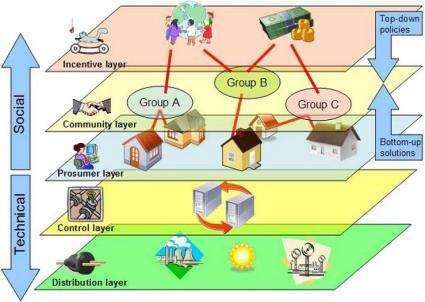
The Energy Web is a power distribution system designed for managing a large-scale, widely distributed network of renewable energy sources. The figure shows the interaction of the different parts of the Energy Web, which includes incentives for "prosumers" (producers and consumers of energy) and allows autonomous self-organization of agents due to evolutionary processes. Image credit: Carreras, et al. ©2010 IEEE.

(PhysOrg.com) -- A decade ago, Gnutella, Kazaa and other early peer-to-peer (P2P) systems showed that a decentralized approach to managing large-scale, widely distributed systems could offer many essential advantages compared to the traditional centralized approach. Since then, researchers have taken the decentralized design method far beyond music sharing, applying it to areas as diverse as database distribution and analysis of biological systems.

In a new study, a team of researchers from the Italian research center CREATE-NET has outlined the ways in which decentralized, bottom-up design approaches could play a critical role in managing the complex, massive-scale networks that are becoming more and more widespread. Systems such as the Internet and ubiquitous computing (in which computing extends beyond the desktop computer to become integrated into everyday objects) are two examples of these kinds of large-scale, dynamic systems that operate in open environments with many autonomous users and are constantly evolving.

In their study, the Italian team has discussed the essential features that a decentralized design approach needs in order to support these large-scale networks and provide the necessary degrees of reliability and dependability. As a case in point, they showed how these concepts could be applied to the management of the future generation of Smart Grids, characterized by the inclusion of a large number of distributed and/or . They call the resulting system the Web, which, as coauthor Daniele Miorandi explains, depicts a future in which bidirectional flows of energy will resemble the way information and data is nowadays exchanged on the Web.

The key to the Energy Web design is the bottom-up approach, in which appropriate laws are implemented to allow desired global behaviors to emerge from only local interactions among individual components. In contrast to the traditional top-down approach, which focuses on performance, the new approach focuses on reliability, stressing how to react to internal failures rather than attempting to avoid them. With reliability in mind, desired behaviors include the ability to self-adapt to unknown conditions, to self-heal in the case of failures, to learn from previous experiences, and to self-protect against external threats. These behaviors require that the system evolves through time in the midst of a changing environment that cannot be accounted for in advance - something that the deterministic approach of traditional methods does not allow for.

When applying this approach to the future Energy Web, the researchers explained how mechanisms and methods should be tuned in order to meet the nature and functional constraints of energy transport and distribution systems. Unlike today’s highly centralized energy systems’ architecture, which for the most part consists of a few large power plants supplying energy to a large number of consumers, the future Energy Web is expected to consist of a very different framework. Large numbers of widely distributed, small-scale energy sources (such as wind turbines and solar panels), smart meters in homes that actively manage consumption, and the emergence of “energy prosumers” (citizens that both produce and consume energy) make the future Energy Web look much more similar to the Internet than to existing power grids. By carefully managing our future energy consumption, the researchers hope to bring about cost and energy savings, as well as a reduction in fossil-based energy production, by using a well-planned, decentralized approach.

More information: Iacopo Carreras, Daniele Miorandi, Regis Saint-Paul, and Imrich Chlamtac. “Bottom-Up Design Patterns and the Energy Web.” IEEE Transactions on Systems, Man, and Cybernetics - Part A: Systems and Humans. DOI:10.1109/TSMCA.2010.2048025

Copyright 2010 PhysOrg.com.
All rights reserved. This material may not be published, broadcast, rewritten or redistributed in whole or part without the express written permission of PhysOrg.com.

3.5 /5 (15 votes)  

Filter


Move the slider to adjust rank threshold, so that you can hide some of the comments.


Display comments: newest first

lengould100
Jul 06, 2010

Rank: 1 / 5 (1)
You should read my 3 papers on IMEUC, Independent Market for Every Utility Customer, IMEUC - Preliminary Business Case at http://www.energy...t_id=729
Eikka
Jul 06, 2010

Rank: not rated yet
People always forget that gnutella, limewire, kazaa etc. were actually awfully slow and unreliable. You didn't bother to search anything rare because even if it was found, you had to wait weeks for the download to complete, only to find that the packet was actually a fake and contained a virus, or it was broken in transit, or the final piece of the puzzle went missing when the only sender went offline at 99.9%.

Sure. The system worked after a fashion, but it was barely useful. If the exact same models were applied to the power grid, you would need to "search" a couple hours for a power producer with available surplus, establish a connection and hope that it doesn't drop out, and then you might get enough power to light a single bulb because the energy is lost in the distance of the grid between you two.
HealingMindN
Jul 06, 2010

Rank: 5 / 5 (2)
I would go for a distributed energy system. It would be far more trustworthy than centralized power, whole city sections wouldn't suffer brownouts and blackouts. If one power site gets ripped out, another takes its place. Of course, this means we can't have greedy people working the system like so much Enron BS.
russcelt
Jul 07, 2010

Rank: 5 / 5 (2)
The big stumbling block to this idea is the addiction to political and managerial power that the meritocracy has. That group of Presidents, Prime Ministers, Potentates, and corporate executives, current and past, and their entourage who can not imagine the world functioning without themselves at its head. Adequately remunerated of course.
Eikka
Jul 07, 2010

Rank: 5 / 5 (1)
I would go for a distributed energy system. It would be far more trustworthy than centralized power, whole city sections wouldn't suffer brownouts and blackouts.


What most people who use P2P networks will tell you is, that there's a sort of pareto law in action: 80% of the users depend on the last 20% to download any content. Most people are just freewheeling along, not contributing to the network.

When the big uploaders go offline, the well dries up and the servers become a disorganized mess where it is very difficult to find anything worthwhile.

The same thing applied to a power grid would mean that losing the big players, like a large nuclear powerplant, or a big grid intertie would still leave millions of people in a blackout, and the rest would barely scrape by.
jerryd
Jul 07, 2010

Rank: not rated yet

I don't think the grid has a choice as DG will happen for 1 reason, you'll be able to make your own power cheaper by far than retail utility prices which are 2-3x's wholesale costs.

The only reason I don't now is my site isn't good as I live in a full coverage old oak forest. But through conservation/eff, insulation, top loading fridge, CFL's, ect my electric/energy is only $24-45/month including charging my EV's.
Eikka
Jul 08, 2010

Rank: 5 / 5 (2)
you'll be able to make your own power cheaper by far than retail utility prices which are 2-3x's wholesale costs.


You might, but the question will still be, can you make enough of it all the time?

Producing something like 3 kW on average is actually pretty hard in a private home, if you need it to be available at all times. If you can only produce 1 kW then losing the grid is a serious matter. One thing you'll lose immediately is hot water, heating and air conditining, because you simply can't support them. (Unless you're using gas/oil for heat)

The thing about micro-production is, that it doesn't stack up nicely. A million people who produce one watt each, doesn't mean you have one megawatt of power available at any arbitrary moment at any arbitrary point in the network. Even if you had the capacity to support all the homes in theory, in reality they all need some input from the big boys on the grid, who can put out gigawatts 24/365.
p2pjunky
Jul 14, 2010

Rank: not rated yet
I don't understand why people are wary of leechers vs producers in this scenario - as the producers of excess energy will charge for it. It's not like a music file you copied from a buddy and uploaded to the internet, and doesn't cost you a dime.

Energy production is expensive, and I doubt very much people will be giving it away for free. I still have my doubts about the ability of alternative energy sources to provide reliable capacity however. I assume this study refers to a future where the tech is more refined/efficient?
Rank 3.5 /5 (15 votes)
Relevant PhysicsForums posts
  • Empirical data regarding shower heads and water
    created5 hours ago
  • feed hold button on CNC lathe
    createdFeb 09, 2012
  • RFAC in Fortran
    createdFeb 09, 2012
  • dynamics 2/32
    createdFeb 08, 2012
  • dynamics
    createdFeb 08, 2012
  • Vibration Absorbtion Problem
    createdFeb 08, 2012
  • More from Physics Forums - General Engineering

More news stories

US video game sales fall 34 percent in January

(AP) -- U.S. retail sales of video game hardware, software and accessories fell 34 percent in January from a year earlier to $751 million due to the lack of new game titles, according to market researcher NPD Group.

Technology / Business

created 2 hours ago | popularity not rated yet | comments 0

Zynga partners with toy maker Hasbro

Old school toy maker Hasbro and online social game star Zynga on Thursday announced a partnership to mesh the Internet firm's hits with real-world products.

Technology / Business

created 1 hour ago | popularity not rated yet | comments 0

Samsung can continue selling Galaxy tabs in Germany: court

South Korea's Samsung Electronics can continue to sell its Galaxy Tab 10.1N tablet computer in Germany, a German court ruled Thursday, rejecting a bid by arch-rival Apple to have them banned.

Technology / Business

created 23 hours ago | popularity 4 / 5 (4) | comments 3

Digital photos could put kids at risk

A study published in the International Journal of Electronic Security and Digital Forensics this month suggests that parents and carers could be putting children at risk if they upload digital photos that are automatically "geota ...

Technology / Internet

created 19 hours ago | popularity 5 / 5 (1) | comments 3

Google launches Chrome browser for Android smartphones

With more and more people connecting to the Internet through a phone or a tablet instead of a PC, Google Inc. is bringing its fast-growing browser, Chrome, to the newest Android-powered mobile devices.

Technology / Software

created 22 hours ago | popularity 5 / 5 (5) | comments 0


Protein libraries in a snap

(PhysOrg.com) -- A Rice University undergraduate will depart with not only a degree but also a possible patent for his invention of an efficient way to create protein libraries, an important component of biomolecular ...

Breastfeeding protects against asthma up to six years of age

(Medical Xpress) -- Research by the University of Otago in Christchurch and Wellington has shown that breastfeeding of infants has a clear protective effect against children developing asthma or wheezing up to six years of ...

Study finds stress hormones fluctuate with mood during pregnancy

(Medical Xpress) -- While pregnant, women pay particular attention to factors such as diet and exercise to ensure their babies are born healthy and develop normally. New research from the University of Calgary’s Faculty ...

Humans may have helped the decline of African rainforests 3000 years ago

(PhysOrg.com) -- Large areas of rainforests in Central Africa mysteriously disappeared over three thousand years ago, to be replaced by savannas. The prevailing theory has been that the cause was a change ...

Japan scientist makes 'Avatar' robot

A Japanese-developed robot that mimics the movements of its human controller is bringing the Hollywood blockbuster "Avatar" one step closer to reality.

Miami battling invasion of giant African snails

No one knows how they got there. But an invasion of African giant snails has southern Florida in a panic over potential crop damage, disease and general yuckiness surrounding the slimy gastropods.