Nexi robot: A matter of trust
July 6, 2010
A matter of trust

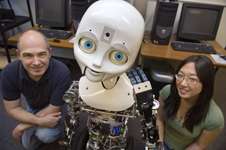
David DeSteno and MIT's Jin Joo Lee worked with Nexi the robot on the research project. Photo by Mary Knox Merrill.

(PhysOrg.com) -- What can a wide-eyed, talking robot teach us about trust? A lot, according to Northeastern psychology professor David DeSteno, and his colleagues, who are conducting innovative research to determine how humans decide to trust strangers -- and if those decisions are accurate.

The interdisciplinary research project, funded by the National Science Foundation (NSF), is being conducted in collaboration with Cynthia Breazeal, director of the MIT Media Lab’s Personal Robots Group, Robert Frank, an economist, and David Pizarro, a psychologist, both from Cornell.

The researchers are examining whether nonverbal cues and gestures could affect our trustworthiness judgments. “People tend to mimic each other’s body language,” said DeSteno, “which might help them develop intuitions about what other people are feeling — intuitions about whether they’ll treat them fairly.”

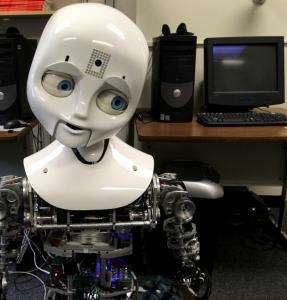
This project tests their theories by having humans interact with the social robot, Nexi, in an attempt to judge her trustworthiness. Unbeknownst to participants, Nexi has been programmed to make gestures while speaking with selected participants — gestures that the team hypothesizes could determine whether or not she’s deemed trustworthy. 

“Using a whose every expression and gesture we can control will allow us to better identify the exact cues and psychological processes that underlie humans’ ability to accurately predict if a stranger is trustworthy,” said DeSteno.

During the first part of the experiment, Nexi makes small talk with her human counterpart for 10 minutes, asking and answering questions about topics such as traveling, where they are from and what they like most about living in Boston.
A matter of trust
“The goal was to simulate a normal conversation with accompanying movements to see what the mind would intuitively glean about the trustworthiness of another,” said DeSteno.

The participants then play an economic game called “Give Some,” which asks them to determine how much money Nexi might give them at the expense of her individual profit.  Simultaneously, they decide how much, if any, they’ll give to Nexi. The rules of the game allow for two distinct outcomes:  higher individual profit for one and loss for the other, or relatively smaller and equal profits for both partners.

“Trust might not be determined by one isolated gesture, but rather a ‘dance’ that happens between the strangers, which leads them to trust or not the other,” said DeSteno, who, with his colleagues, will continue testing their theories by seeing if Nexi can be taught to predict the trustworthiness of human partners.

Provided by Northeastern University (news : web)


Rank 5 /5 (2 votes)
Related Stories
Relevant PhysicsForums posts
  • Calling function with no input argument
    created11 hours ago
  • Force free body diagram problem on gym equipment
    created12 hours ago
  • Empirical data regarding shower heads and water
    created20 hours ago
  • feed hold button on CNC lathe
    createdFeb 09, 2012
  • RFAC in Fortran
    createdFeb 09, 2012
  • dynamics 2/32
    createdFeb 08, 2012
  • More from Physics Forums - General Engineering

More news stories

Google users warned of threat to smartphone wallets

Users of Google smartphone wallets were being warned on Friday that there is a way to crack pass codes intended to thwart thieves from going on illicit shopping sprees.

Technology / Internet

created 4 hours ago | popularity 5 / 5 (2) | comments 0

Anonymous knocks CIA website offline (Update)

The website of the Central Intelligence Agency was inaccessible on Friday after the hacker group Anonymous claimed to have knocked it offline.

Technology / Internet

created 5 hours ago | popularity 5 / 5 (7) | comments 11

New error-correcting codes guarantee the fastest possible rate of data transmission

Error-correcting codes are one of the triumphs of the digital age. They’re a way of encoding information so that it can be transmitted across a communication channel — such as an optical fiber o ...

Technology / Computer Sciences

created 14 hours ago | popularity 4.8 / 5 (6) | comments 6 | with audio podcast

New power source discovered

(PhysOrg.com) -- Researchers at the Massachusetts Institute of Technology (MIT) and RMIT University have made a breakthrough in energy storage and power generation.

Technology / Energy & Green Tech

created 13 hours ago | popularity 4.8 / 5 (21) | comments 7 | with audio podcast

Small modular reactor design could be a 'SUPERSTAR'

(PhysOrg.com) -- Though most of today's nuclear reactors are cooled by water, we've long known that there are alternatives; in fact, the world's first nuclear-powered electricity in 1951 came from a reactor ...

Technology / Energy & Green Tech

created 13 hours ago | popularity 4.3 / 5 (11) | comments 20 | with audio podcast


Complex wiring of the nervous system may rely on a just a handful of genes and proteins

Researchers at the Salk Institute have discovered a startling feature of early brain development that helps to explain how complex neuron wiring patterns are programmed using just a handful of critical genes. ...

The power of estrogen -- male snakes attract other males

A new study has shown that boosting the estrogen levels of male garter snakes causes them to secrete the same pheromones that females use to attract suitors, and turned the males into just about the sexiest ...

Putting the squeeze on planets outside our solar system

(PhysOrg.com) -- Using high-powered lasers, scientists at Lawrence Livermore National Laboratory and collaborators discovered that molten magnesium silicate undergoes a phase change in the liquid state, abruptly ...

Humans may have helped the decline of African rainforests 3000 years ago

(PhysOrg.com) -- Large areas of rainforests in Central Africa mysteriously disappeared over three thousand years ago, to be replaced by savannas. The prevailing theory has been that the cause was a change ...

NASA sees wide-eyed cyclone Jasmine

Cyclone Jasmine's eye has opened wider on NASA satellite imagery, as it moves through the Southern Pacific Ocean.

Grass to gas: Researchers' genome map speeds biofuel development

Researchers at the University of Georgia have taken a major step in the ongoing effort to find sources of cleaner, renewable energy by mapping the genomes of two originator cells of Miscanthus x giganteus, a large perenn ...