A pinch of light: Laser 'tweezers' for medicine, communications and harvesting energy
July 6, 2010
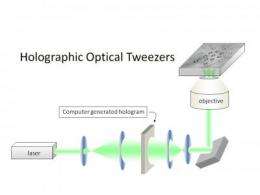
This diagram shows TAU's holographic laser tweezers. Credit: AFTAU
Star Trek fans will remember "tractor beams," lasers that allowed the Starship Enterprise to trap and move objects. Tel Aviv University is now turning this science fiction into science fact -- on a nano scale.
A new tool developed by Tel Aviv University, Holographic Optical Tweezers (HOTs) use holographic technology to manipulate up to 300 nanoparticles at a time, such as beads of glass or polymer, that are too small and delicate to be handled with traditional laboratory instruments. The technology, also known as "optical tweezers," could form the basis for tomorrow's ultra-fast, light-powered communication devices and quantum computers, says Dr. Yael Roichman of Tel Aviv University's School of Chemistry.
She's using these tweezers to build nano structures that control beams of light, aiding in the development of anything from optical microscopes to light-fuelled computer technology, she reports.
Holding onto the light
HOTS are a new family of optical tools that use a strongly-focused light beam to trap, manipulate and transform small amounts of matter. First proposed as a scientific theory in 1986 and prototyped by a University of Chicago team in 1997, holographic optical tweezers have been lauded as indispensible for researching cutting-edge ideas in physics, chemistry, and biology.
Dr. Roichman and her team of researchers are currently pioneering the use of optical tweezers to create the next generation of photonic devices. Made out of carefully arranged particles of materials such as silicon oxide and titanium oxide, these devices have the ability to insulate light, allowing less energy to be lost in transmission.
"Our invention could increase transmission speed and save energy, important for long-life batteries in computers, for instance," says Dr. Roichman.
Photons are already used in optical fibers that bring us everyday luxuries like cable TV. But Dr. Roichman says this technology can be taken much further. In her lab at Tel Aviv University, she is advancing the previous study of photonic crystals, which control and harness light, by manipulating a variety of particles to create 3D heterogeneous structures. The ability to insulate light in a novel way, preserving its potential energy, is central to this goal.
No known material today can resist the flow of light -- its energy is either absorbed by, reflected off, or passed through materials. But Dr. Roichman has devised a new layering technique using special crystals central to the creation of photonic devices. These photonic crystals are arranged to create a path along which light can travel. If they're arranged correctly, she says, the light is trapped along the path.
In Dr. Roichman's approach, different materials are added to absorb or amplify light as required. She is hopeful that the ability to build these devices will transform communications, telescopic instruments, and even medical technology, making them more efficient and powerful.
Shining a light into a bacterium's belly
One project Dr. Roichman is working on tracks the effectiveness of antibiotics. Her improvements to optical microscopy will, for the first time, allow researchers to look at the internal processes within bacteria and see how different types of antibiotics attack them. More than that, her optical tweezers can isolate the bacteria to be studied, handling them without killing them.
Dr. Roichman, whose previous research was published in the journals Applied Optics and Physics Review Letters, notes that HOTs give researchers a platform with infinite possibilities. They give science a valuable tool to reach into the microscopic world -- and their building potential is endless.
-
Nanotechnology gets a new light touch
Oct 02, 2009 |
not rated yet |
0
-
Optoelectronic tweezers push nanowires around
Apr 27, 2007 |
not rated yet |
0
-
Technological breakthrough in Silicon Photonics: Intel Silicon-based Optical Modulator Could Run Faster Than 1GHz
Jul 14, 2004 |
not rated yet |
0
-
Shining a light around corners: Scientists explore a new method for curving 'Airy' light beams
Jun 16, 2010 |
not rated yet |
0
-
Fabricating 3D Photonic Crystals
Jan 21, 2009 |
not rated yet |
0
-
Engineers build first sub-10-nm carbon nanotube transistor
Feb 01, 2012 |
4.9 / 5 (31) |
30
-
Something old, something new: Evolution and the structural divergence of duplicate genes
Jan 31, 2012 |
4.6 / 5 (7) |
1
-
The hidden nanoworld of ice crystals: Revealing the dynamic behavior of quasi-liquid layers
Jan 30, 2012 |
5 / 5 (3) |
1
-
Stock market network reveals investor clustering
Jan 27, 2012 |
3.9 / 5 (23) |
8
-
Of microchemistry and molecules: Electronic microfluidic device synthesizes biocompatible probes
Jan 26, 2012 |
5 / 5 (1) |
0
-
Simple Torque from Gravity Problem
1 hour ago
-
Books To Inspire a Beginnig Physics Student
3 hours ago
-
Pith balls problem
3 hours ago
-
Electrostatics
3 hours ago
-
what is phase constant
3 hours ago
-
Basics In electromagnetic wave
3 hours ago
- More from Physics Forums - General Physics
More news stories
Putting the squeeze on planets outside our solar system
(PhysOrg.com) -- Using high-powered lasers, scientists at Lawrence Livermore National Laboratory and collaborators discovered that molten magnesium silicate undergoes a phase change in the liquid state, abruptly ...
14 hours ago |
4.3 / 5 (7) |
0
|
Hovering not hard if you're top-heavy, researchers find
Top-heavy structures are more likely to maintain their balance while hovering in the air than are those that bear a lower center of gravity, researchers at New York University's Courant Institute of Mathematical Sciences ...
15 hours ago |
5 / 5 (2) |
1
|
SLAC, Stanford team focuses on high-energy electrons to treat cancer
Accelerator physicists at SLAC and cancer specialists from Stanford are working on a new technology that could dramatically reduce the time needed for cancer radiation treatments. The team ran an initial experiment ...
18 hours ago |
5 / 5 (2) |
0
Measurements from high-energy collisions lead to better understanding of why meson particles disappear
For several years, physicists at the Relativistic Heavy Ion Collider (RHIC) at Brookhaven National Laboratory (BNL), USA, have studied an unusual state of matter called the quarkgluon plasma, which they ...
19 hours ago |
4.5 / 5 (4) |
0
Explained: Sigma
It's a question that arises with virtually every major new finding in science or medicine: What makes a result reliable enough to be taken seriously? The answer has to do with statistical significance -- but ...
Feb 09, 2012 |
5 / 5 (16) |
53
Anonymous knocks CIA website offline (Update)
The website of the Central Intelligence Agency was inaccessible on Friday after the hacker group Anonymous claimed to have knocked it offline.
New error-correcting codes guarantee the fastest possible rate of data transmission
Error-correcting codes are one of the triumphs of the digital age. Theyre a way of encoding information so that it can be transmitted across a communication channel such as an optical fiber o ...
Humans may have helped the decline of African rainforests 3000 years ago
(PhysOrg.com) -- Large areas of rainforests in Central Africa mysteriously disappeared over three thousand years ago, to be replaced by savannas. The prevailing theory has been that the cause was a change ...
New power source discovered
(PhysOrg.com) -- Researchers at the Massachusetts Institute of Technology (MIT) and RMIT University have made a breakthrough in energy storage and power generation.
Small modular reactor design could be a 'SUPERSTAR'
(PhysOrg.com) -- Though most of today's nuclear reactors are cooled by water, we've long known that there are alternatives; in fact, the world's first nuclear-powered electricity in 1951 came from a reactor ...
Google users warned of threat to smartphone wallets
Users of Google smartphone wallets were being warned on Friday that there is a way to crack pass codes intended to thwart thieves from going on illicit shopping sprees.