Multicolor quantum dots aid in cancer biopsy diagnosis
July 6, 2010 by Quinn Eastman
Multicolor quantum dots aid in cancer biopsy diagnosis

Enlarge

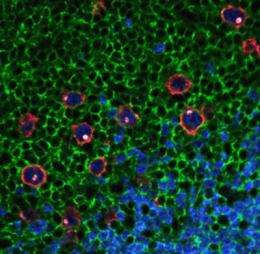
Reed-Sternberg cells can be distinguished by their red outline, blue and white internal staining, and their lack of green staining. Credit: Shuming Nie

The tunable fluorescent nanoparticles known as quantum dots make ideal tools for distinguishing and identifying rare cancer cells in tissue biopsies, Emory and Georgia Tech scientists have demonstrated.

An article to be featured on the cover of the July 15 issue of describes how multicolor quantum dots linked to antibodies can distinguish the Reed-Sternberg cells that are characteristic of Hodgkin's lymphoma.

"Our multicolor quantum dot staining method provides rapid detection and identification of rare from heterogenous tissue specimens," says senior author Shuming Nie, PhD, the Wallace H. Coulter distinguished professor in the Coulter department of biomedical engineering at Georgia Tech and Emory University. "The clinical utility is not limited to Hodgkin's lymphoma but potentially could be extended to detect stem cells, tumor-associated macrophages and other rare cell types."

Quantum dots are nanometer-sized semiconductor crystals that have unique chemical and physical properties due to their size and their highly compact structure. Quantum dots can be chemically linked to antibodies, which can detect molecules present on the surfaces or internal parts of .

As a test of quantum dots' discriminatory power, the authors used four varieties at once -- white, red, green and blue - each detecting a different protein, to stain lymph node biopsies. The goal was to distinguish six Hodgkin's lymphoma cases from two other types of lymphoma and samples from two patients with benign growths in their lymph nodes.

Reed Sternberg cells have a distinctive appearance, but in lymph node tissue, they are usually surrounded by other . The authors describe identifying them as a task like "finding a needle in a haystack."

"We're excited about this technology," says Andrew Young, MD, PhD, associate professor of pathology and laboratory medicine at Emory University School of Medicine and director of clinical laboratories at Grady Health System. "We expect it could help guide the type of treatment a cancer patient gets and that it could be used with a wider variety of tumor types."

The most reliable way to assign cell identity is to look at more than one protein, Young says. With the standard methods in most pathology labs, staining cells with four different antibodies would require four separate slides - a problem when the specimen is very small. Small diagnostic specimens are common today, because they minimize the burden on the patient. In addition, the images from multiple separate slides wouldn't depict exactly the same cells. The allow "multiplexing": superimposing four colors on top of each other.

Hodgkin's lymphoma is usually treated with chemotherapy and radiation, and is notable among the subtypes of adult lymphoma because the survival rate is relatively high. Young says the quantum dot technique could be useful for other types of cancer, where distinguishing cancer cells based on surface or genetic markers can point oncologists towards "targeted therapies" designed for one particular type of tumor.

More information: J. Liu, S.K. Lau, V.A. Varma, B.A Kairdolf and S. Nie. Multiplexed detection of characterization of rare tumor cells in Hodgkin's lymphoma with multicolor quantum dots. Anal. Chem. DOI:10.1021/ac101065b (online before print) 2010.

Provided by Emory University (news : web)


Rank 4 /5 (1 vote)
Relevant PhysicsForums posts
  • Stoichiometry
    createdFeb 10, 2012
  • Boiling and melting point of impure substances
    createdFeb 10, 2012
  • Safe nitrogen compound to decompose a 500 deg C in a furnace?
    createdFeb 09, 2012
  • [ask]electron inside drinking water
    createdFeb 08, 2012
  • How to avoid formation of Lithium Chromate ???
    createdFeb 08, 2012
  • how to choose a reduced or oxidated form in a redox
    createdFeb 08, 2012
  • More from Physics Forums - Chemistry

More news stories

Fool's gold may prove an unlikely alternative to overexploited catalytic materials

Catalytic materials, which lower the energy barriers for chemical reactions, are used in everything from the commercial production of chemicals to catalytic converters in car engines. However, with current catalytic materials ...

Chemistry / Materials Science

created 18 hours ago | popularity 4.4 / 5 (8) | comments 6 | with audio podcast

Unpicking HIV’s invisibility cloak

Drug researchers hunting for alternative ways to treat human immunodeficiency virus (HIV) infections may soon have a novel target—its camouflage coat. HIV hides inside a cloak unusually rich in a sugar ...

Chemistry / Biochemistry

created 18 hours ago | popularity 5 / 5 (5) | comments 0

Hydrogen from acidic water: Researchers develop potential low cost alternative to platinum for splitting water

A technique for creating a new molecule that structurally and chemically replicates the active part of the widely used industrial catalyst molybdenite has been developed by researchers with the Lawrence Berkeley ...

Chemistry / Materials Science

created Feb 09, 2012 | popularity 4.8 / 5 (14) | comments 15 | with audio podcast

No entry without protein recycling: Researchers discover new coherence in enzyme transport

The group of Prof. Dr. Ralf Erdmann at the Ruhr-Universität Bochum, Germany, discovered a connection of peroxisomal protein import and receptor export. In the Journal of Biological Chemistry, they disclo ...

Chemistry / Biochemistry

created 18 hours ago | popularity not rated yet | comments 0

Under the microscope #7

In this video Dr Ingrid Graz shows us a thin layer of gold on top of rubber. Cracks in the gold allow it to stretch and we can use this for stretchable electronics.

Chemistry / Other

created 20 hours ago | popularity not rated yet | comments 0


Anonymous knocks CIA website offline (Update)

The website of the Central Intelligence Agency was inaccessible on Friday after the hacker group Anonymous claimed to have knocked it offline.

New error-correcting codes guarantee the fastest possible rate of data transmission

Error-correcting codes are one of the triumphs of the digital age. They’re a way of encoding information so that it can be transmitted across a communication channel — such as an optical fiber o ...

Humans may have helped the decline of African rainforests 3000 years ago

(PhysOrg.com) -- Large areas of rainforests in Central Africa mysteriously disappeared over three thousand years ago, to be replaced by savannas. The prevailing theory has been that the cause was a change ...

New power source discovered

(PhysOrg.com) -- Researchers at the Massachusetts Institute of Technology (MIT) and RMIT University have made a breakthrough in energy storage and power generation.

Small modular reactor design could be a 'SUPERSTAR'

(PhysOrg.com) -- Though most of today's nuclear reactors are cooled by water, we've long known that there are alternatives; in fact, the world's first nuclear-powered electricity in 1951 came from a reactor ...

Google users warned of threat to smartphone wallets

Users of Google smartphone wallets were being warned on Friday that there is a way to crack pass codes intended to thwart thieves from going on illicit shopping sprees.