Coldest Antimatter Ever Produced
July 6, 2010 By Mike Lucibella
Coldest Antimatter Ever Produced

Enlarge

Credit: CERN Geneva

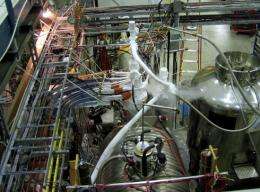
(PhysOrg.com) -- Physicists working at the CERN nuclear research lab on the border of Switzerland and France have generated the coldest particles of antimatter ever recorded.

The team cooled down antiprotons to temperatures colder than the surface of Pluto, as low as -443 degrees F (9.26 kelvin) -- just 17 degrees above absolute zero. Physicists studying cold hope to ultimately glean insights into why the universe is made of matter rather than antimatter.

In order to study this problem in depth, the team would need to combine cold antiprotons with an electron's antimatter partner, known as a positron, to form cooled atoms of antihydrogen. In this way physicists will be able to hold the neutral atoms in magnetic traps and analyze the behavior of antimatter more carefully.

" is one of the most studied systems in physics," said Jeff Hangst, spokesperson for the group responsible for antimatter research at low temperatures at , in Geneva. "We would like to do the same kinds of precision measurements in the antimatter spectrum."

The anti-hydrogen cooler collects a large number of particles in a magnetic trap with an open top. Over time, the most energetic particles will bounce out of the trap, while particles with less energy remain trapped. The trap is gradually shrunk so that progressively cooler particles can escape, ultimately leaving behind only the very coldest particles.

"It's the same principle that cools your coffee while it sits on the table," said Hangst, referring to the way the hottest in your coffee evaporate away first, leaving cooler ones behind.

The previous record for the coldest antimatter was set in 1989 by a team at Harvard University who cooled antiprotons down to about -272 F (104.3 kelvin).

• Learn about becoming PhysOrg.com sponsor

Provided by Inside Science News Service

4.2 /5 (39 votes)  

Filter


Move the slider to adjust rank threshold, so that you can hide some of the comments.


Display comments: newest first

Skeptic_Heretic
Jul 06, 2010

Rank: 4.2 / 5 (5)
The team cooled down antiprotons to temperatures colder than the surface of Pluto, as low as -443 degrees F (9.26 kelvin) -- just 17 degrees above absolute zero.
Anyone else see the problem here?
tigger
Jul 06, 2010

Rank: 2.7 / 5 (3)
Anyone else see the problem here?


um, yeah... isn't 9.26 kelvin "just 9.26 degrees above absolute zero"?

In any case they should have put "just 9.26 degrees
(insert metric here e.g Kelvin) above absolute zero"... to stipulate the metric used.

Anyway, magnetic traps are great :-)

captavait
Jul 06, 2010

Rank: 3.7 / 5 (3)
They just mean absolute zero is -460 F or more specifically -459.67 F
DamienS
Jul 06, 2010

Rank: 3.7 / 5 (6)
"um, yeah... isn't 9.26 kelvin 'just 9.26 degrees above absolute zero'?"

To be pedantic, no. If you're talking degrees, then you're not talking Kelvin. The Kelvin scale doesn't use the degree qualifier.
yOnsa
Jul 06, 2010

Rank: 3 / 5 (2)
i'm glad you are all here to clear that up.
bredmond
Jul 07, 2010

Rank: 3.7 / 5 (3)
Anyone else see the problem here?


um, yeah... isn't 9.26 kelvin "just 9.26 degrees above absolute zero"?

In any case they should have put "just 9.26 degrees
(insert metric here e.g Kelvin) above absolute zero"... to stipulate the metric used.


they probably mean 17 degrees farenheit. the original measure was in farenheit. that way the argument about kelvin being degrees or not is now resolved. they do mean degrees. they just assumed we understood it was farenheit. just like they assumed that we knew they meant the temperature of the antiproton, not the temperature of Pluto, which was also mentioned.
fmfbrestel
Jul 07, 2010

Rank: 4.5 / 5 (8)
One thing is for certain, this news service took info from CERN which was certainly released using SI units and then converted them all to farenheit. But why? so we americans could better understand just how cold? I'm sorry but i dont think farenheit helps me understand 9.26K. "Cold" doesnt do 9K justice. Temperatures that low have long since stopped being relatable to human sensation.

Anyway, if your going to publish a science news story, use SI units. If your giving a weather update, use farenheit.
ancronym
Jul 07, 2010

Rank: 3 / 5 (2)
Anyway, if your going to publish a science news story, use SI units. If your giving a weather update, use farenheit.


Indeed, but they never listen ...

Plainview
Jul 07, 2010

Rank: 2 / 5 (4)
Wow. The people commenting on this site are exactly like the guys in the show "Big Bang Theory." I mean this in the nicest way possible, but what a bunch of nerds.
Skeptic_Heretic
Jul 07, 2010

Rank: 5 / 5 (1)
Wow. The people commenting on this site are exactly like the guys in the show "Big Bang Theory." I mean this in the nicest way possible, but what a bunch of nerds.

Just say something about God and the stupid ones will come out of the woodwork.
coldy_lox
Jul 07, 2010

Rank: not rated yet
Doesn't Data have a Positronic brain? No wonder he's so cool-headed.
plasticpower
Jul 11, 2010

Rank: not rated yet
I'm curious, is antimatter containment possible only due to the extremely low temperatures? Wouldn't it want to "react" with normal matter immediately upon production? I would assume antimatter is produced in some scenario where a lot of energy is released, which would definitely raise the temperatures and cause it to annihilate right away, or does antimatter survive for a period of time? Sorry, antimatter noob here!
fmfbrestel
Jul 11, 2010

Rank: 1 / 5 (1)
Anti-matter has predictable electromagnetic properties which allow for magnetic confinement. But yes, their temperature when created is VERY high and it takes quite a good deal of anti-mater collection in order to have much left over after evaporating enough off to achieve these temperatures.
fmfbrestel
Jul 11, 2010

Rank: 5 / 5 (1)
And despite what you may have seen in Angles and Demons, we are nowhere near good enough at anti-mater collection to create a bomb out of it.
Rank 4.2 /5 (39 votes)
Related Stories
Relevant PhysicsForums posts
  • Does light travel for ever?
    created1 hour ago
  • Infinity by Particles
    created2 hours ago
  • what does negative resistivity mean
    created2 hours ago
  • Calculating Electrostatic force between parallel plates
    created4 hours ago
  • Strength of induced magnetic field inside an inductor
    created7 hours ago
  • increasing time of daylight
    created8 hours ago
  • More from Physics Forums - General Physics

More news stories

Putting the squeeze on planets outside our solar system

(PhysOrg.com) -- Using high-powered lasers, scientists at Lawrence Livermore National Laboratory and collaborators discovered that molten magnesium silicate undergoes a phase change in the liquid state, abruptly ...

Physics / Condensed Matter

created 7 hours ago | popularity 4.8 / 5 (4) | comments 0 | with audio podcast

Hovering not hard if you're top-heavy, researchers find

Top-heavy structures are more likely to maintain their balance while hovering in the air than are those that bear a lower center of gravity, researchers at New York University's Courant Institute of Mathematical Sciences ...

Physics / General Physics

created 8 hours ago | popularity 5 / 5 (1) | comments 1 | with audio podcast

SLAC, Stanford team focuses on high-energy electrons to treat cancer

Accelerator physicists at SLAC and cancer specialists from Stanford are working on a new technology that could dramatically reduce the time needed for cancer radiation treatments. The team ran an initial experiment ...

Physics / General Physics

created 11 hours ago | popularity 5 / 5 (1) | comments 0

Measurements from high-energy collisions lead to better understanding of why meson particles disappear

For several years, physicists at the Relativistic Heavy Ion Collider (RHIC) at Brookhaven National Laboratory (BNL), USA, have studied an unusual state of matter called the quark–gluon plasma, which they ...

Physics / General Physics

created 11 hours ago | popularity 5 / 5 (1) | comments 0

Explained: Sigma

It's a question that arises with virtually every major new finding in science or medicine: What makes a result reliable enough to be taken seriously? The answer has to do with statistical significance -- but ...

Physics / General Physics

created Feb 09, 2012 | popularity 5 / 5 (16) | comments 48


Google users warned of threat to smartphone wallets

Users of Google smartphone wallets were being warned on Friday that there is a way to crack pass codes intended to thwart thieves from going on illicit shopping sprees.

Anonymous knocks CIA website offline (Update)

The website of the Central Intelligence Agency was inaccessible on Friday after the hacker group Anonymous claimed to have knocked it offline.

Complex wiring of the nervous system may rely on a just a handful of genes and proteins

Researchers at the Salk Institute have discovered a startling feature of early brain development that helps to explain how complex neuron wiring patterns are programmed using just a handful of critical genes. ...

New error-correcting codes guarantee the fastest possible rate of data transmission

Error-correcting codes are one of the triumphs of the digital age. They’re a way of encoding information so that it can be transmitted across a communication channel — such as an optical fiber o ...

The power of estrogen -- male snakes attract other males

A new study has shown that boosting the estrogen levels of male garter snakes causes them to secrete the same pheromones that females use to attract suitors, and turned the males into just about the sexiest ...

NASA sees wide-eyed cyclone Jasmine

Cyclone Jasmine's eye has opened wider on NASA satellite imagery, as it moves through the Southern Pacific Ocean.