Mouseless, the 'invisible' computer mouse (w/ Video)

July 8, 2010 by Lin Edwards report
Mouseless, the 'invisible' computer mouse (w/ Video)

Enlarge

(PhysOrg.com) -- Mouseless is a computer mouse that allows you to interact with a computer with a mouse in the same way as usual - except that there is no mouse hardware. The researchers call it an "invisible mouse."

A group of scientists working with the Fluid Interfaces Group at the Massachusetts Institute of Technology (MIT) Media Lab in Cambridge Massachusetts, were interested in removing the requirement for a physical , while still allowing computer users to interact with their computers in a way with which they were familiar.

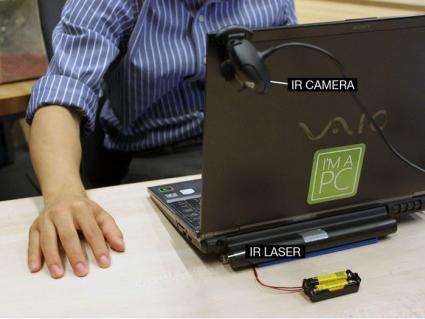
The researchers, Pranav Mistry, Liyan Chang, and Pattie Maes, developed an infrared (IR) laser beam and associated camera that could be incorporated into the computer so that a plane of IR laser would be created just above the surface on which the is resting. The user acts as though a physical mouse were present and the is intersected by the hand, and parts of the hand are shown up as bright spots of light that change position as the hand moves. The built-in camera then interprets the changes in position of the hand and fingers and translates them as moves of the mouse and clicks on the two buttons, and the on the screen moves as if the user was operating a physical mouse.

This video is not supported by your browser at this time.

Mouseless is an invisible computer mouse.

There are no plans for commercializing the "invisible mouse," but the prototype Mouseless was built for around $20 USD. The MIT group of researchers are now working on improvements to the recognition and tracking algorithms with the aim of building up an expanded command library. This may in the future lead to more complex than is possible at present, and could ultimately give the Mouseless a number of advantages over a physical mouse, since the number of functions handled by a physical mouse is limited.
Mouseless, the 'invisible' computer mouse (w/ Video)
Enlarge

Mouseless working prototype system

The MIT Media Lab’s Fluid Interfaces group works on ways of integrating the world of digital information and services more naturally into our normal lives, by designing intuitive and intelligent interfaces.

Pranav Mistry is a PhD student and research assistant at MIT Media Lab. His project “SixthSense” won the Popular Science Invention of the Year award in 2009.

• Learn about becoming PhysOrg.com sponsor

More information: http://www.pranavm … s/mouseless/

© 2010 PhysOrg.com

4.2 /5 (14 votes)  

Filter


Move the slider to adjust rank threshold, so that you can hide some of the comments.


Display comments: newest first

visual
Jul 08, 2010

Rank: 4.5 / 5 (2)
WTF, how can they not plan commercializing this? They can be selling one with every laptop, or even every desktop keyboard that is ever made from next year onwards...
CreepyD
Jul 08, 2010

Rank: 2 / 5 (1)
I can't see this ever being accurate enough.
For most people maybe, but for someone who is fast on a PC, you will NEVER replace a good mouse and keyboard.
Only a direct brain interface has that potential.
I do think people would buy this though if it was commercialized.
ArchV
Jul 08, 2010

Rank: 2 / 5 (1)
How do you click and drag? ... Gotcha.
stanfrax
Jul 08, 2010

Rank: 1 / 5 (1)
its a grat idea but it will put corporations at a loss having loosing a little profit margin - they want to keep the slave wheel turning - just another peice of held back tech like the everlasting battery and light bulb
Justavian
Jul 08, 2010

Rank: 3.5 / 5 (2)
I have a seven button mouse, and use six of those buttons constantly (the regular three buttons, plus copy, cut, and paste). Are they going to reproduce that? Also, there were non-physical laser keyboards at one point, and those obviously didn't catch on. I don't think this would be any different.
akademy
Jul 08, 2010

Rank: 4 / 5 (1)
How do you click and drag? ... Gotcha.

It looks like every "click" is a double tap of the finger. So I'd imagine a drag would be a single tap of the finger, until there's another single tap.
ArchV
Jul 08, 2010

Rank: 1 / 5 (1)
Because changing our normal single click we've been using for years to a double click wouldn't be confusing at all ;) I'm glad this won't be commercialized. Not that I care really, I wouldn't buy it :)
El_Nose
Jul 08, 2010

Rank: 5 / 5 (1)
@ArchV

You know before the web - almost everyone used double clicking - and outside of a browser you have to double click to do everything except changing context.

it would seem the click drag is safe -- this is implemented in the OS. the click on the border gives the border context, written into the program that describes border windows ( in windows everything on the screen except text is technically a window and they all have slightly different rules -- this is hidden from the user but programmers are aware of the difference) -- anyway clicking on a border to drag, once the initial click down is detected you enter a new part of the program that allows you to resize until a release of the mouse button is detected.

This is just a working prototype I wouldn;t expect that to be addressed at this stage but looks highly feasible.

this will probably not cut into anyones bottom line as hardware that has to move tends to be expensive to engineer. This is a sensor with software.
danlgarmstrong
Jul 08, 2010

Rank: not rated yet
Wonder when someone will have a computer that reads sign language? Do they exist now...I'll google it and let you know...
Yep - of course
http://en.wikiped...ognition
AngryMoose
Jul 08, 2010

Rank: 3 / 5 (2)
Pretty sure the ends of your fingers would feel pretty strange after rubbing the desk for a few hours while gaming. Think I'll stick with my trusty mouse until the neuro interface makes it so I don't have to do anything other than breath
JJC
Jul 08, 2010

Rank: 3 / 5 (1)
It looks a bit laggy in the video, though maybe it is just the recording.

Also, the camera & laser would need to be MUCH smaller for this to be marketable.

And unlike a wireless mouse that can go anywhere (including switching to other side for lefties), this can only be used in a fairly small section to the right of the laptop.
denfire
Jul 08, 2010

Rank: 4 / 5 (1)
there is something there though.... if they can package it better and improve the software so that it becomes more accurate... i think they got a winner... ont surpised if apple gets to it in the near future!
Javinator
Jul 08, 2010

Rank: 4 / 5 (1)
" This may in the future lead to more complex gesture recognition than is possible at present, and could ultimately give the Mouseless a number of advantages over a physical mouse, since the number of functions handled by a physical mouse is limited."

I think once the research hits this point it will be much more commercially viable. Cool concept though.
ClickHere
Jul 08, 2010

Rank: 4 / 5 (2)
Mouseless mouse? Last three laptops I've owned have had mouseless mouses, they call it a touchpad, and it's already multi-gesture capable.

For the type of work I do on a computer I'd still rather have a multi-gesture capable 24" LCD, or better still, as others have mentioned, neural input.
newsreader
Jul 08, 2010

Rank: not rated yet
I'd like to see an interface that allows you to position the mouse pointer with your eyes and then you hit a key on the keyboard to select.
SMMAssociates
Jul 08, 2010

Rank: not rated yet
I hate touchpads, and rodents, but like trackballs....

But this might be a useful device for the more mobile folks who still hate touchpads :)....

(A built-in trackball on one notebook, some years ago, worked well enough to install the software for an external trackball.... Otherwise, it was a waste....)

GaryB
Jul 08, 2010

Rank: not rated yet
I can no longer live without the scroll wheel. I suppose you could try to approximate that with middle finger gestures. Responsiveness and accuracy would be the key here. I think the camera better be faster than 30fps. More like 100fps.
Anthony_Casey
Jul 08, 2010

Rank: not rated yet
1. Humans need a certain amount of tactile feed-back. I guess there is some from the desktop surface, but I'm not sure if that is enough to make it feel natural enough.
2. Once they get to the point where is can detect more sophisticated hand gestures, then it might work.
3. Move the camera around in front of the monitor, and turn the laser into a 3-d grid and you could have the old-school VR-type interface without the gloves.

But as-is, I don't see people buying into it.
trekgeek1
Jul 08, 2010

Rank: not rated yet
Seems like the cursor was floating about even when the hand changed direction. Touch screen is the only alternative until we just have a neurological interface.
dirk_bruere
Jul 08, 2010

Rank: not rated yet
OK - so why didn't the video camera shooting the YouTube video pick up the IR light?
trekgeek1
Jul 08, 2010

Rank: not rated yet
OK - so why didn't the video camera shooting the YouTube video pick up the IR light?


Because that camera isn't designed to pick up that part of the spectrum. Some cameras will be able to detect infrared in black and white mode.
Neurons_At_Work
Jul 08, 2010

Rank: not rated yet
I'd like to see an interface that allows you to position the mouse pointer with your eyes and then you hit a key on the keyboard to select.

They already have this, and I use it from time to time with the webcam built into my laptop. You don't even have to touch the keyboard; just pause on an area and it double-clicks for you. It's called 'Camera Mouse 2010'. Freeware, and fairly fun to use. It's at www.cameramouse.org.
Neurons_At_Work
Jul 08, 2010

Rank: not rated yet
Also, if you check out the picture on the website next to 'More Information--', it does show the ability to left click, right click, move, scroll, and drag--all of the basic mouse functions seem to be addressed.

They REALLY ought to release the code and put the design on www.instructables.com or something--I've got $20 just waiting for something like this.
MorituriMax
Jul 09, 2010

Rank: not rated yet
Yawn.

Yawn.

I really have to laugh when they try and take an input device and SHAZAM make it better! All they are doing is substituting a table surface for the mouse.

The table does not move like the mouse so you get that wonderful sensation, there is nothing revolutionary about how you tell it what you want to do, you do exactly the same basic thing you do with.. gasp, existing mice.

Yawn.

Yawn.
jt81ma
Jul 10, 2010

Rank: not rated yet
Now lets take a look at this five years from now, when you aren't moving your hand, just minor finger movements. Think bio-metric scanners of today. Each fingernail is different- the laser and camera can focus on each.... now you have five times the capability of your mouse or other HID! By reducing the movements, you increase the focusing ability and accuracy, not to mention reducing your energy expenditure and chance of RMIs.

Just think about it, if I need to move the mouse across the screen, I simply move my index finger and the system gauges speed and direction and reacts accordingly until it recognizes the finger return to approximated original locale. Your middle finger can still be scroll, an that leaves your thumb and other two fingers for other directional, preset or macro commands..... or better yet, multiple commands at the same time!

I cannot wait to see where they take this and how quickly they increase accuracy!
Jimbaloid
Jul 13, 2010

Rank: not rated yet
My physical mouse is set so sensitive I do not move my hand for some operations, merely flex my fingers. I too am skeptical for the accuracy and lack of anything tactile. Then there is one quality of the 'traditional' mouse that many attempts to 'better' it fail on, I can lift my hand away from the physical mouse and leave the pointer to be still in one place. I can also lift the mouse to 'reset' the relative location on the table - distinguishing it from a tablet device.
Rank 4.2 /5 (14 votes)
Related Stories
Relevant PhysicsForums posts
  • Calling function with no input argument
    created3 hours ago
  • Force free body diagram problem on gym equipment
    created4 hours ago
  • Empirical data regarding shower heads and water
    created12 hours ago
  • feed hold button on CNC lathe
    createdFeb 09, 2012
  • RFAC in Fortran
    createdFeb 09, 2012
  • dynamics 2/32
    createdFeb 08, 2012
  • More from Physics Forums - General Engineering

More news stories

Expat French get Internet vote for first time

French citizens will for the first time this year be able to vote in a parliamentary election over the Internet, an experiment that could be extended to other elections if successful.

Technology / Internet

created 37 minutes ago | popularity not rated yet | comments 0

"Twisted Metal" gamers get shot at real gunplay

Fans of "Twisted Metal" will get to welcome a long-awaited sequel of the car-battle videogame with a real-world bang by blasting an ice cream truck to bits with a machine gun.

Technology / Software

created 26 minutes ago | popularity not rated yet | comments 0

New error-correcting codes guarantee the fastest possible rate of data transmission

Error-correcting codes are one of the triumphs of the digital age. They’re a way of encoding information so that it can be transmitted across a communication channel — such as an optical fiber o ...

Technology / Computer Sciences

created 6 hours ago | popularity 5 / 5 (3) | comments 3 | with audio podcast

India probes Google over 'forex transactions'

Indian authorities are probing whether online giant Google broke domestic foreign-exchange transactions rules while shifting funds abroad, the Press Trust of India reported on Friday.

Technology / Internet

created 1 hour ago | popularity not rated yet | comments 0

Small modular reactor design could be a 'SUPERSTAR'

(PhysOrg.com) -- Though most of today's nuclear reactors are cooled by water, we've long known that there are alternatives; in fact, the world's first nuclear-powered electricity in 1951 came from a reactor ...

Technology / Energy & Green Tech

created 6 hours ago | popularity 4.2 / 5 (10) | comments 14 | with audio podcast


Putting the squeeze on planets outside our solar system

(PhysOrg.com) -- Using high-powered lasers, scientists at Lawrence Livermore National Laboratory and collaborators discovered that molten magnesium silicate undergoes a phase change in the liquid state, abruptly ...

Employers feel no love for unscrupulous practice of 'service sweethearting'

A new study led by two Florida State University marketing professors finds that some frontline service employees who are rewarded for hikes in customer loyalty and satisfaction also may engage in "service ...

US issues guidelines to avoid heparin contamination

Four years after US drug-maker Baxter International's blood thinner heparin was contaminated in China, causing dozens of deaths, US regulators on Friday issued draft guidelines for safe production.

The power of estrogen -- male snakes attract other males

A new study has shown that boosting the estrogen levels of male garter snakes causes them to secrete the same pheromones that females use to attract suitors, and turned the males into just about the sexiest ...

Curry spice component may help slow prostate tumor growth

Curcumin, an active component of the Indian curry spice turmeric, may help slow down tumor growth in castration-resistant prostate cancer patients on androgen deprivation therapy (ADT), a study from researchers ...

Grass to gas: Researchers' genome map speeds biofuel development

Researchers at the University of Georgia have taken a major step in the ongoing effort to find sources of cleaner, renewable energy by mapping the genomes of two originator cells of Miscanthus x giganteus, a large perenn ...