A chemical to make brain cells grow: Mental decline thwarted in aging rats
July 8, 2010
Mental decline thwarted in aging rats

Enlarge

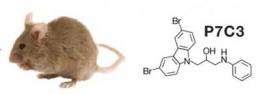
The neuroprotective compound P7C3 was discovered by testing more than 1000 small molecules in living mice. Credit: Andrew Pieper, M.D., Ph.D., UT Southwestern Medical Center

Scientists have discovered a compound that restores the capacity to form new memories in aging rats, likely by improving the survival of newborn neurons in the brain's memory hub. The research, funded in part by the National Institutes of Health, has turned up clues to a neuroprotective mechanism that could lead to a treatment for Alzheimer's disease.

"This neuroprotective compound, called P7C3, holds special promise because of its medication-friendly properties," explained Steven McKnight, Ph.D., who co-led the research with Andrew Pieper, M.D., Ph.D., both of University of Texas Southwestern Medical Center, Dallas. "It can be taken orally, crosses the blood-brain barrier with long-lasting effects, and is safely tolerated by mice during many stages of development."

The researchers report on their findings July 9, 2010 in the journal Cell. Their work was funded, in part, by the NIH's National Institute of Mental Health (NIMH), a NIH Director's Pioneer Award funded through the Common Fund and managed by the National Institute of General Medical Sciences, and National Cancer Institute.

"This striking demonstration of a treatment that stems age-related cognitive decline in living animals points the way to potential development of the first cures that will address the core illness process in ," said NIMH Director Thomas Insel, M.D.

Physical activity, social, or other enriching experiences promote neurogenesis - the birth and maturation of new . This growth takes place in the dentate gyrus, a key area of the brain's memory hub, the hippocampus. But even in the normal adult brain, most of these newborn neurons die during the month it takes to develop and get wired into . To survive, the cells must run a gauntlet of challenges. Newborn hippocampus neurons fare much worse in aging-related disorders like Alzheimer's, marked by runaway cell death.

In hopes of finding compounds that might protect such vulnerable neurons during this process, Pieper, McKnight and colleagues tested more than 1000 small molecules in living mice. One of the compounds, designated P7C3, corrected deficits in the brains of adult mice engineered to lack a gene required for the survival of newborn neurons in the hippocampus. Giving P7C3 to the mice reduced programmed death of newborn cells - normalizing stunted growth of branch-like neuronal extensions and thickening an abnormally thin layer of cells by 40 percent. Among clues to the mechanism by which P7C3 works, the researchers discovered that it protects the integrity of machinery for maintaining a cell's energy level.
Mental decline thwarted in aging rats
Enlarge

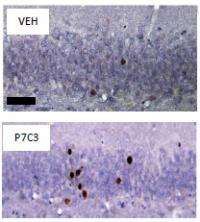
Aged rats treated with P7C3 performed significantly better on a memory test than control rats treated with an inactive substance (veh). This was traced to a three-fold higher number of newborn neurons in the dentate gyrus area of the hippocampus. Credit: Andrew Pieper, M.D., Ph.D., UT Southwestern Medical Center

To find out if P7C3 could similarly stem aging-associated neuronal death and , the researchers gave the compound to aged rats. Rodents treated with P7C3 for two months significantly outperformed their placebo-treated peers on a water maze task, a standard assay of hippocampus-dependent learning. This was traced to a threefold higher-than-normal level of newborn neurons in the dentate gyrus of the treated animals. Rats were used instead of mice for this phase of the study because the genetically engineered mice could not swim.

The researchers pinpointed a derivative of P7C3, called A20, which is even more protective than the parent compound. They also produced evidence suggesting that two other neuroprotective compounds eyed as possible Alzheimer's cures may work through the same mechanism as P7C3. The A20 derivative proved 300 times more potent than one of these compounds currently in clinical trials for Alzheimer's disease. This suggested that even more potent neuroprotective agents could potentially be discovered using the same methods. Following up on these leads, the researchers are now searching for the molecular target of P7C3 - key to discovering the underlying neuroprotective mechanism.

More information: References:

-- Discovery of a Pro-neurogenic, Neuroprotective Chemical. Pieper AA, Xie S, Capota E, Estill SJ, Zhong J, Long JM, Becker GL, Huntington P, Goldman SE, Shen CH, Capota M, Britt JK, Kotti T, Ure K, Brat DJ, Williams NS, MacMillan KS, Naidoo J, Melito L, Hsieh J, Brabander JD, Ready JM, McKnight SL. 2010, Jul 8. Cell, DOI:10.1016/j.cell.2010.06.018

-- A selective allosteric potentiator of the M1 muscarinic acetylcholine receptor increases activity of medial prefrontal cortical neurons and restores impairments in reversal learning. Shirey JK, Brady AE, Jones PJ, Davis AA, Bridges TM, Kennedy JP, Jadhav SB, Menon UN, Xiang Z, Watson ML, Christian EP, Doherty JJ, Quirk MC, Snyder DH, Lah JJ, Levey AI, Nicolle MM, Lindsley CW, Conn PJ. J Neurosci. 2009 Nov 11;29(45):14271-86.PMID: 19906975

-- Discovery and Characterization of Novel Subtype-Selective Allosteric Agonists for the Investigation of M1 Receptor Function in the Central Nervous System. Lebois EB, Bridges TM, Lewis LM, Dawson ES, Kane AS, Xiang S, Jadhav SB, Yin H, Kennedy JP, Meiler J, Niswender CM, Jones CK, Conn PJ, Weaver DC and Lindsley CW. ACS Chem. Neurosci., 2010, 1 (2), pp 104-121, September 25, 2009. DOI: 10.1021/cn900003h

Provided by National Institutes of Health

Filter


Move the slider to adjust rank threshold, so that you can hide some of the comments.


Display comments: newest first

pauljpease
Jul 08, 2010

Rank: 3 / 5 (1)
When you compare the effects of this chemical with that of cannabanoids such as THC (more new neurons!), and see the similar structures of the molecules, you start to wonder what the real effects of marijuana on memory are. Maybe pot decreases memory in some ways because producing so many new neurons disrupts memories, but it maintains creativity by allowing formation of new circuits with those new neurons. Whatever the case, we should definitely be doing 10-100 times more research on the effects of THC since a huge fraction of the population regularly uses this substance.
dirk_bruere
Jul 08, 2010

Rank: not rated yet
Can't wait to get some some!
H+ rules...
sender
Jul 09, 2010

Rank: not rated yet
Gacyclidine also looks promising in this area.
xamien
Jul 09, 2010

Rank: not rated yet
paul - I understand what you're getting at, but I think you are misunderstanding the current research on the effect of cannabinoids on receptors in the human brain. There are alot of unanswered questions on the use of marijuana that have yet to be answered in a sufficiently controlled manner like this study in the article.

I like what they're reporting about this, especially given the safe large doses it suggests the mice are taking to achieve this. Question posed is what a problem it will be to get passed through FDA and how much it will be charged for...
GreyLensman
Jul 09, 2010

Rank: not rated yet
The flip side of enhancing cell srvival is the promotion of tumors - I wonder if the samples was large enough to detect any such effect?
plasticpower
Jul 11, 2010

Rank: not rated yet
I think this particular method is safe against tumors because it doesn't prolong cell survival, it simply shields the younger cells from the harsh environment they are born into. Once the cells mature, they become regular neurons that will still experience programmed cell death at the correct time. Though the article doesn't specify whether the compound also protects already mature neurons, but from what I can see it doesn't affect PCD mechanisms, so it shouldn't cause cells to go cancerous.
Rank 5 /5 (26 votes)
Relevant PhysicsForums posts
  • Is Everyday Technology Killing Us?
    createdFeb 08, 2012
  • Exercise and weight loss
    createdFeb 08, 2012
  • Why do we have head aches? Our brains can't feel anything.
    createdFeb 07, 2012
  • "The end of diseases" by David Agus, interview from Daily Show with Jon Stewart
    createdFeb 04, 2012
  • Oncolytic adenovirus
    createdFeb 04, 2012
  • Nutrition label stuffs and diets
    createdFeb 02, 2012
  • More from Physics Forums - Medical Sciences

More news stories

Curry spice component may help slow prostate tumor growth

Curcumin, an active component of the Indian curry spice turmeric, may help slow down tumor growth in castration-resistant prostate cancer patients on androgen deprivation therapy (ADT), a study from researchers ...

Medicine & Health / Cancer

created 44 minutes ago | popularity not rated yet | comments 0 | with audio podcast

Antidepressants and pregnancy: Women must consider the impact of drugs on baby, and of depression on baby, themselves

Upon learning they are pregnant, most women dutifully nix the alcohol, sushi and caffeine. But what about antidepressants?

Medicine & Health / Medications

created 4 minutes ago | popularity not rated yet | comments 0

Arthritic knees, but not hips, have robust repair response

Researchers at Duke University Medical Center used new tools they developed to analyze knees and hips and discovered that osteoarthritic knee joints are in a constant state of repair, while hip joints are not.

Medicine & Health / Diseases

created 54 minutes ago | popularity not rated yet | comments 0 | with audio podcast

To avoid early labor and delivery, weight and diet changes not the answer

One of the strongest known risk factors for spontaneous or unexpected preterm birth – any birth that occurs before the 37th week of pregnancy, most often without a known cause – is already having had one. For women ...

Medicine & Health / Health

created 1 hour ago | popularity not rated yet | comments 0 | with audio podcast

Team isolates nerve cells involved in storing long term memory and gene proteins associated with them

(Medical Xpress) -- A research team in Taiwan has succeeded in isolating two nerve cells in fruit fly brains that are believed to be the major players in allowing for the formation of long term memories. Furthermore, ...

Medicine & Health / Neuroscience

created 1 hour ago | popularity 5 / 5 (3) | comments 1 | with audio podcast report


Netflix light on flicks as viewers soak up TV shows

Like most fresh faces that arrive in Hollywood, Netflix wanted to be a movie star. But now it's learning what many in Tinseltown have known for decades: Movies are sexy, but the real money is in television.

Sony's Hirai refuses to abandon dire TV business

Struggling Japanese entertainment giant Sony will not abandon its cash-bleeding television business, its incoming CEO says, but he acknowledges tough decisions lie ahead including over redundancies.

The power of estrogen -- male snakes attract other males

A new study has shown that boosting the estrogen levels of male garter snakes causes them to secrete the same pheromones that females use to attract suitors, and turned the males into just about the sexiest ...

Fool's gold may prove an unlikely alternative to overexploited catalytic materials

Catalytic materials, which lower the energy barriers for chemical reactions, are used in everything from the commercial production of chemicals to catalytic converters in car engines. However, with current catalytic materials ...

Experts reveal how plants don't get sunburn

(PhysOrg.com) -- Experts at the University of Glasgow have discovered how plants survive the harmful rays of the sun.

Humans may have helped the decline of African rainforests 3000 years ago

(PhysOrg.com) -- Large areas of rainforests in Central Africa mysteriously disappeared over three thousand years ago, to be replaced by savannas. The prevailing theory has been that the cause was a change ...