Novel ion trap with optical fiber could link atoms and light in quantum networks
July 8, 2010
Novel ion trap with optical fiber could link atoms and light in quantum networks

Enlarge

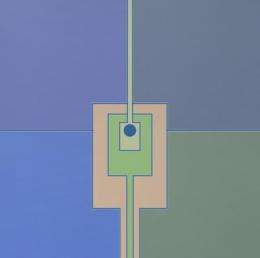
This is a diagram of a NIST ion trap that incorporates an optical fiber to collect light emitted by the ions (electrically charged atoms). Individual electrodes used to trap an ion 30 to 50 micrometers above the surface are shown in different colors surrounding a 50-micrometer-wide hole where light is collected and deposited in a fiber attached below. Credit: A. VanDevender/NIST

Physicists at the National Institute of Standards and Technology have demonstrated an ion trap with a built-in optical fiber that collects light emitted by single ions (electrically charged atoms), allowing quantum information stored in the ions to be measured. The advance could simplify quantum computer design and serve as a step toward swapping information between matter and light in future quantum networks.

Described in a forthcoming issue of ,* the new device is a 1-millimeter-square ion trap with a built-in optical fiber. The authors use ions as quantum bits (qubits) to store information in experimental , which may someday solve certain problems that are intractable today. An ion can be adjustably positioned 80 to 100 micrometers from an , which detects the ion's fluorescence signals indicating the qubit's information content.

"The design is helpful because of the tight coupling between the ion and the fiber, and also because it's small, so you can get a lot of fibers on a chip," says first author Aaron VanDevender, a NIST postdoctoral researcher.

NIST scientists demonstrated the new device using magnesium ions. Light emitted by an ion passes through a hole in an electrode and is collected in the fiber below the electrode surface (see image). By contrast, conventional ion traps use large external lenses typically located 5 centimeters away from the ions—about 500 times farther than the fiber—to collect the fluorescence light. Optical fibers may handle large numbers of ions more easily than the bulky optical systems, because multiple fibers may eventually be attached to a single .

The fiber method currently captures less light than the but is adequate for detecting because ions are extremely bright, producing millions of photons (individual particles of light) per second, VanDevender says. The authors expect to boost efficiency by shaping the fiber tip and using anti-reflection coating on surfaces. The new trap design is intended as a prototype for eventually pairing single ions with single photons, to make an interface enabling matter qubits to swap information with photon qubits in a quantum computing and communications network.

Photons are used as qubits in quantum communications, the most secure method known for ensuring the privacy of a communications channel. In a quantum network, the information encoded in the "spins" of individual could be transferred to, for example, electric field orientations of individual photons for transport to other processing regions of the network.

More information: *A.P. VanDevender, Y. Colombe, J. Amini, D. Leibfried and D.J. Wineland. Efficient fiber optic detection of trapped ion fluorescence. Physical Review Letters. Forthcoming.

Provided by National Institute of Standards and Technology (news : web)

4.6 /5 (8 votes)  

Rank 4.6 /5 (8 votes)
Related Stories
Relevant PhysicsForums posts
  • Non-Integrable Quadratic Hamiltonian
    created2 hours ago
  • Mysteries in Classical Physics
    created4 hours ago
  • (Conceptual) questions about capacitors, circuits
    created4 hours ago
  • a steel rod and an iron rod is placed inside an ac current soleoid
    created5 hours ago
  • Nature of principal strains
    created5 hours ago
  • Magnet in a AC current solenoid
    created6 hours ago
  • More from Physics Forums - Classical Physics

More news stories

Putting the squeeze on planets outside our solar system

(PhysOrg.com) -- Using high-powered lasers, scientists at Lawrence Livermore National Laboratory and collaborators discovered that molten magnesium silicate undergoes a phase change in the liquid state, abruptly ...

Physics / Condensed Matter

created 15 hours ago | popularity 4.3 / 5 (7) | comments 0 | with audio podcast

Hovering not hard if you're top-heavy, researchers find

Top-heavy structures are more likely to maintain their balance while hovering in the air than are those that bear a lower center of gravity, researchers at New York University's Courant Institute of Mathematical Sciences ...

Physics / General Physics

created 16 hours ago | popularity 5 / 5 (2) | comments 1 | with audio podcast

SLAC, Stanford team focuses on high-energy electrons to treat cancer

Accelerator physicists at SLAC and cancer specialists from Stanford are working on a new technology that could dramatically reduce the time needed for cancer radiation treatments. The team ran an initial experiment ...

Physics / General Physics

created 19 hours ago | popularity 5 / 5 (2) | comments 0

Measurements from high-energy collisions lead to better understanding of why meson particles disappear

For several years, physicists at the Relativistic Heavy Ion Collider (RHIC) at Brookhaven National Laboratory (BNL), USA, have studied an unusual state of matter called the quark–gluon plasma, which they ...

Physics / General Physics

created 20 hours ago | popularity 4.5 / 5 (4) | comments 0

Explained: Sigma

It's a question that arises with virtually every major new finding in science or medicine: What makes a result reliable enough to be taken seriously? The answer has to do with statistical significance -- but ...

Physics / General Physics

created Feb 09, 2012 | popularity 5 / 5 (16) | comments 53


Anonymous knocks CIA website offline (Update)

The website of the Central Intelligence Agency was inaccessible on Friday after the hacker group Anonymous claimed to have knocked it offline.

New error-correcting codes guarantee the fastest possible rate of data transmission

Error-correcting codes are one of the triumphs of the digital age. They’re a way of encoding information so that it can be transmitted across a communication channel — such as an optical fiber o ...

Humans may have helped the decline of African rainforests 3000 years ago

(PhysOrg.com) -- Large areas of rainforests in Central Africa mysteriously disappeared over three thousand years ago, to be replaced by savannas. The prevailing theory has been that the cause was a change ...

Small modular reactor design could be a 'SUPERSTAR'

(PhysOrg.com) -- Though most of today's nuclear reactors are cooled by water, we've long known that there are alternatives; in fact, the world's first nuclear-powered electricity in 1951 came from a reactor ...

New power source discovered

(PhysOrg.com) -- Researchers at the Massachusetts Institute of Technology (MIT) and RMIT University have made a breakthrough in energy storage and power generation.

The power of estrogen -- male snakes attract other males

A new study has shown that boosting the estrogen levels of male garter snakes causes them to secrete the same pheromones that females use to attract suitors, and turned the males into just about the sexiest ...