Woven electronics

July 8, 2010
Woven electronics

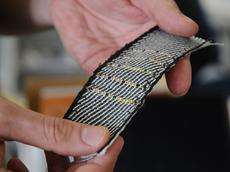
The fabric strip contains conductors and electronic parts such as temperature sensors woven into it. (Photo: Peter Rüegg / ETH Zurich)

Electrical engineers from ETH Zurich have devised intelligent textiles that already have electronic components such as sensors and conductive filaments woven into them. The advantage: the fabric can be mass-produced on conventional ribbon looms - and washed.

Researchers have been experimenting with “intelligent” textiles for quite some time by integrating standard . However, for the most part the electronic parts have only been attached to or sewn into plain old clothes like coats or T-shirts - an endeavor ultimately doomed to fail because of one practical drawback: they’re difficult to wash. Moreover, it takes a lot of handiwork to produce them, which bumps up the price of the clothes.

Scientists from Professor Gerhard Tröster’s Wearable Computing Lab, however, have now gone one step further: they’ve developed a new technology to attach thin-film electronics and miniaturized, commercially available chips to . The researchers eventually succeeded in integrating a large number of microchips and other microelectronic elements directly into the architecture of the material. In order to weave the E-fibers into conventional threads, the ETH-Zurich scientists used customary textile machines.

Despite the woven-in electronic components, the fabric is elegant and foldable. Moreover, it feels like normal material, which means clothes made out of it could be worn in daily life. And the beauty of the microchips, which sit on plastic strips, is that they are encapsulated, which means the fabric can be washed several times in a washing machine using a mild detergent, without damaging the e-fibers.

The Tröster group’s electronic fabric is still ribbon-like. Nevertheless, the researchers aim to produce their intelligent textiles in any size so they can also be cut as required to satisfy the requirements of the clothing industry, for instance. After all, by exploiting the grid structure of woven textiles, the scientists can easily broaden the architecture of the intelligent textiles to support large-scale sensor devices or bus structures.
Woven electronics

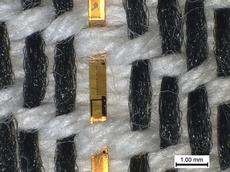
Smart textiles under the microscope: the woven plastic fibers with integrated temperature sensors are clearly recognizable (Photo: K. Cherenack / ETH Zurich)

To start with, the researchers have produced two demonstration objects: a table cloth with temperature and humidity sensors and woven-in LEDs; and an undershirt that measures body temperature. They sewed a functional panel of fabric onto both items and connected it up to measuring instruments to demonstrate that their concept works. “One of the major issues is still the electricity supply, however”, says project leader Kunigunde Cherenack, a senior assistant at the Wearable Computing Lab. After all, to perform all of the measurements the fabric needs power.

The ETH-Zurich researchers realize that smart textiles are nothing new; however, the way they have embedded electronic components in the fabric is a completely novel approach, especially as the functional panels of material are to be mass-produced to make the method attractive industrially.

Kunigunde Cherenack also sees numerous applications for hybrid fabrics in monitoring the heart rate, helping athletes train or recover from injuries, or supervising aid workers or fire fighters; even keyboards or monitors in everyday clothing might by areas where functional hybrid textiles could be deployed.

The development of the novel electronic sensor fibers is part of the “TexInTex” project under the Swiss “nano-tera.ch” initiative.

More information: Cherenack KH, Kinkeldei T, Zysset C, & Tröster G: Woven thin-film metal interconnects. Accepted for publication by the IEEE Electron Device Letters.

Provided by ETH Zurich

4.3 /5 (3 votes)  

Rank 4.3 /5 (3 votes)
Relevant PhysicsForums posts
  • Calling function with no input argument
    created13 hours ago
  • Force free body diagram problem on gym equipment
    created14 hours ago
  • Empirical data regarding shower heads and water
    created22 hours ago
  • feed hold button on CNC lathe
    createdFeb 09, 2012
  • RFAC in Fortran
    createdFeb 09, 2012
  • dynamics 2/32
    createdFeb 08, 2012
  • More from Physics Forums - General Engineering

More news stories

Google users warned of threat to smartphone wallets

Users of Google smartphone wallets were being warned on Friday that there is a way to crack pass codes intended to thwart thieves from going on illicit shopping sprees.

Technology / Internet

created 6 hours ago | popularity 5 / 5 (2) | comments 0

Anonymous knocks CIA website offline (Update)

The website of the Central Intelligence Agency was inaccessible on Friday after the hacker group Anonymous claimed to have knocked it offline.

Technology / Internet

created 8 hours ago | popularity 5 / 5 (8) | comments 13

New error-correcting codes guarantee the fastest possible rate of data transmission

Error-correcting codes are one of the triumphs of the digital age. They’re a way of encoding information so that it can be transmitted across a communication channel — such as an optical fiber o ...

Technology / Computer Sciences

created 16 hours ago | popularity 4.9 / 5 (8) | comments 6 | with audio podcast

New power source discovered

(PhysOrg.com) -- Researchers at the Massachusetts Institute of Technology (MIT) and RMIT University have made a breakthrough in energy storage and power generation.

Technology / Energy & Green Tech

created 15 hours ago | popularity 4.8 / 5 (25) | comments 8 | with audio podcast

Small modular reactor design could be a 'SUPERSTAR'

(PhysOrg.com) -- Though most of today's nuclear reactors are cooled by water, we've long known that there are alternatives; in fact, the world's first nuclear-powered electricity in 1951 came from a reactor ...

Technology / Energy & Green Tech

created 16 hours ago | popularity 4.3 / 5 (12) | comments 22 | with audio podcast


Humans may have helped the decline of African rainforests 3000 years ago

(PhysOrg.com) -- Large areas of rainforests in Central Africa mysteriously disappeared over three thousand years ago, to be replaced by savannas. The prevailing theory has been that the cause was a change ...

Complex wiring of the nervous system may rely on a just a handful of genes and proteins

Researchers at the Salk Institute have discovered a startling feature of early brain development that helps to explain how complex neuron wiring patterns are programmed using just a handful of critical genes. ...

The power of estrogen -- male snakes attract other males

A new study has shown that boosting the estrogen levels of male garter snakes causes them to secrete the same pheromones that females use to attract suitors, and turned the males into just about the sexiest ...

Putting the squeeze on planets outside our solar system

(PhysOrg.com) -- Using high-powered lasers, scientists at Lawrence Livermore National Laboratory and collaborators discovered that molten magnesium silicate undergoes a phase change in the liquid state, abruptly ...

Could Venus be shifting gear?

(PhysOrg.com) -- ESA’s Venus Express spacecraft has discovered that our cloud-covered neighbour spins a little slower than previously measured. Peering through the dense atmosphere in the infrared, the ...

Fool's gold may prove an unlikely alternative to overexploited catalytic materials

Catalytic materials, which lower the energy barriers for chemical reactions, are used in everything from the commercial production of chemicals to catalytic converters in car engines. However, with current catalytic materials ...