The eyes have it for perfect predator
July 9, 2010
The eyes have it for perfect predator

Enlarge

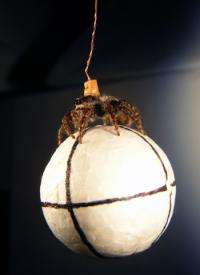
(PhysOrg.com) -- The most striking feature of jumping spiders is their arsenal of big eyes. In contrast to web-building spiders, they rely on their excellent vision to actively hunt and catch their insect prey. New research gives an insight into just how incredibly sophisticated the jumping spider's vision actually is, and explains why they are such an effective predator.

As published in the , and highlighted in the current issue journal Nature, Daniel Zurek and his colleagues from Macquarie University, Australia, decided to test the functioning ability of just one of the three sets of eyes of the species Servaea vestita. Using removable dental silicone they covered the larger central pair of eyes and the pair positioned more to the rear of the spiders' heads, leaving just the smaller forward-facing pair of eyes (the anterior lateral eyes) uncovered.

They then showed the spiders moving dots on a screen as well as tethered live house flies, favoured prey of the spiders, and recorded their responses to each, replicating this experiment with 52 individual spiders.

"Even when the spiders were confined to from this secondary pair of eyes, they could respond to targets that are very hard for other animals to see. They were able to detect, stalk and attack flies, which was unexpected," Zurek says.

"We believe this pair of eyes could have been underestimated by scientists in the past, and may be the most versatile element of their visual system, providing both spatial acuity and motion detection.

"It's astonishing that these animals, which have a body length of just 12 millimetres and a brain a fraction of the size of a honeybee's, have developed such a sophisticated visual system covering almost 360 degrees with such high resolution," he added.

"They divvy up different visual tasks, such as motion detection or high acuity detail analysis across the various sets of eyes, and it is likely that this modular approach helps the to handle the computational demands of vision."

Provided by Macquarie University


Rank 5 /5 (6 votes)
Related Stories
Relevant PhysicsForums posts
  • Flowering Plant Revived After 30,000 Years in Permafrost
    createdFeb 21, 2012
  • Toba volcano eruptions - 1.000 - 10,000 breeding pairsunb
    createdFeb 20, 2012
  • How is a specific gene removed from DNA
    createdFeb 20, 2012
  • Reproduction and Human evolution
    createdFeb 19, 2012
  • Viruses: Living or Non-living organisms
    createdFeb 19, 2012
  • Would you eat brainless animals?
    createdFeb 16, 2012
  • More from Physics Forums - Biology

More news stories

Surprising diversity at a synapse hints at complex diversity of neural circuitry

A new study reveals a dazzling degree of biological diversity in an unexpected place – a single neural connection in the body wall of flies.

Biology / Other

created 7 hours ago | popularity 5 / 5 (4) | comments 0 | with audio podcast

Men might not 'become extinct' after all: Theory of the 'rotting' Y chromosome dealt a fatal blow

If you were to discover that a fundamental component of human biology has survived virtually intact for the past 25 million years, you'd be quite confident in saying that it is here to stay.

Biology / Biotechnology

created 10 hours ago | popularity 5 / 5 (6) | comments 1 | with audio podcast

Climate change affects bird migration timing in North America

Bird migration timing across North America has been affected by climate change, according to a study published Feb. 22 in the open access journal PLoS ONE.

Biology / Ecology

created 6 hours ago | popularity 4.5 / 5 (2) | comments 2

New family of legless amphibians found in India

Since before the age of dinosaurs it has burrowed unbothered beneath the monsoon-soaked soils of remote northeast India - unknown to science and mistaken by villagers as a deadly, miniature snake.

Biology / Plants & Animals

created 18 hours ago | popularity 5 / 5 (8) | comments 3

New iridescent lizard species found in Cambodia

A new species of lizard with striking iridescent rainbow skin, a long tail and very short legs has been discovered in the rainforest in northeast Cambodia, conservationists announced Wednesday.

Biology / Plants & Animals

created 7 hours ago | popularity not rated yet | comments 0


Researchers build first physical 'metatronic' circuit

(PhysOrg.com) -- The technological world of the 21st century owes a tremendous amount to advances in electrical engineering, specifically, the ability to finely control the flow of electrical charges using ...

Faster than light neutrinos? More like faulty wiring

You can shelf your designs for a warp drive engine (for now) and put the DeLorean back in the garage; it turns out neutrinos may not have broken any cosmic speed limits after all.

Spitzer finds solid buckyballs in space

(PhysOrg.com) -- Astronomers using data from NASA's Spitzer Space Telescope have, for the first time, discovered buckyballs in a solid form in space. Prior to this discovery, the microscopic carbon spheres ...

Physicists surprised by disappearing and reappearing superconductivity in iron selenium chalcogenides

Superconductivity is a rare physical state in which matter is able to conduct electricity -- maintain a flow of electrons -- without any resistance. This phenomenon can only be found in certain materials at low temperatures, ...

Scientists create potent molecules aimed at treating muscular dystrophy

While RNA is an appealing drug target, small molecules that can actually affect its function have rarely been found. But now scientists from the Florida campus of The Scripps Research Institute have for the first time designed ...

Stanford research team cracks animated NuCaptcha

(PhysOrg.com) -- The research team from Stanford University, led by Elie Bursztein, that previously had cracked regular CAPTCHAs and then audio CAPTCHAs, now has also successfully cracked the animated version called NuCapt ...