A new spin on drug delivery: Enhanced delivery of DNA payloads into cells
July 9, 2010
A new spin on drug delivery

Enlarge

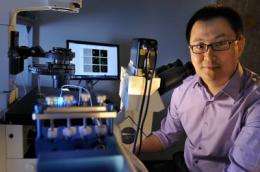
Chang Lu, an associate professor of chemical engineering at Virginia Tech, and his research group are featured in the July 8, 2010, issue of Nature and their work will also be in an upcoming issue of Lab on a Chip. They have shown how to "greatly enhance" the delivery of DNA payloads into cells. Credit: Virginia Tech

Chang Lu and his chemical engineering research group at Virginia Tech have discovered how to "greatly enhance" the delivery of DNA payloads into cells. The description of their work will be featured on the cover of Lab on a Chip (issue 16), the premier journal for researchers in microfluidics.

The work also appears in the July 8 issue of Nature magazine (Vol. 466, p. 163).

Lu's ultimate goal is to apply this technique to create genetically modified for cancer immunotherapy, stem cell therapy and .

One of the most widely used physical methods to deliver genes into cells "is incredibly inefficient because only a small fraction of a cell's total membrane surface can be permeated," said Lu, an associate professor of chemical engineering at Virginia Tech.

The method Lu is referring to is called electroporation, a phenomenon known for decades that increases the permeability of a cell by applying an to generate tiny pores in the of cells.

Lu called the process "a new spin on DNA delivery." He explained the process saying, "Conventional electroporation methods deliver DNA only within a very small portion of the cell surface, determined by the physics governing the interaction between an electric field and a cell. Our method enables uniform DNA delivery over the entire cell surface, which is the first time we are aware that this has been demonstrated. The result is a greatly enhanced transfer of the ."

Lu said his new approach harnesses "hydrodynamic effects that uniquely occur when fluids flow along curved paths. Flow under these conditions is known to generate vortices. Cells carried by such flow experience rotation and spinning that help expose the majority area of its surface to the electric field. " Having the gene delivery done by flows in curved paths is key in the gene delivery as opposed to the traditionally used, electroporation in static solution or in straight channels. "A spiral-shaped channel design yields a two-fold increase than a straight channel and an even larger factor compared to in static solution," he added.

By using fluorescence microscopy, they were able to "map" the area on the cell surface that was subjected to electroporation, and determine the extent of the DNA entry into the cell.

Lu explained the conventional delivery using a cuvette-type of device with static cell suspension produces DNA delivery confined to a narrow zone on the cell surface. However, when electroporation is applied to flowing cells in a spiral or curved channel , the images "appear dramatically different with the DNA delivery uniformly distributed over the entire cell surface."

Provided by Virginia Tech (news : web)


Rank 5 /5 (5 votes)
Relevant PhysicsForums posts
  • Mitosis
    created6 hours ago
  • Stem cell question.
    created7 hours ago
  • Protease cleavage
    created13 hours ago
  • Pertubance in a model
    created20 hours ago
  • Cancer drugs and Alzheimer's, Oh my!
    createdFeb 09, 2012
  • Squishing cells
    createdFeb 09, 2012
  • More from Physics Forums - Biology

More news stories

What lies beneath: Mapping hidden nanostructures

The ability to diagnose and predict the properties of materials is vital, particularly in the expanding field of nanotechnology. Electron and atom-probe microscopy can categorize atoms in thin sheets of material, ...

Nanotechnology / Nanophysics

created 18 hours ago | popularity 5 / 5 (3) | comments 1

New kind of solar cell could capture significantly more energy than current cells

New solar cells could increase the maximum efficiency of solar panels by over 25%, according to scientists from the University of Cambridge.

Nanotechnology / Nanophysics

created Feb 08, 2012 | popularity 4.5 / 5 (12) | comments 14 | with audio podcast

Nanoshell whispering galleries improve thin solar panels

Visitors to Statuary Hall in the U.S. Capitol Building may have experienced a curious acoustic feature that allows a person to whisper softly at one side of the cavernous, half-domed room and for another on ...

Nanotechnology / Nanomaterials

created Feb 07, 2012 | popularity 4.3 / 5 (6) | comments 6 | with audio podcast

'Dark plasmons' transmit energy

Microscopic channels of gold nanoparticles have the ability to transmit electromagnetic energy that starts as light and propagates via "dark plasmons," according to researchers at Rice University.

Nanotechnology / Nanophysics

created Feb 09, 2012 | popularity 4.8 / 5 (9) | comments 1 | with audio podcast

Revealing how a battery material works

Since its discovery 15 years ago, lithium iron phosphate (LiFePO4) has become one of the most promising materials for rechargeable batteries because of its stability, durability, safety and ability to deliver ...

Nanotechnology / Nanomaterials

created Feb 08, 2012 | popularity 5 / 5 (5) | comments 0 | with audio podcast


Anonymous knocks CIA website offline (Update)

The website of the Central Intelligence Agency was inaccessible on Friday after the hacker group Anonymous claimed to have knocked it offline.

New error-correcting codes guarantee the fastest possible rate of data transmission

Error-correcting codes are one of the triumphs of the digital age. They’re a way of encoding information so that it can be transmitted across a communication channel — such as an optical fiber o ...

Humans may have helped the decline of African rainforests 3000 years ago

(PhysOrg.com) -- Large areas of rainforests in Central Africa mysteriously disappeared over three thousand years ago, to be replaced by savannas. The prevailing theory has been that the cause was a change ...

New power source discovered

(PhysOrg.com) -- Researchers at the Massachusetts Institute of Technology (MIT) and RMIT University have made a breakthrough in energy storage and power generation.

Small modular reactor design could be a 'SUPERSTAR'

(PhysOrg.com) -- Though most of today's nuclear reactors are cooled by water, we've long known that there are alternatives; in fact, the world's first nuclear-powered electricity in 1951 came from a reactor ...

Google users warned of threat to smartphone wallets

Users of Google smartphone wallets were being warned on Friday that there is a way to crack pass codes intended to thwart thieves from going on illicit shopping sprees.