Artificial blood developed for the battlefield
July 13, 2010 by Lin Edwards report
blood

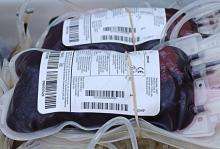
Bags of blood collected during donation. Image: Wikipedia.

(PhysOrg.com) -- US scientists working for the experimental arm of the Pentagon have developed artificial blood for use in transfusions for wounded soldiers in battlefields. The blood cells are said to be functionally indistinguishable from normal blood cells and could end forever the problem of blood donor shortages in war zones and difficulties in transporting blood to remote and inaccessible areas.

The blood is made from from discarded human umbilical cords, which are turned into large quantities of by a method called "blood pharming" that mimics the functions of bone marrow. Pharming is a method of using genetically engineered plants or animals to create medically useful substances in large quantities. Using this process the cells from one umbilical cord can produce about 20 units of blood, which is enough for over three transfusions for injured soldiers in the field.

The blood is being manufactured for the Defense Advanced Research Projects Agency (DARPA) by Ohio company Arteriocyte, which has already submitted samples of O-negative blood to the US (FDA) for evaluation and safety testing. The company received funding of $1.95 million in 2008 to find a way of making large quantities of .

Don Brown of Arteriocyte said the method works but the production needs to be scaled up to produce enough blood. Scaling up would also bring the costs per unit (around a pint) down from the current $5,000 to $1,000 or less. The scaling up could involve improving the technology to produce more units from each umbilical cord, or finding a way to make the culture chambers that mimic bone marrow more efficient and therefore cheaper.

Mr Brown said that in war zones it can take three weeks for donated blood (which mostly comes from donations made in the US) to reach patients. It must be used within a week or two to avoid the risk of or infection that can occur if the blood is stale. There are mobile blood banks in the field, but if there are many injured soldiers, there is often not enough fresh blood available.

Human trials of the "pharmed" blood are expected to start in 2013, but the blood could be available for military use within five years. It could also eventually be used in hospitals to make up for shortages of blood. The is O-negative, which can be used on all patients, regardless of their blood type.

More information: http://www.arpa.mi … rm/index.htm

© 2010 PhysOrg.com

4.7 /5 (41 votes)  

Filter


Move the slider to adjust rank threshold, so that you can hide some of the comments.


Display comments: newest first

danlgarmstrong
Jul 13, 2010

Rank: 4.4 / 5 (7)
Sounds like real blood to me - why is the title about 'artificial blood'? Hopefully they can figure out how to get past that 20 unit limit from the starter cells they get from the umbilical cord, that would make the price drop alot further.
Objectivist
Jul 13, 2010

Rank: 4 / 5 (4)
Why do I recall hearing about this years ago? I specifically remember that it was mentioned to be fortunate for e.g. members of the Jehovas witness cult as they refuse to accept blood from another human.
Skultch
Jul 13, 2010

Rank: 4.2 / 5 (5)
I recall hearing about this years ago, also. I probably read it in Sci-Am.

This is GREAT news. As an Iraq war vet, this really hits an emotional chord. I'm also a native Ohioan, so that makes me proud. This will save many, many lives.
mysticshakra
Jul 13, 2010

Rank: 3.9 / 5 (15)
You know what saves even more lives? Not invading other countries under false pretense. Not fighting wars for the financial elite. Not believing that you will be dying to protect freedom.
Parsec
Jul 13, 2010

Rank: 4.6 / 5 (10)
You know what saves even more lives? Not invading other countries under false pretense. Not fighting wars for the financial elite. Not believing that you will be dying to protect freedom.

Car crashes, accidents of all sorts, earthquakes, etc. produce a huge demand for this product. It is a significant advance and will save many lives. Doesn't that matter?
DozerIAm
Jul 13, 2010

Rank: 5 / 5 (7)
"Scaling up would also bring the costs per unit (around a pint) down from the current $5,000 to $1,000 or less."

And I've been giving away my blood to the Red Cross FOR FREE!!!
zealous
Jul 13, 2010

Rank: 4.2 / 5 (5)
pffft, the vampires have had this tech for years, this is nothing new
Icester
Jul 13, 2010

Rank: 2.2 / 5 (11)
You know what saves even more lives? Not invading other countries under false pretense. Not fighting wars for the financial elite. Not believing that you will be dying to protect freedom.


Congratulations! You win the "Dumbass Comment of the Day" award.

If you are upset with the U.S.'s policies, then send letters to your Congress-person. Trolling gets you nowhere and does nothing to further your cause.
xanderjones
Jul 13, 2010

Rank: 1 / 5 (2)
Uh oh. This sounds like the beginning of a bad vampire movie.

The artificial blood contaminates some little kid spotlighted in the media, and it turns him into a zombie/werewolf/vampire (take your pick) and he in turn infects an entire city and then this is where our hero comes in and saves the day.

Wow.
rocinante
Jul 13, 2010

Rank: 1 / 5 (2)
"Stupid is as stupid does." - Forrest Gump

Misspelling "Congress" (or "chakra" for that matter) doesn't support your tinfoil-progressive talking points or incline me take you seriously.

Troll fail.
Sanescience
Jul 14, 2010

Rank: 4.8 / 5 (4)
I've read about kinds of artificial blood which are composed of chemical units much smaller than blood cells and can oxygenate through gaps in blockages that prevent normal circulation, can be stored at room temperatures, and have much longer shelf life. If those products are ever perfected, this kind of artificial blood will go the way of the Dodo.
MarkyMark
Jul 17, 2010

Rank: 3 / 5 (2)
They should retail this for Vampires [i.e. the Goth kids] And call it "True Blood".

Seriously tho with blood shortages and problems with contanimation this blood product will save more than just the Soldiers.
trekgeek1
Jul 18, 2010

Rank: 5 / 5 (1)
I've read about kinds of artificial blood which are composed of chemical units much smaller than blood cells and can oxygenate through gaps in blockages that prevent normal circulation, can be stored at room temperatures, and have much longer shelf life. If those products are ever perfected, this kind of artificial blood will go the way of the Dodo.


Yeah, I was checking this out but it doesn't seem that the people in this line of research feel they are very close. Transporting oxygen is one thing, but blood does a lot more. I agree though, if they can do it, medicine would be changed. Maybe for emergencies though, just oxygen would suffice. Especially for strokes where smaller oxygen transport units could help with brain damage.
thematrix606
Jul 20, 2010

Rank: 5 / 5 (1)
You know what saves even more lives? Not invading other countries under false pretense. Not fighting wars for the financial elite. Not believing that you will be dying to protect freedom.


I'm happy to see some sane people around. Thank you.
BarryF
Jul 24, 2010

Rank: not rated yet
You know what saves even more lives? Not invading other countries under false pretense. Not fighting wars for the financial elite. Not believing that you will be dying to protect freedom.


Congratulations! You win the "Dumbass Comment of the Day" award.

If you are upset with the U.S.'s policies, then send letters to your Congress-person. Trolling gets you nowhere and does nothing to further your cause.


If you are upset with his/her right to free speech, then send letters to your Congressperson and ask for a repeal of the first amendment.
Rank 4.7 /5 (41 votes)
Related Stories
Relevant PhysicsForums posts
  • Is Everyday Technology Killing Us?
    createdFeb 08, 2012
  • Exercise and weight loss
    createdFeb 08, 2012
  • Why do we have head aches? Our brains can't feel anything.
    createdFeb 07, 2012
  • "The end of diseases" by David Agus, interview from Daily Show with Jon Stewart
    createdFeb 04, 2012
  • Oncolytic adenovirus
    createdFeb 04, 2012
  • Nutrition label stuffs and diets
    createdFeb 02, 2012
  • More from Physics Forums - Medical Sciences

More news stories

FDA-approved drug rapidly clears amyloid from the brain, reverses Alzheimer's symptoms in mice

Neuroscientists at Case Western Reserve University School of Medicine have made a dramatic breakthrough in their efforts to find a cure for Alzheimer's disease. The researchers' findings, published in the journal Science, show t ...

Medicine & Health / Neuroscience

created 8 hours ago | popularity 5 / 5 (28) | comments 6 | with audio podcast

Anyone can learn to be more inventive, cognitive researcher says

There will always be a wild and unpredictable quality to creativity and invention, says Anthony McCaffrey, a cognitive psychology researcher at the University of Massachusetts Amherst, because an "Aha moment" is rare and ...

Medicine & Health / Psychology & Psychiatry

created 4 hours ago | popularity 4.5 / 5 (2) | comments 0 | with audio podcast

Cell biologists describes mechanism by which some people may be more susceptible to colon cancer

An international research team led by cell biologists at the University of California, Riverside has uncovered a new insight into colon cancer, the third leading cause of cancer-related deaths in the United ...

Medicine & Health / Cancer

created 5 hours ago | popularity 5 / 5 (1) | comments 0 | with audio podcast

Researchers weigh in on ethics of H5N1 research

(Medical Xpress) -- In a commentary on the biosecurity controversy surrounding publication of bird flu research details, a bioethicist and a vaccine expert at Johns Hopkins reaffirm that "all scientists have an affirmativ ...

Medicine & Health / Other

created 7 hours ago | popularity not rated yet | comments 0 | with audio podcast

Scientists identify most lethal known species of prion protein

Scientists from the Florida campus of The Scripps Research Institute have identified a single prion protein that causes neuronal death similar to that seen in "mad cow" disease, but is at least 10 times more ...

Medicine & Health / Research

created 7 hours ago | popularity 5 / 5 (3) | comments 2 | with audio podcast


'Dark plasmons' transmit energy

Microscopic channels of gold nanoparticles have the ability to transmit electromagnetic energy that starts as light and propagates via "dark plasmons," according to researchers at Rice University.

Hydrogen from acidic water: Researchers develop potential low cost alternative to platinum for splitting water

A technique for creating a new molecule that structurally and chemically replicates the active part of the widely used industrial catalyst molybdenite has been developed by researchers with the Lawrence Berkeley ...

Ultraviolet protection molecule in plants yields its secrets

Lying around in the sun all day is hazardous not just for humans but also for plants, which have no means of escape. Ultraviolet (UV) radiation from the sun can damage proteins and DNA inside cells, leading ...

New method makes culture of complex tissue possible in any lab

Scientists at the University of California, San Diego have developed a new method for making scaffolds for culturing tissue in three-dimensional arrangements that mimic those in the body. This advance, published online in ...

Flexible paper robots

(PhysOrg.com) -- These inexpensive robots can stretch, bend and twist under control, and lift objects up to 120 times their own weight. Being soft, they can apply gentle and even pressure, and adapt to varied ...

Deadly bird parasite evolves at exceptionally fast rate

A new study of a devastating bird disease that spread from poultry to house finches in the mid-1990s reveals that the bacteria responsible for the disease evolves at an exceptionally fast rate. What's more, ...