New research on rapidly-disappearing ancient plant offers hope for species recovery
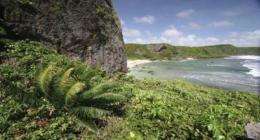
Cycads, "living fossil" descendents of the first plants that colonized land and reproduced with seeds, are rapidly going extinct because of invasive pests and habitat loss, especially those species endemic to islands. But new research on Cycas micronesica published recently as the cover article in Molecular Ecology calls into question the characterization of these plants as relicts (leftovers of formerly abundant organisms), and gives a glimpse into how the remaining plants—those that survived the loss of more than 90% of their population -- can be conserved and managed.
By sampling what is left of C. micronesica on Guam, researchers, including some from the American Museum of Natural History, found moderate genetic variation within local populations and different levels of gene flow between populations.
"Cycas micronesica is one of the most ecologically important plants on Guam and nearby islands, and it is now rapidly disappearing," says Angélica Cibrián-Jaramillo, a researcher at the American Museum of Natural History and at The New York Botanical Garden. "But with new genomic tools we developed microsatellite markers to quickly assess individual plants. This technique is ideal for species that need quick answers for conservation reasons." Microsatellite markers are short genetic sequences typically used to determine how individuals are related to each other (kinship) and other population studies.
Cycads have been around for about 300 million years and are among the first spermatophytes, or plants that reproduce with seeds. Although this group's large crowns of feathery compound leaves was once common, cycads now number about 300 species throughout the world, and about half of these are threatened or endangered. C. micronesica is found on four island groups in Micronesia.
Within four years, the millions of C. micronesica on Guam were reduced by more than 90%. The primary culprit was an insect that often parasitizes plants (in this case, a scale) that invaded Guam in 2003, although other invasive species including butterflies and feral pigs are contributing to plant mortality. The invasive species are also spreading to other islands.
"This ecological disaster is typical on islands," says Thomas Marler, professor at the University of Guam. "There has been a cascade of invasive species in a short time. This study will give conservation groups information about how to manage the surviving plants: the most efficient way to establish nurseries and where to collect seeds, and how to reintroduce them if the [invasive] insect is brought under control."
For this study, Marler collected leaf samples from all C. micronesica habitats on Guam, and Cibrián-Jaramillo found 18 genetic populations among 24 locations. The results showed that local populations are not genetically poor but instead have moderate genetic variation with some inbreeding, which is what would be expected in longer-lived plants with similar seed dispersal. The amount of genetic flow between Guam's populations was low but very dynamic within regions in the island, which means that plants are similar genetically and the observed variation points to patterns of seed dispersal. Cycas micronesica plants in the north are more likely to be related to each other, while populations in the south are genetically different from each other. This contrast is most likely due to southern Guam's more fragmentary forests, more rivers for seed transportation (C. micronesica seeds are one of the few cycad seeds that float), and the smaller size of seeds, which can be dispersed to greater distances.
"We hope that these results from the plant perspective will fit into the management of invasive insects in general, which is one of the most important drivers of biodiversity loss worldwide and very costly economically," says Rob DeSalle, curator at the American Museum of Natural History who works in the Sackler Institute for Comparative Genomics.
More information: Molecular Ecology 19, 2364-2379, doi:10.1111/j.1365-294X.2010.04638.x
Provided by American Museum of Natural History


