Whisker stimulation prevents strokes in rats, study finds
July 13, 2010
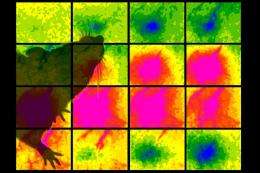
UCI researchers found that mechanically stroking a single whisker activated a rat’s cerebral cortex - seen lighting up in magenta and blue - and prompted obstructed blood to take other routes to the brain. Photo illustration by Christopher Lay and Cynthia Chen-Bee
(PhysOrg.com) -- Talk about surviving by a whisker. The most common type of stroke can be completely prevented in rats by stimulating a single whisker, according to a new study by UC Irvine researchers.
Strokes are the No. 3 cause of death in the U.S., after heart disease and cancer. About 795,000 Americans suffer them annually, according to the American Heart Association, and more than 137,000 die as a result.
So should we be tickling our own whiskers? And what about women, who are less likely to have facial hair? While it's too soon to tell if the findings will translate to humans, researchers say it's possible, and stubble is not required. We have sensitive body parts wired to the same area of the brain as rodents' fine-tuned whiskers.
In people, "stimulating the fingers, lips or face in general could all have a similar effect," says UCI doctoral student Melissa Davis, co-author of the study, which appears in the June issue of PLoS One.
"It's gender-neutral," adds co-author Ron Frostig, professor of neurobiology & behavior.
He cautions that the research, funded by the National Institutes of Health, is a first step, albeit an important one. "This is just the beginning of the whole story," he says, "with the potential for maybe doing things before a victim even reaches the emergency room."
A stroke usually happens when a main artery bringing oxygen and nutrients to the brain either ruptures or is blocked by a clot, causing partial brain death. The key to preventing strokes in rats whose main cerebral artery has been obstructed, UCI researchers found, is to stimulate the middle part of the brain.
The team discovered that mechanically stroking just one whisker for four minutes within the first two hours of the blockage caused the blood to quickly flow to other arteries - like cars exiting a gridlocked freeway to find detours.
But unlike freeway off-ramps, which can quickly clog, the alternate arteries expanded beyond their normal size, opening wide to allow critical blood flow to the brain. The technique was 100 percent effective in preventing strokes in rats with arterial obstruction.
UC San Diego neuroscientist David Kleinfeld, who has also studied brain structure and strokes, calls the results "unexpected and spectacular." Random stimulation of the rat whisker also worked, but timing was critical - waiting three hours to do so led to major brain cell death.
Scientists have struggled for years to find ways of preventing strokes or minimizing their effects, which include slurred speech, paralysis and brain damage. One drug can help some patients but also often causes bleeding in the brain.
People believed to be suffering a stroke are currently told to lie still and stay calm in a quiet environment. Frostig says a good massage, listening to a song or otherwise stimulating the right nerve endings might work better.
Kleinfeld cautions that the rodent findings might not be relevant to humans. But with such clear evidence that strokes in rats were prevented, he says, "it would be criminal not to try" controlled human studies. That could be tricky, since it's not possible to predict when someone will have a stroke.
The UCI team - which also includes graduate students Christopher Lay and Cynthia Chen-Bee - would like to find physicians or emergency medical technicians willing to try the technique on patients with early stroke symptoms.
Signs of stroke include:
- Sudden numbness or weakness in face or limbs, especially on one side
- Sudden confusion, trouble speaking or understanding
- Sudden difficulty seeing or walking
- Dizziness or loss of balance or coordination
- Sudden, severe headache with no known cause
More information: Paper link: http://www.plosone … pone.0011270
Provided by University of California - Irvine
-
The Medical Minute: Strike back at stroke -- know your risks
May 19, 2010 |
not rated yet |
0
-
Children can have recurrent strokes
Feb 24, 2010 |
not rated yet |
0
-
Clinical Trial Uses Bat Saliva Enzyme for Stroke Treatment
Dec 30, 2008 |
not rated yet |
0
-
Probing Question: Why can a stroke victim remember some things and not others?
Nov 29, 2007 |
not rated yet |
0
-
Stroke therapy window might be extended past nine hours for some
Feb 09, 2009 |
not rated yet |
0
-
Engineers build first sub-10-nm carbon nanotube transistor
Feb 01, 2012 |
4.9 / 5 (31) |
30
-
Something old, something new: Evolution and the structural divergence of duplicate genes
Jan 31, 2012 |
4.6 / 5 (7) |
1
-
The hidden nanoworld of ice crystals: Revealing the dynamic behavior of quasi-liquid layers
Jan 30, 2012 |
5 / 5 (3) |
1
-
Stock market network reveals investor clustering
Jan 27, 2012 |
3.9 / 5 (23) |
8
-
Of microchemistry and molecules: Electronic microfluidic device synthesizes biocompatible probes
Jan 26, 2012 |
5 / 5 (1) |
0
-
Is Everyday Technology Killing Us?
Feb 08, 2012
-
Exercise and weight loss
Feb 08, 2012
-
Why do we have head aches? Our brains can't feel anything.
Feb 07, 2012
-
"The end of diseases" by David Agus, interview from Daily Show with Jon Stewart
Feb 04, 2012
-
Oncolytic adenovirus
Feb 04, 2012
-
Nutrition label stuffs and diets
Feb 02, 2012
- More from Physics Forums - Medical Sciences
More news stories
Complex wiring of the nervous system may rely on a just a handful of genes and proteins
Researchers at the Salk Institute have discovered a startling feature of early brain development that helps to explain how complex neuron wiring patterns are programmed using just a handful of critical genes. ...
11 hours ago |
4.9 / 5 (9) |
1
|
Team isolates nerve cells involved in storing long term memory and gene proteins associated with them
(Medical Xpress) -- A research team in Taiwan has succeeded in isolating two nerve cells in fruit fly brains that are believed to be the major players in allowing for the formation of long term memories. Furthermore, ...
Seeing colors in music, tasting flavors in shapes may happen in life's early months
Famed violinist Itzhak Perlman sees a deep forest green whenever he plays a B-flat on his Stradivarius' G string. The A on the E string is red.
Medicine & Health / Psychology & Psychiatry
18 hours ago |
4.5 / 5 (2) |
2
|
Both maternal and paternal age linked to autism
Older maternal and paternal age are jointly associated with having a child with autism, according to a recently published study led by researchers at The University of Texas Health Science Center at Houston (UTHealth).
Medicine & Health / Psychology & Psychiatry
15 hours ago |
4.3 / 5 (3) |
0
|
New understanding of DNA repair could eventually lead to cancer therapy
A research group in the Faculty of Medicine & Dentistry at the University of Alberta is hoping its latest discovery could one day be used to develop new therapies that target certain types of cancers.
14 hours ago |
4.8 / 5 (6) |
0
|
Anonymous knocks CIA website offline (Update)
The website of the Central Intelligence Agency was inaccessible on Friday after the hacker group Anonymous claimed to have knocked it offline.
New error-correcting codes guarantee the fastest possible rate of data transmission
Error-correcting codes are one of the triumphs of the digital age. Theyre a way of encoding information so that it can be transmitted across a communication channel such as an optical fiber o ...
Google users warned of threat to smartphone wallets
Users of Google smartphone wallets were being warned on Friday that there is a way to crack pass codes intended to thwart thieves from going on illicit shopping sprees.
Humans may have helped the decline of African rainforests 3000 years ago
(PhysOrg.com) -- Large areas of rainforests in Central Africa mysteriously disappeared over three thousand years ago, to be replaced by savannas. The prevailing theory has been that the cause was a change ...
New power source discovered
(PhysOrg.com) -- Researchers at the Massachusetts Institute of Technology (MIT) and RMIT University have made a breakthrough in energy storage and power generation.
Small modular reactor design could be a 'SUPERSTAR'
(PhysOrg.com) -- Though most of today's nuclear reactors are cooled by water, we've long known that there are alternatives; in fact, the world's first nuclear-powered electricity in 1951 came from a reactor ...
Jul 13, 2010
Rank: 1 / 5 (1)
We probably are the only species where such vast numbers of fertile males get simply ignored to oblivion.
As one of them, I get approached by women on week-end nights downtown. My problem is, if I couldn't get it up with this crowd as an adolescent, how the heck could I now?? Duh??
At this rate, I'm doomed to asexuality, which should sound positively LETHAL, since nobody in my position gets any other regular exercise either. Which in turn leads us to the Heading, or actually its corollary: no stimulation leads to strokes. I bet BOTH in humans and rats.
Good G*d, I'm happy that I got three kids while I didn't know better! They're the love of my life!
Jul 14, 2010
Rank: not rated yet
If you have none then MAKE some. Get a hobby. Go out and mingle. Do something instead of sitting in front of the TV.
Having a wife and kids that 'stimulate you' is just the passive way out.