New project enables mobile phone use in areas with no reception
July 14, 2010 by Lin Edwards report
New project enables mobile phone use in areas with no reception

Enlarge

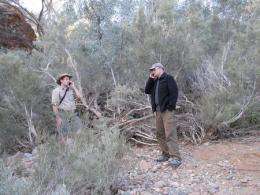
Paul Gardner-Stephen (left) talks with a colleague in the wilderness using his new system. Credit: Village Telco

(PhysOrg.com) -- Australian scientists have invented software that enables mobile (cell) phones to work in remote areas where there is no conventional coverage and in locations where the infrastructure has been destroyed through disaster, or is not economically viable. The technology enables ordinary mobile phones to make and receive calls without the need for phone towers or satellites.

Leader of the team, Dr Paul Gardner-Stephen of Flinders University in Adelaide, South Australia, named the project the Serval Project, after an African wildcat renowned for its problem-solving abilities. The aim is to "provide fast, cheap, robust and effective telecommunications systems" for areas where there is currently no telephone infrastructure, or where it has been destroyed by or civil unrest.

The project includes two systems that can operate separately or be combined. One is specifically for disaster areas, and consists of a temporary, self-organizing and self-powered network that operates via small phone towers dropped into the area by aircraft.

The second system consists of a permanent mesh-based phone network between Wi-Fi enabled mobile phones, with no tower infrastructure required. Eventually, the system will also include the “Batphone,” which will be a specially designed phone able to operate on other unlicensed frequencies.

The systems use open-source software developed by the team and dubbed Distributed Numbering Architecture (DNA). The software allows mobile phones to make calls out and receive calls on their existing numbers. The mesh was developed by Village Telco and is integrated with the software to create a mesh network in which each phone acts as an independent router.

Dr Gardner-Stephen said the device essentially “incorporates a compact version of a mobile phone tower into the phone itself.” It uses the Wi-Fi interface in modern Wi-Fi-enabled phones, carrying voice over it in such a way that it does not need to go back to a tower anywhere.

The current range between phones is only a few hundred meters, which limits the usefulness of the system in remote areas, but Gardner-Stephen said adding small transmitters and more devices could expand the range considerably. The real benefit of the current system would be in disaster areas where there are plenty of phones but the towers are destroyed or the infrastructure is no longer functioning. In the recent Haiti disaster area for example, the was knocked out for over two days after the earthquake struck, and did not return to normal operation for a week.

Director of the Research Centre for Disaster Resilience and Health at Flinders University, Professor Paul Arbon said the systems could prove invaluable in disasters, providing an instant network allowing people to call out and receive calls from concerned relatives, and helping volunteers to coordinate the response. The system could also provide the community with updates and warnings.

The systems have been successfully tested in remote areas of the Flinders Ranges in South Australia where there is no mobile phone reception, with the three researchers creating a network over one square kilometer. The next stages in the project are to increase the range and improve sound quality. The team is also working on developing a method of dropping the temporary towers into disaster areas.

Dr Gardner-Stephen said the system could be operational within 18 months provided the project receives adequate funding. He said his dream was for every mobile phone to be equipped with the system so that if there is a disaster all the phones in the region will automatically switch to the mesh network mode of operation as a fallback.

This video is not supported by your browser at this time.


More information: http://www.servalproject.org

© 2010 PhysOrg.com

4.5 /5 (21 votes)  

Filter


Move the slider to adjust rank threshold, so that you can hide some of the comments.


Display comments: newest first

freethinking
Jul 14, 2010

Rank: 5 / 5 (3)
Absolutely nothing new here. I've worked on systems like this over 10 years ago. If anyone thinks this is new let me know and I'll send you the details.
zealous
Jul 14, 2010

Rank: not rated yet
It's new, send me details
Eugene
Jul 14, 2010

Rank: 5 / 5 (2)
Is he talking to the colleague in the picture? If so that is funny! Hang-up and talk using directly. Why limit this to non-covered areas? Sounds like a great way to dump the telcos within a small community with only a community broadband connection for long-distance voip.
zealous
Jul 14, 2010

Rank: 5 / 5 (2)
Well it is mentioned in the article that they are using open source software so we might see something like this pop up
Hunnter
Jul 14, 2010

Rank: not rated yet
Wireless internet mesh ideas have been pulled off in city-wide scenarios before. But i'm not so sure it has been tried with phones much, or it was so small-scale that nobody knows much about them due to little coverage. (pardon that)

Since phones have these tiny antennas now, their ranges are limited.
Some phones have external antenna ports for longer distances.
It would be nice to see this happen on more phones, but of course it won't since those phones are built by phone companies who want to charge you for using their network. Without your messages bouncing around in their systems, they can't reliably track what is happening.

An open-source phone would be required for this to fully work.
No doubt this sort of project will start off in more areas since phone companies are becoming stupidly strict with packages these days.
This is generally why i stay away from phones.

Also, remember the satellite phone?
Does anyone still sell those to the general public?
CarolinaScotsman
Jul 14, 2010

Rank: 3 / 5 (1)
I don't see that much difference between his system and two-way radios with a system of repeaters to increase distance.
PinkElephant
Jul 14, 2010

Rank: 4.5 / 5 (2)
@CarolinaScotsman,

The difference is that they're leveraging Wi-Fi spatial locality of signal and contention resolution protocols and hardware, as well as the inherent echo-canceling and reliable transmission features of the existing, off-the-shelf protocols and hardware. As a result, you can push a lot of data around -- e.g. lots of simultaneous point-to-point conversations -- losslessly over a single channel. Try that with a regular walkie-talkie...

The big downside is that all of this fancy realtime network topology construction/tracking, and transmission management and forwarding is energy-intensive. In a disaster zone, once your phone's battery runs down, where do you go to recharge it? I suspect a typical smartphone won't last more than one hour, from a full charge, as an active member of such a network...
CarolinaScotsman
Jul 14, 2010

Rank: not rated yet
Try digital transmissions over short wave bands. You can push a lot of data around that way too; ask NASA, and it's still two way radio.
PinkElephant
Jul 14, 2010

Rank: 4.5 / 5 (2)
Try digital transmissions over short wave bands. You can push a lot of data around that way too; ask NASA, and it's still two way radio.
With a directional antenna. When you want to talk to someone, do you first find them with a telescope, then pivot your parabolic dish in their exact direction and make sure you track them accurately while they move around? Oh, and they better have their own antenna in the form of a parabolic dish pointed at you, or else your signal just might be swamped by background noise...

The nice thing about wi-fi technology, is that it's omnidirectional, just like any ordinary radio.

And, it's not just two-way. It's N-way. It's basically wireless Ethernet.
scidog
Jul 15, 2010

Rank: not rated yet
Sat phones are common,you can buy one on Ebay among other places.canoe outfitters rent them out--$11 a day--for people who want to keep in contact with home or work.they are not fool proof,you need to be in a open area and point the antenna right.used one,no big deal.
plasticpower
Jul 15, 2010

Rank: 5 / 5 (1)
It would not be good to use this in a city environment, because from what I understand this is basically a p2p network. So a lot of traffic would go through your normally idle cell phone that's acting like router, rendering its battery useless. Cell phones already have crappy batteries, no need to drain them any more. This is only great for true emergencies.
freethinking
Jul 16, 2010

Rank: not rated yet
http://www.viasat...s-effort

This isnt the system I was talking about, but it is close enough, the other system was briefcase sized and could provide up to 16 cell calls with a range of 10KM.
Rank 4.5 /5 (21 votes)
Related Stories
Relevant PhysicsForums posts
  • Calling function with no input argument
    created3 hours ago
  • Force free body diagram problem on gym equipment
    created4 hours ago
  • Empirical data regarding shower heads and water
    created12 hours ago
  • feed hold button on CNC lathe
    createdFeb 09, 2012
  • RFAC in Fortran
    createdFeb 09, 2012
  • dynamics 2/32
    createdFeb 08, 2012
  • More from Physics Forums - General Engineering

More news stories

Review: Netflix and Hulu's new scripted originals

Within just over a week, Netflix and Hulu are both debuting their first stabs at original scripted programming.

Technology / Business

created 1 hour ago | popularity not rated yet | comments 0

India probes Google over 'forex transactions'

Indian authorities are probing whether online giant Google broke domestic foreign-exchange transactions rules while shifting funds abroad, the Press Trust of India reported on Friday.

Technology / Internet

created 46 minutes ago | popularity not rated yet | comments 0

Germany freezes signing of disputed Internet pact

Germany on Friday halted the signing of a controversial international accord billed as a way to beat online piracy that has sparked angry protests, saying it needed more time to consider it.

Technology / Internet

created 57 minutes ago | popularity not rated yet | comments 0

Expat French get Internet vote for first time

French citizens will for the first time this year be able to vote in a parliamentary election over the Internet, an experiment that could be extended to other elections if successful.

Technology / Internet

created 7 minutes ago | popularity not rated yet | comments 0

New error-correcting codes guarantee the fastest possible rate of data transmission

Error-correcting codes are one of the triumphs of the digital age. They’re a way of encoding information so that it can be transmitted across a communication channel — such as an optical fiber o ...

Technology / Computer Sciences

created 6 hours ago | popularity 5 / 5 (3) | comments 2 | with audio podcast


Hovering not hard if you're top-heavy, researchers find

Top-heavy structures are more likely to maintain their balance while hovering in the air than are those that bear a lower center of gravity, researchers at New York University's Courant Institute of Mathematical Sciences ...

Grass to gas: Researchers' genome map speeds biofuel development

Researchers at the University of Georgia have taken a major step in the ongoing effort to find sources of cleaner, renewable energy by mapping the genomes of two originator cells of Miscanthus x giganteus, a large perenn ...

Putting the squeeze on planets outside our solar system

(PhysOrg.com) -- Using high-powered lasers, scientists at Lawrence Livermore National Laboratory and collaborators discovered that molten magnesium silicate undergoes a phase change in the liquid state, abruptly ...

Researchers develop new method for creating tissue engineering scaffolds

Researchers at Northwestern University have developed a new method for creating scaffolds for tissue engineering applications, providing an alternative that is more flexible and less time-intensive than current technology.

Molecular profiling reveals differences between primary and recurrent ovarian cancers

There is a need to analyze tumor specimens at the time of ovarian cancer recurrence, according to a new study published in Molecular Cancer Therapeutics. Researchers used a diagnostic technology called molecular profiling to examine ...

C-sections linked to breathing problems in preterm infants

Research conducted at Yale School of Medicine shows that a cesarean (C-section) delivery, which was thought to be harmless, is associated with breathing problems in preterm babies who are small for gestational age.