Study finds Triceratops, Torosaurus were different stages of one dinosaur
July 14, 2010
Study finds Triceratops, Torosaurus were different stages of one dinosaur

Enlarge

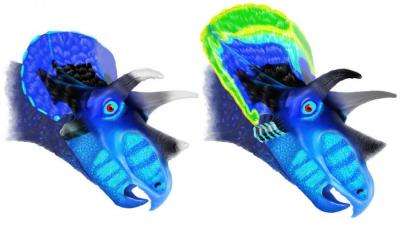
The classic image of a Triceratops is on the left. On the right is the new face of Triceratops, previously called Torosaurus. (Artwork by Holly Woodward, MSU graduate student).

(PhysOrg.com) -- Research by a Montana State University doctoral student and one of the nation's top paleontologists is upending more than 100 years of thought regarding the dinosaurs known as Triceratops and Torosaurus.

Since the late 1800s, scientists have believed that and Torosaurus were two different types of . Triceratops had a three-horned skull with a rather short frill, whereas Torosaurus had a much bigger frill with two large holes through it.

MSU paleontologists John Scannella and Jack Horner said in the July 14 issue of the , however, that Triceratops and Torosaurus are actually the same dinosaur at different stages of growth. They added that the discovery contributes to an unfolding theory that dinosaur diversity was extremely depleted at the end of the dinosaur age.

The Journal of Vertebrate Paleontology is the official journal of the Society of Vertebrate Paleontology. Scannella is a doctoral student in earth sciences, and Horner is Regents Professor of Paleontology at MSU's Museum of the Rockies.

The confusion over Triceratops and Torosaurus was easy to understand, Scannella said, because juvenile dinosaurs weren't just miniature versions of adults. They looked very different, and their skulls changed radically as they matured. Recent studies have revealed extreme changes in the skulls of pachycephalosaurs, tyrannosaurs and other dinosaurs that died out about 65 million years ago in North America.

"Paleontologists are at a disadvantage because we can't go out into the field and observe a living Triceratops grow up from a baby to an adult," Scannella said. "We have to put together the story based on fossils. In order to get the complete story, you need to have a large sample of fossils from many individuals representing different growth stages."

The Triceratops study suggests that it is critical that paleontologists consider ontogeny (growth from a juvenile to an adult) as a source of major morphological variations before naming new species of dinosaurs to account for variation between specimens, Scannella added.

"Without considering changes in shape throughout ontogeny, we overestimate dinosaur diversity and hence produce an unrealistic view of the paleoecology of these animals," Scannella said.

Scannella and Horner benefited from an extensive 10-year study of the Hell Creek Formation in Eastern Montana. Led by Horner, the large-scale project was conducted to reconstruct the ecosystems that existed during the Cretaceous Period that ended about 65 million years ago when there was a mass extinction of dinosaurs. As part of the study, field crews collected hundreds of specimens. Forty percent of the specimens came from Triceratops at different stages of growth. Some of the skulls belonged to juvenile Triceratops and roughly the size of footballs. Other skulls are the size of a small car.

"Torosaurus" specimens are much rarer than Triceratops, however. None of the Torosaurus specimens came from immature animals, Scannella said. When the paleontologists did find "Torosaurus" skulls, the skulls were all large.

"If Torosaurus is actually the mature form of Triceratops, we must ask why ‛Torosaurus' specimens are relatively rare compared to Triceratops," Scannella said. "It is possible that mortality was fairly high for Triceratops before they reached their fully mature morphology."

Scannella and Horner examined more than 50 Triceratops specimens for their study. More than 30 were skulls that came out of the Hell Creek Formation and are housed at the Museum of the Rockies. The paleontologists also examined skulls from several North American institutions, including the American Museum of Natural History in New York, the National Museum of Natural History at the Smithsonian Institution in Washington, D.C., and the Peabody Museum of Natural History at Yale University in New Haven, Conn.

Scannella and Horner measured the length, width and thickness of the skulls. They examined the microstructure, surface textures and shape changes of the frills. Microscope studies revealed that the tissues of Torosaurus specimens are more heavily remodeled than those of even the largest Triceratops, strongly suggesting that Torosaurus specimens are in fact adult Triceratops, Scannella said. Even in Triceratops that were previously considered to be adults, the skull was still undergoing dramatic changes.

Many undergraduate students, as well as volunteers from around the world, participated in the project by discovering and excavating the Triceratopsspecimens in the field. Some undergraduates also helped prepare the fossils once they were brought back to the Museum of the Rockies.

Scannella said he and Horner tried for three years to look for alternative explanations for their findings. They finally agreed that the Triceratops and Torosaurus were the same dinosaur.

"Every avenue of investigation we took in attempts to falsify the hypothesis only supported the idea further," Scannella said.

Scannella said he presented his and Horner's findings at the 2009 Society of Vertebrate Paleontology Conference in Bristol, England, and it was met with equal parts intrigue and skepticism.

"Skepticism is important and a good thing," Scannella commented. "But so far, all the evidence we have strongly supports the idea."

The finding that Torosaurus was a grown-up Triceratops adds fuel to the theory that dinosaur diversity at the end of the Cretaceous Period and Mesozoic Era was far less than previously thought, Scannella said.

"A major decline in diversity may have put the dinosaurs in a vulnerable state at the time when the large meteor struck the Earth at the end of the Cretaceous Period," Scannella said. "It may have been the combination of the two factors -- lower diversity and a major global catastrophe -- that resulted in the extinction of all the non-avian dinosaurs."

If the apparent decline in diversity wasn't triggered by a meteor -- a relatively uncommon event -- Scannella said, "It may have been caused by circumstances which are more likely to affect diversity today, perhaps large-scale sea level fluctuations or climate change.

"If so, Triceratops may have a lot to teach us about biodiversity and extinction today," Scannella said. "By studying patterns of diversity in the past, we attain insights into current ecological trends."

Provided by Montana State University (news : web)

4.9 /5 (19 votes)  

Filter


Move the slider to adjust rank threshold, so that you can hide some of the comments.


Display comments: newest first

Skeptic_Heretic
Jul 14, 2010

Rank: 5 / 5 (2)
Have they considered that, like mammals, males would have a more embellished appearance and survive in far smaller number?

One could draw a comparison to Hippos. In a large group there are a great many females and only one or two mature males.
Donutz
Jul 14, 2010

Rank: 5 / 5 (2)
It seems possible that the change to the frill was an adaptation for increasing weight. Like with steel girders where regular holes will decrease overall weight without significantly reducing strength.
yyz
Jul 14, 2010

Rank: 5 / 5 (1)
"The finding that Torosaurus was a grown-up Triceratops adds fuel to the theory that dinosaur diversity at the end of the Cretaceous Period and Mesozoic Era was far less than previously thought."

In that case I wonder if the Creation Museum is planning any changes to its 'saddled' Triceratops?

http://scienceblo...ssed.php

http://en.wikiped...ddle.jpg
trekgeek1
Jul 14, 2010

Rank: 5 / 5 (1)
"The finding that Torosaurus was a grown-up Triceratops adds fuel to the theory that dinosaur diversity at the end of the Cretaceous Period and Mesozoic Era was far less than previously thought."

In that case I wonder if the Creation Museum is planning any changes to its 'saddled' Triceratops?

http://scienceblo...ssed.php


Ha!! They're going to feel so dumb when they realize the dinosaur they've been riding is not scientifically accurate!
jsa09
Jul 15, 2010

Rank: 5 / 5 (2)
@skeptic.

I was thinking the exact same thing. They may well have had a herd dominated by a single male, with the herd containing many females and immature males. The dinosaurs may even have regulated growth hormones etc to limit maturity in male members of the herd.
MarkyMark
Jul 15, 2010

Rank: not rated yet
"The finding that Torosaurus was a grown-up Triceratops adds fuel to the theory that dinosaur diversity at the end of the Cretaceous Period and Mesozoic Era was far less than previously thought."

In that case I wonder if the Creation Museum is planning any changes to its 'saddled' Triceratops?

http://scienceblo...ssed.php


Actually that image is pretty cool if you have say 5 of them and replace the riders with gun toting mexican bandits ;)

Anyway on topic this finding is going to cause a lot of headaches in more than just the creationist circles.
Caelus
Jul 18, 2010

Rank: not rated yet
@ Skeptic & JSA

To my knowledge the sex of a fossilized dinosaur specimen can usually be determined by the structure of its hips/pelvis.

ASSUMING that they had multiple intact fossils to examine, the paleontoligists should be able to tell if all of the 'Torosaurs' were male and Triceratops were female.
Silver_Fang
Jul 31, 2010

Rank: not rated yet
I've read that some triceratops skeletons have been found that are larger than the torosaur skeletons. Wouldn't that negate the idea of the torosaur being an adult triceratops?
Skeptic_Heretic
Jul 31, 2010

Rank: not rated yet
I've read that some triceratops skeletons have been found that are larger than the torosaur skeletons. Wouldn't that negate the idea of the torosaur being an adult triceratops?

I was 6'5" at age 14, while my mother was 5'2" at age 40. Does that mean I'm not human?
Rank 4.9 /5 (19 votes)
Related Stories
Relevant PhysicsForums posts
  • Pertubance in a model
    created5 hours ago
  • Cancer drugs and Alzheimer's, Oh my!
    created13 hours ago
  • Squishing cells
    created13 hours ago
  • Any books/articles for evolutionary stable strategy models in humans?
    createdFeb 09, 2012
  • Science behind the bore feeling?
    createdFeb 09, 2012
  • Homo Sapien vs. Chimpanzee - Divergence Timeline
    createdFeb 09, 2012
  • More from Physics Forums - Biology

More news stories

Sonic Cradle lands spot in TED exhibition

A Simon Fraser University graduate student project that melds music, meditation and modern technology has landed a rare spot as an exhibit at TEDActive 2012 in Palm Springs, California this month.

Other Sciences / Other

created 1 hour ago | popularity not rated yet | comments 0

A frank discussion of the power law and linking correlation to causation

(PhysOrg.com) -- Michael Stumpf a mathematics professor at Imperial College in London, and Mason Porter a lecturer at Oxford have teamed together to write and publish a perspective piece in Science regarding the in ...

Other Sciences / Mathematics

created 5 hours ago | popularity 5 / 5 (1) | comments 2 | with audio podcast report

The question of life in the ancient world

There’s a general feeling that we don’t get the Greeks – ancient or modern. Many, including heads of state like Angela Merkel, visibly shake their head in exasperation, rightly or wrongly, at ...

Other Sciences / Archaeology & Fossils

created 4 hours ago | popularity 1 / 5 (1) | comments 2

Chilean miners' rescue capsule on show in London

The capsule used to rescue Chilean miners trapped underground for two months goes on display Saturday at the Science Museum in London -- the first time it has been seen in Europe.

Other Sciences / Other

created 3 hours ago | popularity not rated yet | comments 0

US workers are 'giving away the store,' costing firms billions

Nearly 70 percent of the nation's service employees give away free goods and services – from hamburgers to cable TV – costing companies billions of dollars a year, according to a groundbreaking study.

Other Sciences / Economics & Business

created 22 hours ago | popularity 4.5 / 5 (2) | comments 10


New understanding of DNA repair could eventually lead to cancer therapy

A research group in the Faculty of Medicine & Dentistry at the University of Alberta is hoping its latest discovery could one day be used to develop new therapies that target certain types of cancers.

Hovering not hard if you're top-heavy, researchers find

Top-heavy structures are more likely to maintain their balance while hovering in the air than are those that bear a lower center of gravity, researchers at New York University's Courant Institute of Mathematical Sciences ...

Grass to gas: Researchers' genome map speeds biofuel development

Researchers at the University of Georgia have taken a major step in the ongoing effort to find sources of cleaner, renewable energy by mapping the genomes of two originator cells of Miscanthus x giganteus, a large perenn ...

Night, weekend delivery OK for babies with birth defects

Weekday delivery is no better than night or weekend delivery for infants with birth defects, according to a new study presented today at The Pregnancy Meeting, the Society for Maternal-Fetal Medicine's annual conference. ...

Drug halts organ damage in inflammatory genetic disorder

A new study shows that Kineret (anakinra), a medication approved for the treatment of rheumatoid arthritis, is effective in stopping the progression of organ damage in people with neonatal-onset multisystem inflammatory disease ...

Cochlear implants may be safe, effective for organ transplant patients

Cochlear implants may be a safe, effective option for some organ transplant patients who've lost their hearing as an unfortunate consequence of their transplant-related drug regime, researchers report.