Record-breaking X-ray blast briefly blinds space observatory
July 14, 2010 by Barbara K. Kennedy
Record-breaking X-ray blast briefly blinds space observatory

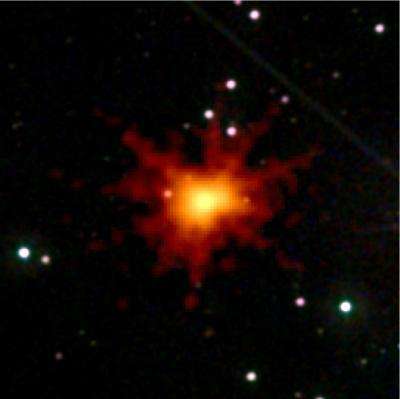
The brightest gamma-ray burst ever seen in X-rays temporarily blinded Swift's X-ray Telescope on 21 June 2010. This image merges the X-rays (red to yellow) with the same view from Swift's Ultraviolet/Optical Telescope, which showed nothing extraordinary. (The image is 5 arcminutes across.) Credit: NASA/Swift/Stefan Immler

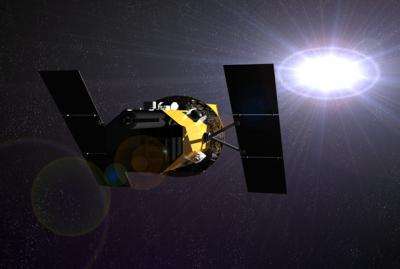
A blast of the brightest X-rays ever detected from beyond our Milky Way galaxy's neighborhood temporarily blinded the X-ray eye on NASA's Swift space observatory earlier this summer, astronomers now report. The X-rays traveled through space for 5-billion years before slamming into and overwhelming Swift's X-ray Telescope on 21 June. The blindingly bright blast came from a gamma-ray burst, a violent eruption of energy from the explosion of a massive star morphing into a new black hole.

"This is by far the brightest light source ever seen in X-ray wavelengths at cosmological distances," said David Burrows, senior scientist and professor of astronomy and astrophysics at Penn State University and the lead scientist for Swift's X-ray Telescope (XRT).

Although the was designed specifically to study gamma-ray bursts, the instrument was not designed to handle an X-ray blast this bright. "The intensity of these X-rays was unexpected and unprecedented" said Neil Gehrels, Swift's principal investigator at NASA's Goddard Space Flight Center. He said the burst, named GRB 100621A, is the brightest X-ray source that Swift has detected since the observatory began X-ray observation in early 2005. "Just when we were beginning to think that we had seen everything that gamma-ray bursts could throw at us, this burst came along to challenge our assumptions about how powerful their X-ray emissions can be," Gehrels said.

"The burst was so bright when it first erupted that our data-analysis software shut down," said Phil Evans, a postdoctoral research assistant at the University of Leicester in the United Kingdom who wrote parts of Swift's X-ray-analysis software. "So many photons were bombarding the detector each second that it just couldn't count them quickly enough. It was like trying to use a rain gauge and a bucket to measure the flow rate of a tsunami."

The software soon resumed capturing the evolution of the burst over time, and Evans recovered the data that Swift had detected during the software's brief shutdown. The scientists then were able to measure the blast's X-ray brightness at 143,000 X-ray photons per second during its fleeting period of greatest brightness, which is more that 140 times brighter than the brightest continuous X-ray source in the sky -- a neutron star that is more than 500,000 times closer to Earth than the gamma-ray burst, and that sends a 'mere' 10,000 photons per second streaming toward Swift's telescopes.
Record-breaking X-ray blast briefly blinds space observatory
Enlarge


Gamma-ray bursts typically begin with a bright flash of high-energy gamma-rays and X-rays, then fade away like a fireworks display, sometimes leaving behind a disappearing afterglow in less-energetic wavelengths, including optical and ultraviolet. Surprisingly, although the energy from this burst was the brightest ever in X-rays, it was merely ordinary in optical and ultraviolet wavelengths.

The Swift scientists were able to estimate the overall brightness of GRB 100621A by sampling the photons at some distance from its overexposed center -- a standard correction technique. Scientists who study the Sun use a similar approach to observe the Sun's corona by blocking out its much-brighter center. "With this burst, we had to sample the photons twice as far from the center as we ever had to go before," Burrows said. "The correction factor for the X-rays from GRB 100621A was 168 times larger than for a typical gamma-ray burst and 5 times larger than for the brightest burst we previously had seen. We never thought we'd see anything this bright."

Automated analysis of the Swift XRT data is performed at the University of Leicester in the United Kingdom, which has been studying X-rays from outer space for the past half century. Evans was the first to see the processed data from the burst's initial blast. "When I first saw the strange data from this burst, I knew that I had discovered something extraordinary," he said. "It was an indescribable feeling when I realized, at that moment, that I was the only person in the whole universe who knew that this extraordinary event had occurred. Now, after our analysis of the data, we know that this burst is one for the record books."

More information: NASA's "Geeked on Goddard" blog has a related story about the GRB 100621A burst at http://geeked.gsfc … .gov/?p=1417

Provided by Pennsylvania State University (news : web)

4.7 /5 (28 votes)  

Filter


Move the slider to adjust rank threshold, so that you can hide some of the comments.


Display comments: newest first

LariAnn
Jul 14, 2010

Rank: 4.5 / 5 (10)
"It was an indescribable feeling when I realized, at that moment, that I was the only person in the whole universe who knew that this extraordinary event had occurred."
Really? With so much space and time between us and the event, the odds are very good that someone else in the universe besides Evans knew about this, especially if they were close enough to it for damaging effects to manifest on their world, observatory, or spacecraft!
Sonhouse
Jul 14, 2010

Rank: 4.5 / 5 (8)
It might be a stretch to say 'I am the only person in the UNIVERSE who knew about this'. Since this event was at cosmological distances, it had to have swept through millions of galaxies on its way to Earth. I think it safe to say somewhere in those galaxies lies a civilization who also received that burst. That said, it is a heck of a discovery! Good work!
SteveL
Jul 14, 2010

Rank: 4.2 / 5 (6)
"The X-rays traveled through space for 5-billion years before slamming into and overwhelming Swift's X-ray Telescope on 21 June."

"It was an indescribable feeling when I realized, at that moment, that I was the only person in the whole universe who knew that this extraordinary event had occurred"

The only person within 10 billion light years (5 billion in just our direction). What an incredible waste of space. So lonely...

Ugh, eating lunch and posting - I was too slow. Seems several of us caught that.
jselin
Jul 14, 2010

Rank: 4.8 / 5 (4)
"It was an indescribable feeling when I realized, at that moment, that I was the only person in the whole universe who knew that this extraordinary event had occurred."

I'd have to disagree... the "locals" 5 billion years ago when this thing went off were probably quite aware a nearby star exploded. That is, if you believe life is abundant.

EDIT: Haha, wow too slow I guess. I like that 4 of us were all typing the same basic thing!
Ravenrant
Jul 14, 2010

Rank: 1.8 / 5 (5)
Actually his statement is correct, there probably wasn't anyone else who was alive at that time that knew about it.
frajo
Jul 14, 2010

Rank: 3.4 / 5 (5)
there probably wasn't anyone else who was alive at that time that knew about it.
How do you calculate this probability?
omatumr
Jul 14, 2010

Rank: 2.1 / 5 (7)
More important would be information on the energy source for the blast.

The US Department of Energy should know, or at least have some ideas.

The largest known sources of nuclear are:
Neutron Repulsion > Fusion > Fission
Journal of Fusion Energy 20 (2001) 197-201

With kind regards,
Oliver K. Manuel
Former NASA Principal
Investigator for Apollo
Ethelred
Jul 15, 2010

Rank: 3.7 / 5 (7)
Neutron Repulsion > Fusion > Fission


Nonexistent things can't be greater than Fusion or Fission or for that matter a lighter.

And a few you failed to mention. Matter anti-Matter, core collapse super-nova, stellar collisions, Neutron Star collisions. Oh yes how about a neutron star colliding with a black hole.

Ethelred
Hesperos
Jul 15, 2010

Rank: not rated yet
Ok, a jet was pointed at the Solar System. Is that such a big deal? It could be if the source were 5 million instead of 5 billion light years away.
omatumr
Jul 15, 2010

Rank: 3 / 5 (4)
Please see the related news story and comments on PhysOrg, "Unravelling the Mystery of Massive Star Birth: All Stars are Born the Same Way"

With kind regards,
Oliver K. Manuel
Ethelred
Jul 16, 2010

Rank: 4 / 5 (4)
Please notice the total lack of any sign of a neutron star in that article.

How about you figure out just how often an iron atom is supposed to decay your hypothesis? Then see how big a stack of iron would be needed to see a decay in a reasonable length of time. Then compare it the experiment in India. Do the math first before you look please.

Ethelred
Modernmystic
Jul 27, 2010

Rank: 1 / 5 (1)
Didn't Luke blow that thing up?
Rank 4.7 /5 (28 votes)
Related Stories
Relevant PhysicsForums posts
  • Scale of the Universe
    created7 hours ago
  • Titan's lack of impact craters
    createdFeb 09, 2012
  • Real pictures of black hole eating a star?
    createdFeb 08, 2012
  • Hypothetical way to travel faster than light, but not technically exceed lightspeed
    createdFeb 06, 2012
  • How do scientists monitor the Sun's activity?
    createdFeb 05, 2012
  • Search patterns in observational studies
    createdFeb 05, 2012
  • More from Physics Forums - General Astronomy

More news stories

Humans may have helped the decline of African rainforests 3000 years ago

(PhysOrg.com) -- Large areas of rainforests in Central Africa mysteriously disappeared over three thousand years ago, to be replaced by savannas. The prevailing theory has been that the cause was a change ...

Space & Earth / Environment

created 18 hours ago | popularity 4.2 / 5 (10) | comments 12 | with audio podcast report

Could Venus be shifting gear?

(PhysOrg.com) -- ESA’s Venus Express spacecraft has discovered that our cloud-covered neighbour spins a little slower than previously measured. Peering through the dense atmosphere in the infrared, the ...

Space & Earth / Space Exploration

created 14 hours ago | popularity 5 / 5 (7) | comments 7 | with audio podcast

NASA budget will axe Mars deal with Europe: scientists

US President Barack Obama's budget proposal to be submitted next week for 2013 will cut NASA's budget by 20 percent and eliminate a major partnership with Europe on Mars exploration, scientists said Thursday.

Space & Earth / Space Exploration

created 17 hours ago | popularity 5 / 5 (2) | comments 18

Mars Science Laboratory computer issue resolved

(PhysOrg.com) -- Engineers have found the root cause of a computer reset that occurred two months ago on NASA's Mars Science Laboratory and have determined how to correct it.

Space & Earth / Space Exploration

created 15 hours ago | popularity 4.7 / 5 (6) | comments 3 | with audio podcast

Two new moons for Jupiter

Advances in technology have lead to the discovery of new planets outside of our Solar System, and now even new moons in our own backyard.

Space & Earth / Space Exploration

created 14 hours ago | popularity 4 / 5 (1) | comments 7


Anonymous knocks CIA website offline (Update)

The website of the Central Intelligence Agency was inaccessible on Friday after the hacker group Anonymous claimed to have knocked it offline.

Google users warned of threat to smartphone wallets

Users of Google smartphone wallets were being warned on Friday that there is a way to crack pass codes intended to thwart thieves from going on illicit shopping sprees.

New error-correcting codes guarantee the fastest possible rate of data transmission

Error-correcting codes are one of the triumphs of the digital age. They’re a way of encoding information so that it can be transmitted across a communication channel — such as an optical fiber o ...

Complex wiring of the nervous system may rely on a just a handful of genes and proteins

Researchers at the Salk Institute have discovered a startling feature of early brain development that helps to explain how complex neuron wiring patterns are programmed using just a handful of critical genes. ...

The power of estrogen -- male snakes attract other males

A new study has shown that boosting the estrogen levels of male garter snakes causes them to secrete the same pheromones that females use to attract suitors, and turned the males into just about the sexiest ...

New power source discovered

(PhysOrg.com) -- Researchers at the Massachusetts Institute of Technology (MIT) and RMIT University have made a breakthrough in energy storage and power generation.