Insulin signaling key to caste development in bees
July 14, 2010
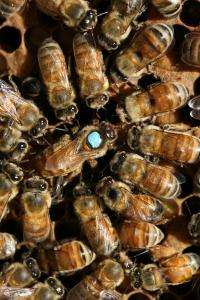
Insulin signaling is key to separating those who would be queen (marked in blue) from workers. Credit: Credit: F. Wolschin and AJ Siegel
What makes a bee grow up to be a queen? Scientists have long pondered this mystery. Now, researchers in the School of Life Sciences at Arizona State University have fit a new piece into the puzzle of bee development. Their work not only adds to understanding about bees, but also adds insights into our own development and aging.
The study, which appeared in the June 30 online edition of Biology Letters, shows that a key protein in the insulin signaling pathway plays a strong role in caste development among bees.
A female bee can become either a worker or a queen. Queen bees are larger and live longer than workers. Queen bees are also fertile while workers are essentially sterile. A queen has only one role—to lay eggs—while workers tend the hive, care for the queen and larvae, and forage for food.
"The incredible thing is that both of these types of female honeybees emerge from the same genome," says Florian Wolschin, an assistant research professor in the School of Life Sciences in ASU's College of Liberal Arts and Sciences, is the lead author of the study. "So how does that happen?"
Workers determine the fate of the larvae by what they feed them. The amount and composition of food that the larvae receive determine whether they become workers or queens. People have known this for many years, but exactly what happens inside the cells to create this split isn't completely clear.
Wolschin, Gro Amdam, an associate professor, and Navdeep S. Mutti, a postdoctoral research associate, found that the insulin signaling pathway plays a role in caste development. Insulin is a hormone found in humans and many other animals, and insulin-like peptides have been discovered in bees. Insulin moves glucose—sugar—from the bloodstream into the body's cells where it can be used.
The researchers suppressed one of the key proteins in this pathway in honeybee larvae. The protein, called the insulin receptor substrate (IRS), has been linked to growth, development and reproduction in mice. The researchers fed the altered larvae a queen's diet, but they developed into workers, not queens.
IRS is only one component of the process that decides a bee's ultimate fate. Wolschin says several other molecules are known to play a role, including DNA methyltransferase, juvenile hormone and a protein called TOR.
"Those are all very important and fundamental mechanisms," says Wolschin. "One single part cannot alone be responsible. It has to be the interplay between different mechanisms that finally results in the divergence of queens and workers."
The researchers are now looking at the interconnections between several of these factors. "We want to see if maybe there's a hierarchy involved. Several of the components are probably 'upstream' of other processes. So they serve as mass regulators and switches," says Wolschin.
Honeybees are vitally important to our economy through pollination of crops as well as production of honey, wax and royal jelly. Understanding bee biology is crucial to maintaining this industry in the face of problems like colony collapse disorder.
Wolschin adds that bees also provide an important model system that can help us understand our own biology. For example, scientists have successfully reversed many signs of aging in worker bees.
"That is pretty unique," says Wolschin. "You don't have other model organisms in aging research that can do that."
More information: Read the full study here
-
Royal jelly makes bee queens, boosts nurture case
Mar 14, 2008 |
not rated yet |
0
-
Bees with an impaired insulin partner gene prefer proteins over carbs
Apr 01, 2010 |
not rated yet |
0
-
The making of a queen: Road to royalty begins early in paper wasps
May 19, 2010 |
not rated yet |
0
-
Bees may transmit viruses to offspring
Jan 19, 2006 |
not rated yet |
0
-
Why do some queen bees eat their worker bee's eggs?
Dec 04, 2006 |
not rated yet |
0
-
Engineers build first sub-10-nm carbon nanotube transistor
Feb 01, 2012 |
4.9 / 5 (30) |
30
-
Something old, something new: Evolution and the structural divergence of duplicate genes
Jan 31, 2012 |
4.6 / 5 (7) |
1
-
The hidden nanoworld of ice crystals: Revealing the dynamic behavior of quasi-liquid layers
Jan 30, 2012 |
5 / 5 (3) |
1
-
Stock market network reveals investor clustering
Jan 27, 2012 |
3.9 / 5 (23) |
8
-
Of microchemistry and molecules: Electronic microfluidic device synthesizes biocompatible probes
Jan 26, 2012 |
5 / 5 (1) |
0
-
Cancer drugs and Alzheimer's, Oh my!
3 hours ago
-
Squishing cells
3 hours ago
-
Any books/articles for evolutionary stable strategy models in humans?
15 hours ago
-
Science behind the bore feeling?
21 hours ago
-
Homo Sapien vs. Chimpanzee - Divergence Timeline
Feb 09, 2012
-
a single mRNA strand is attached to sevaral ribosomes?
Feb 08, 2012
- More from Physics Forums - Biology
More news stories
Ultraviolet protection molecule in plants yields its secrets
Lying around in the sun all day is hazardous not just for humans but also for plants, which have no means of escape. Ultraviolet (UV) radiation from the sun can damage proteins and DNA inside cells, leading ...
11 hours ago |
5 / 5 (5) |
0
|
Deadly bird parasite evolves at exceptionally fast rate
A new study of a devastating bird disease that spread from poultry to house finches in the mid-1990s reveals that the bacteria responsible for the disease evolves at an exceptionally fast rate. What's more, ...
10 hours ago |
5 / 5 (2) |
0
|
Decoding the molecular machine behind E. coli and cholera
Scientists from Queen Mary, University of London have discovered the workings behind some of the bacteria that kill hundreds of thousands every year, possibly paving the way for new antibiotics that could treat infections ...
10 hours ago |
not rated yet |
0
|
Deciding to go left or right: Researchers use device to determine that lower animals can navigate too
For decades, scientists have associated binary decision making opting to go left or right with higher-ranking animals, including humans. A team of Harvard researchers, however, is rewriting that ...
18 hours ago |
not rated yet |
2
|
5-10 percent corn yield jump using erosion-slowing cover crops shown in new study
The most recent annual results from a four-year Iowa State University study on using cover crops between rows of corn reveals that higher yields by as much as 10 percent are possible using the ...
13 hours ago |
not rated yet |
2
'Dark plasmons' transmit energy
Microscopic channels of gold nanoparticles have the ability to transmit electromagnetic energy that starts as light and propagates via "dark plasmons," according to researchers at Rice University.
FDA-approved drug rapidly clears amyloid from the brain, reverses Alzheimer's symptoms in mice
Neuroscientists at Case Western Reserve University School of Medicine have made a dramatic breakthrough in their efforts to find a cure for Alzheimer's disease. The researchers' findings, published in the journal Science, show t ...
Hydrogen from acidic water: Researchers develop potential low cost alternative to platinum for splitting water
A technique for creating a new molecule that structurally and chemically replicates the active part of the widely used industrial catalyst molybdenite has been developed by researchers with the Lawrence Berkeley ...
Soraa LED light may dim 50-watt halogen rivals
(PhysOrg.com) -- Soraa, a Fremont, California company founded in 2008, this week launched its first product, a light that uses LEDS (light emitting diodes). The "Soraa LED MR16 lamp" is the "perfect" replacement ...
Anyone can learn to be more inventive, cognitive researcher says
There will always be a wild and unpredictable quality to creativity and invention, says Anthony McCaffrey, a cognitive psychology researcher at the University of Massachusetts Amherst, because an "Aha moment" is rare and ...
Flexible paper robots
(PhysOrg.com) -- These inexpensive robots can stretch, bend and twist under control, and lift objects up to 120 times their own weight. Being soft, they can apply gentle and even pressure, and adapt to varied ...