Remarkable fossil cave shows how ancient marsupials grew
July 14, 2010 By Bob Beale
Remarkable fossil cave shows how ancient marsupials grew

Enlarge

Image credit: Karen Black

(PhysOrg.com) -- The discovery of a remarkable 15-million-year-old Australian fossil limestone cave packed with even older animal bones has revealed almost the entire life cycle of a large prehistoric marsupial, from ...

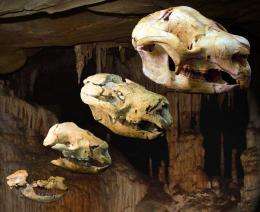
The discovery of a remarkable 15-million-year-old Australian limestone cave packed with even older animal bones has revealed almost the entire life cycle of a large prehistoric marsupial, from suckling young in the pouch still cutting their milk teeth to elderly adults.

In an unprecedented find, a team of UNSW researchers has unearthed from the cave floor hundreds of beautifully preserved fossils of the extinct browsing wombat-like marsupial Nimbadon lavarackorum, along with the remains of galloping kangaroos, primitive bandicoots, a fox-sized thylacine and forest bats.

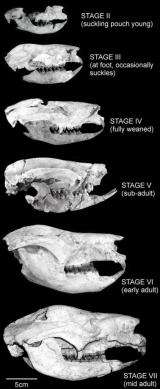
By comparing the skulls of 26 different Nimbadon individuals that died in the cave at varying stages of life the team has been able to show that its babies developed in much the same way as marsupials today, probably being born after only a month's gestation and crawling to the mother's pouch to complete their early development.

Details of the find at a site known as AL90 in the famous Riversleigh World Heritage fossil field in Queensland are published in the , by a team led by Dr Karen Black, of the UNSW School of Biological, Earth and Environmental Sciences. The research was supported by the Xstrata Community Partnership Program North Queensland and the Australian Research Council.

"This is a fantastic and incredibly rare site," says Dr Black. "The exceptional preservation of the fossils has allowed us to piece together the growth and development of Nimbadon from baby to adult. So far 26 skulls - ranging in age from suckling pouch young and juveniles right through to elderly adults - have been recovered, as well as associated skeletons.
Remarkable fossil cave shows how ancient marsupials grew
Enlarge

Image credit: Karen Black

"The animals appear to have plunged to their deaths through a vertical cave entrance that may have been obscured by vegetation and acted as a natural pit-fall trap. These animals - including mothers with pouch young - either unwittingly fell to their deaths or survived the fall only to be entombed and unable to escape.

"The ceiling and walls of the cave were eroded away millions of years ago, but the floor of the cave remains at ground level. We have literally only scratched its surface, with thousands more bones evident at deeper levels in the deposit.'

The site is also scientifically important because it documents a critical time in the evolution of Australia's flora and fauna when lush greenhouse conditions were giving way to a long, slow drying out that fundamentally reshaped the continent's cargo of life as rainforests retreated.

Dr Black notes that the Nimbadon skulls also reveal that early in life, the emphasis of its growth was on the development of bones at the front of the face, to help the baby to suckle from its mother. As it grew older and its diet changed to eating leaves, the rest of the skull developed and grew quite massive by way of a series of bony chambers surrounding the brain.
Cave of marsupial fossils discovered in Outback (AP)
Enlarge

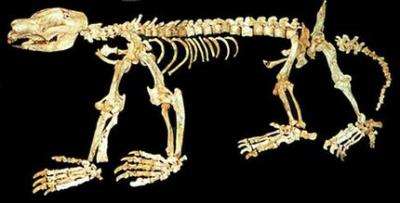
In this undated photo supplied by The University of New South Wales Friday, July 16, 2010, composite skeleton of the sheep-sized extinct, wombat-like marsupial called Nimbadon lavarackorum is pictured in Sydney, Australia. University of New South Wales researchers have unearthed 26 such skulls from a cave in the Riversleigh World Heritage fossil field, 250 km (155 miles) north-west of Mt Isa, Queensland, Australia. The findings were described in an article published this week in the Journal of Vertebrate Paleontology. (The University of New South Wales, Karen Black)

Team member Professor Mike Archer says: "Yet we found that its brain was quite small and stopped growing relatively early in its life. We think it needed a large surface area of skull to provide attachments for all the muscle power it required to chew large quantities of leaves, so its skull features empty areas, or sinus cavities. Roughly translated, this may be the first demonstration of how a growing mammal ‘pays' for the need to eat more greens - by becoming an ‘airhead'.

"The abundance of Nimbadon fossils also suggests that they travelled in family groups or perhaps even larger gatherings: it's possible that this also reflects the beginning of mob behaviour in herbivorous marsupials, such as we see today in grey kangaroos."

Provided by University of New South Wales (news : web)

4.9 /5 (8 votes)  

Filter


Move the slider to adjust rank threshold, so that you can hide some of the comments.


Display comments: newest first

Trim
Jul 15, 2010

Rank: not rated yet
Is there any chance of their DNA being viable? And if so is there any chance of them being resuscitated?
Rank 4.9 /5 (8 votes)
Related Stories
Relevant PhysicsForums posts
  • Mitosis
    created8 hours ago
  • Stem cell question.
    created9 hours ago
  • Protease cleavage
    created16 hours ago
  • Pertubance in a model
    created22 hours ago
  • Cancer drugs and Alzheimer's, Oh my!
    createdFeb 09, 2012
  • Squishing cells
    createdFeb 09, 2012
  • More from Physics Forums - Biology

More news stories

A frank discussion of the power law and linking correlation to causation

(PhysOrg.com) -- Michael Stumpf a mathematics professor at Imperial College in London, and Mason Porter a lecturer at Oxford have teamed together to write and publish a perspective piece in Science regarding the in ...

Other Sciences / Mathematics

created 22 hours ago | popularity 5 / 5 (4) | comments 8 | with audio podcast report

Employers feel no love for unscrupulous practice of 'service sweethearting'

A new study led by two Florida State University marketing professors finds that some frontline service employees who are rewarded for hikes in customer loyalty and satisfaction also may engage in "service ...

Other Sciences / Economics & Business

created 16 hours ago | popularity 4 / 5 (1) | comments 7

The question of life in the ancient world

There’s a general feeling that we don’t get the Greeks – ancient or modern. Many, including heads of state like Angela Merkel, visibly shake their head in exasperation, rightly or wrongly, at ...

Other Sciences / Archaeology & Fossils

created 22 hours ago | popularity 1.3 / 5 (3) | comments 4

Sonic Cradle lands spot in TED exhibition

A Simon Fraser University graduate student project that melds music, meditation and modern technology has landed a rare spot as an exhibit at TEDActive 2012 in Palm Springs, California this month.

Other Sciences / Other

created 18 hours ago | popularity not rated yet | comments 0

US workers are 'giving away the store,' costing firms billions

Nearly 70 percent of the nation's service employees give away free goods and services – from hamburgers to cable TV – costing companies billions of dollars a year, according to a groundbreaking study.

Other Sciences / Economics & Business

created Feb 09, 2012 | popularity 3.3 / 5 (3) | comments 10


Anonymous knocks CIA website offline (Update)

The website of the Central Intelligence Agency was inaccessible on Friday after the hacker group Anonymous claimed to have knocked it offline.

New error-correcting codes guarantee the fastest possible rate of data transmission

Error-correcting codes are one of the triumphs of the digital age. They’re a way of encoding information so that it can be transmitted across a communication channel — such as an optical fiber o ...

Small modular reactor design could be a 'SUPERSTAR'

(PhysOrg.com) -- Though most of today's nuclear reactors are cooled by water, we've long known that there are alternatives; in fact, the world's first nuclear-powered electricity in 1951 came from a reactor ...

New power source discovered

(PhysOrg.com) -- Researchers at the Massachusetts Institute of Technology (MIT) and RMIT University have made a breakthrough in energy storage and power generation.

The power of estrogen -- male snakes attract other males

A new study has shown that boosting the estrogen levels of male garter snakes causes them to secrete the same pheromones that females use to attract suitors, and turned the males into just about the sexiest ...

Advanced power-grid model finds low-cost, low-carbon future in West

(PhysOrg.com) -- The least expensive way for the Western U.S. to reduce greenhouse gas emissions enough to help prevent the worst consequences of global warming is to replace coal with renewable and other ...