Microbial protein restores vision in blind animals
July 14, 2010
Microbial protein restores vision in blind animals

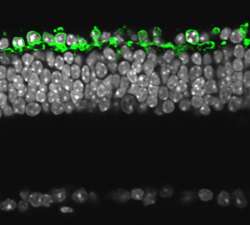
Cross section of a degenerated Retinitis pigmentosa retina. The archaebacterial halorhodopsin is produced in the remaining cone photoreceptor cells (green). Only one row of photoreceptor cells is left. In white the nuclear layers of the retina.

(PhysOrg.com) -- Scientists from the Friedrich Miescher Institute for Biomedical Research (FMI) restore vision in retinitis pigmentosa using an archaebacterial protein. Introducing halorhodopsin into the remaining but nonfunctional cone photoreceptors of the retina of mice not only reactivates the cone cells' ability to interact with the rest of the visual system, it also prompts sophisticating visually guided behavior.

With their collaborators in the Vision Institute of Paris, the scientists were able to validate their results in light-insensitive human retinas in vitro, which were able to respond to light again after treatment. These groundbreaking results were published today in the journal Science.

Retinitis pigmentosa is a diverse group of hereditary diseases that lead to incurable blindness and affect two million people worldwide. Despite the diversity of its cause, the manifestation of the disease is similar: the highly sensitive rod photoreceptors, which allow us to see in the dusk, die. Intriguingly, the cones that operate during daylight and are responsible for high-resolution survive longer, though they gradually lose their function. However, it was unknown if these persisting photoreceptors would be accessible for .

Neurobiologists from Botond Roska's group at the Friedrich Miescher Institute for Biomedical Research, which is part of the Novartis Research Foundation, now have devised a gene therapeutic method to restore the functionality of the cone cells in models of retinitis pigmentosa. In a groundbreaking approach they used a light-sensitive protein called halorhodopsin from archaebacteria to re-establish vision.

In their work, featured today in the reknown journal Science, they were not only able to specifically produce halorhodopsin in the dormant cone cells of mice with retinitis pigmentosa, but they could also show that the cones were able to interact with the rest of the visual system. The existing network of cells was able to reproduce many of the functions of the complicated cascade of molecular events that turn a unit of light into a neuronal signal. What is more, behavioral tests indicated that the retinal information was used for visually guided behavior. The remaining cone cells are therefore an optimal target for gene-therapeutic intervention in disease where photoreceptor function is lost.

As a first step to translate these findings to patients, together with their collaborators from the Vision Institute of Paris, the FMI group introduced the archaebacterial halorhodopsin into nonfunctional human . And these treated cones in isolated human retinas started to respond to light.

"We believe that with our gene therapeutic method we have found a powerful approach that could eventually help a subset of patients. Our colleagues in Paris are screening patients to determine who may benefit most from this approach," comments Botond Roska.

More information: Busskamp V, Duebel J, Balya D, Fradot M, Viney JT, Siegert S, Groner AC, Cabuy E, Forster V, Seeliger M, Biel M, Humphries P, Paques M, Mohand-Said S, Trono D, Deisseroth K, Sahel JA, Picaud S, Roska B.(2010) Genetic Reactivation of Cone Photoreceptors Restores Visual Responses in Retinitis Pigmentosa. Science, DOI:10.1126/science.1190897

Provided by Friedrich Miescher Institute for Biomedical Research


Rank 5 /5 (8 votes)
Related Stories
Relevant PhysicsForums posts
  • "The end of diseases" by David Agus, interview from Daily Show with Jon Stewart
    createdFeb 04, 2012
  • Oncolytic adenovirus
    createdFeb 04, 2012
  • Nutrition label stuffs and diets
    createdFeb 02, 2012
  • Lowe syndrom genetic test
    createdFeb 02, 2012
  • Bill Doyle: Treating cancer with electric fields
    createdFeb 01, 2012
  • Colonoscopy - which drugs are better?
    createdJan 31, 2012
  • More from Physics Forums - Medical Sciences

More news stories

New findings highlight the benefit of exercise ECGs just as they are being scrapped

In the UK, the exercise electrocardiogram (ECG) is the most common initial test for the evaluation of stable chest pain and has been used widely for almost half a century. However, recent NICE guidelines recommend that it ...

Medicine & Health / Cardiology

created 52 minutes ago | popularity not rated yet | comments 0

Long-term study shows epilepsy surgery improves seizure control and quality of life

While epilepsy surgery is a safe and effective intervention for seizure control, medical therapy remains the more prominent treatment option for those with epilepsy. However, a new 26-year study reveals that following epilepsy ...

Medicine & Health / Diseases

created 1 hour ago | popularity not rated yet | comments 0

Research suggests use of LE strips to diagnose PJI

Rothman Institute at Jefferson joint researchers continue to seek better ways to diagnose and subsequently treat periprosthetic joint infection (PJI) in patients following total joint arthroplasty. Their latest research shows ...

Medicine & Health / Diseases

created 30 minutes ago | popularity not rated yet | comments 0

EASL publishes first European Clinical Practice Guidelines for Wilson's disease

Geneva, Switzerland: The first European Clinical Practice Guidelines (CPGs) for the diagnosis and management of Wilson's disease are published today by the European Association for the Study of the Liver (EASL) on the EASL ...

Medicine & Health / Diseases

created 10 minutes ago | popularity not rated yet | comments 0

Obama to seek more Alzheimer's research money

(AP) -- The Obama administration wants to spend just over half a billion dollars on Alzheimer's research next year, hoping to battle back against what could become the defining disease of the aging baby-boom generation.

Medicine & Health / Diseases

created 41 minutes ago | popularity not rated yet | comments 0


Our Amorphophallus is smaller: New plant species from Madagascar smells like roadkill

The famed "corpse flower" plant – known for its giant size, rotten-meat odor and phallic shape – has a new, smaller relative: A University of Utah botanist discovered a new species of Amorphophallus that i ...

Invasive alien predator causes rapid declines of European ladybirds

A new study provides compelling evidence that the arrival of the invasive non-native harlequin ladybird to mainland Europe and subsequent spread has led to a rapid decline in historically-widespread species ...

Counties with thriving small businesses have healthier residents, researchers find

Counties and parishes with a greater concentration of small, locally-owned businesses have healthier populations — with lower rates of mortality, obesity and diabetes — than do those that rely on large companies ...

Looking for work? There may be an app for that

(AP) -- Looking for a promising career in a lousy economy? A new study suggests you're apt to find it in apps - the services and tools built to run on smartphones, computer tablets and Facebook's online social network.

Firm claims Apple infringing trademark in China

A Taiwan-linked company which claims ownership of the iPad trademark in China has filed lawsuits and lodged complaints against Apple for infringement, according to a lawyer.

New DVT guidelines: No evidence to support 'economy class syndrome'

New evidence-based guidelines from the American College of Chest Physicians (ACCP) address the many risk factors for developing a deep vein thrombosis (DVT), or blood clot, as the result of long-distance travel. These risk ...