A Puzzling Collapse of Earth's Upper Atmosphere
July 15, 2010 by Dr. Tony Phillips
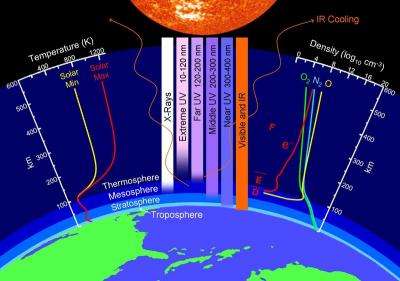
Layers of Earth's upper atmosphere. Credit: John Emmert/NRL.
NASA-funded researchers are monitoring a big event in our planet's atmosphere. High above Earth's surface where the atmosphere meets space, a rarefied layer of gas called "the thermosphere" recently collapsed and now is rebounding again.
"This is the biggest contraction of the thermosphere in at least 43 years," says John Emmert of the Naval Research Lab, lead author of a paper announcing the finding in the June 19th issue of the Geophysical Research Letters (GRL). "It's a Space Age record."
The collapse happened during the deep solar minimum of 2008-2009—a fact which comes as little surprise to researchers. The thermosphere always cools and contracts when solar activity is low. In this case, however, the magnitude of the collapse was two to three times greater than low solar activity could explain.
"Something is going on that we do not understand," says Emmert.
The thermosphere ranges in altitude from 90 km to 600+ km. It is a realm of meteors, auroras and satellites, which skim through the thermosphere as they circle Earth. It is also where solar radiation makes first contact with our planet. The thermosphere intercepts extreme ultraviolet (EUV) photons from the sun before they can reach the ground. When solar activity is high, solar EUV warms the thermosphere, causing it to puff up like a marshmallow held over a camp fire. (This heating can raise temperatures as high as 1400 K—hence the name thermosphere.) When solar activity is low, the opposite happens.
Lately, solar activity has been very low. In 2008 and 2009, the sun plunged into a century-class solar minimum. Sunspots were scarce, solar flares almost non-existent, and solar EUV radiation was at a low ebb. Researchers immediately turned their attention to the thermosphere to see what would happen.
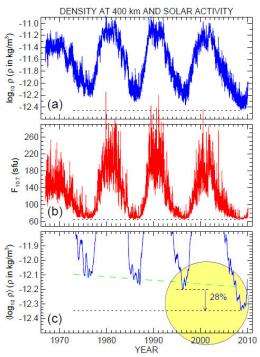
These plots show how the density of the thermosphere (at a fiducial height of 400 km) has waxed and waned during the past four solar cycles. Frames (a) and (b) are density; frame (b) is the sun's radio intensity at a wavelength of 10.7 cm, a key indicator of solar activity. Note the yellow circled region. In 2008 and 2009, the density of the thermosphere was 28% lower than expectations set by previous solar minima. Credit: Emmert et al. (2010), Geophys. Res. Lett., 37, L12102.
How do you know what's happening all the way up in the thermosphere?
Emmert uses a clever technique: Because satellites feel aerodynamic drag when they move through the thermosphere, it is possible to monitor conditions there by watching satellites decay. He analyzed the decay rates of more than 5000 satellites ranging in altitude between 200 and 600 km and ranging in time between 1967 and 2010. This provided a unique space-time sampling of thermospheric density, temperature, and pressure covering almost the entire Space Age. In this way he discovered that the thermospheric collapse of 2008-2009 was not only bigger than any previous collapse, but also bigger than the sun alone could explain.
One possible explanation is carbon dioxide (CO2).
When carbon dioxide gets into the thermosphere, it acts as a coolant, shedding heat via infrared radiation. It is widely-known that CO2 levels have been increasing in Earth's atmosphere. Extra CO2 in the thermosphere could have magnified the cooling action of solar minimum.
"But the numbers don't quite add up," says Emmert. "Even when we take CO2 into account using our best understanding of how it operates as a coolant, we cannot fully explain the thermosphere's collapse."
This video is not supported by your browser at this time.
An NCAR video shows how carbon dioxide warms the lower atmosphere, but cools the upper atmosphere.
According to Emmert and colleagues, low solar EUV accounts for about 30% of the collapse. Extra CO2 accounts for at least another 10%. That leaves as much as 60% unaccounted for.In their GRL paper, the authors acknowledge that the situation is complicated. There's more to it than just solar EUV and terrestrial CO2. For instance, trends in global climate could alter the composition of the thermosphere, changing its thermal properties and the way it responds to external stimuli. The overall sensitivity of the thermosphere to solar radiation could actually be increasing.
"The density anomalies," they wrote, "may signify that an as-yet-unidentified climatological tipping point involving energy balance and chemistry feedbacks has been reached."
Or not.
Important clues may be found in the way the thermosphere rebounds. Solar minimum is now coming to an end, EUV radiation is on the rise, and the thermosphere is puffing up again. Exactly how the recovery proceeds could unravel the contributions of solar vs. terrestrial sources.
"We will continue to monitor the situation," says Emmert.
More information: Emmert, J. T., J. L. Lean, and J. M. Picone (2010), Record-low thermospheric density during the 2008 solar minimum, Geophys. Res. Lett., 37, L12102.
Source: Science@NASA
-
Climate change affecting Earth's outermost atmosphere
Dec 11, 2006 |
not rated yet |
0
-
Breathing cycles in Earth's upper atmosphere tied to solar wind disturbances
Dec 15, 2008 |
not rated yet |
0
-
Team Observes Record-Low Densities in Upper Atmosphere
Jun 21, 2010 |
not rated yet |
0
-
EVE: Measuring the Sun's hidden variability
Sep 22, 2009 |
not rated yet |
0
-
The Sun's Sneaky Variability
Oct 28, 2009 |
not rated yet |
0
-
Engineers build first sub-10-nm carbon nanotube transistor
Feb 01, 2012 |
4.9 / 5 (30) |
30
-
Something old, something new: Evolution and the structural divergence of duplicate genes
Jan 31, 2012 |
4.6 / 5 (7) |
1
-
The hidden nanoworld of ice crystals: Revealing the dynamic behavior of quasi-liquid layers
Jan 30, 2012 |
5 / 5 (3) |
1
-
Stock market network reveals investor clustering
Jan 27, 2012 |
3.9 / 5 (23) |
8
-
Of microchemistry and molecules: Electronic microfluidic device synthesizes biocompatible probes
Jan 26, 2012 |
5 / 5 (1) |
0
-
Discrepancy between oxygen and carbon-dioxide levels
15 hours ago
-
where gems are found in the world
18 hours ago
-
Wind Waves in Reservoir ~ Wind run-up and Wind set-up
Feb 08, 2012
-
Balance of oxygen in the atmosphere
Feb 01, 2012
-
The case for a methanol-based economy
Jan 30, 2012
-
Weather in a rotating cylinder
Jan 25, 2012
- More from Physics Forums - Earth
More news stories
Could Venus be shifting gear?
(PhysOrg.com) -- ESAs Venus Express spacecraft has discovered that our cloud-covered neighbour spins a little slower than previously measured. Peering through the dense atmosphere in the infrared, the ...
Space & Earth / Space Exploration
3 hours ago |
5 / 5 (4) |
4
|
Humans may have helped the decline of African rainforests 3000 years ago
(PhysOrg.com) -- Large areas of rainforests in Central Africa mysteriously disappeared over three thousand years ago, to be replaced by savannas. The prevailing theory has been that the cause was a change ...
Clam fields found at deep, low-temperature Mariana vents
(PhysOrg.com) -- Scientists have marveled at the unusual life forms thriving at high temperature hydrothermal vents of the deep ocean.
Space & Earth / Earth Sciences
4 hours ago |
not rated yet |
0
|
Mars Science Laboratory computer issue resolved
(PhysOrg.com) -- Engineers have found the root cause of a computer reset that occurred two months ago on NASA's Mars Science Laboratory and have determined how to correct it.
Space & Earth / Space Exploration
4 hours ago |
5 / 5 (5) |
2
|
Two new moons for Jupiter
Advances in technology have lead to the discovery of new planets outside of our Solar System, and now even new moons in our own backyard.
Space & Earth / Space Exploration
3 hours ago |
not rated yet |
2
New understanding of DNA repair could eventually lead to cancer therapy
A research group in the Faculty of Medicine & Dentistry at the University of Alberta is hoping its latest discovery could one day be used to develop new therapies that target certain types of cancers.
Hovering not hard if you're top-heavy, researchers find
Top-heavy structures are more likely to maintain their balance while hovering in the air than are those that bear a lower center of gravity, researchers at New York University's Courant Institute of Mathematical Sciences ...
Grass to gas: Researchers' genome map speeds biofuel development
Researchers at the University of Georgia have taken a major step in the ongoing effort to find sources of cleaner, renewable energy by mapping the genomes of two originator cells of Miscanthus x giganteus, a large perenn ...
Night, weekend delivery OK for babies with birth defects
Weekday delivery is no better than night or weekend delivery for infants with birth defects, according to a new study presented today at The Pregnancy Meeting, the Society for Maternal-Fetal Medicine's annual conference. ...
Sonic Cradle lands spot in TED exhibition
A Simon Fraser University graduate student project that melds music, meditation and modern technology has landed a rare spot as an exhibit at TEDActive 2012 in Palm Springs, California this month.
Drug halts organ damage in inflammatory genetic disorder
A new study shows that Kineret (anakinra), a medication approved for the treatment of rheumatoid arthritis, is effective in stopping the progression of organ damage in people with neonatal-onset multisystem inflammatory disease ...

Jul 15, 2010
Rank: 2 / 5 (16)
Jul 15, 2010
Rank: 1.9 / 5 (16)
Jul 15, 2010
Rank: 4.8 / 5 (18)
It's actually quite simple. CO2 is well studied in the lab, so it is possible to say that at X concentration and Y temperature, the CO2 should radiate Z amount of heat into space. Similarly, it is easy to measure the amount of EUV absorption and compare it to the decrease of EUV in the last solar cycle. The amount CO2 radiates, plus the expected decrease from low solar radiation adds up to a number. Compare that number to the observed temperature and find that they do not match. Therefore, you can conclude that there are things at work you have not identified.
It's called science. No problem is ever known fully, and if it is, it's no longer science.
Jul 15, 2010
Rank: 4.9 / 5 (8)
Jul 15, 2010
Rank: 5 / 5 (1)
Jul 16, 2010
Rank: 1.4 / 5 (5)
Jul 16, 2010
Rank: 2.1 / 5 (7)
Jul 16, 2010
Rank: 4.6 / 5 (10)
Jul 16, 2010
Rank: 1.4 / 5 (10)
Jul 16, 2010
Rank: 4.6 / 5 (8)
But this is not outer space, we are talking about low Earth orbit. It is not complete vacuum, because otherwise satelites, shuttles and even ISS would not decay. It is a long-known fact.
Jul 16, 2010
Rank: 4.9 / 5 (7)
Jul 16, 2010
Rank: 2.3 / 5 (9)
Unfortunately for us taxpayers this is common NASA fare.
Jul 16, 2010
Rank: 4.5 / 5 (4)
Welcome to the wonderful world of science nice of you to join us. Unfortunatly for US Taxpayers NASA is one of the least funded highly important government agencies in the United states, taking only 00.6 to 00.8 percent of the government budget... ouch my wallet. Honestly there are a lot worst government programs out there your money IS going to at least nasa actually has an impact on our future.
Jul 16, 2010
Rank: 2.6 / 5 (5)
That's from wiki. Small periodic fluctuations in tidal forces could account for a portion of the missing 60%. A quick google search gave me several explanations, including the magnetic field mentioned above. If they are experts and they still have no idea of a possible cause, then I'm speechless.
Jul 16, 2010
Rank: 1.4 / 5 (5)
Just some stuff I heard, seen some shows on it. Seemed relevant.
Jul 17, 2010
Rank: 1 / 5 (5)
when is this debacle going to end...omg
i need c02 so my veggies grow big and strong in the vegetable garden.
maybe we should start to collect c02 and store it underground for future use...when everyone has stopped producing it(c02)and there is no trace of it being in the air that we breath and all our plants and bee's are dieing off we will have enough stored c02 to send back into the atmosphere for my veggie garden to grow...lol..for published scientific literature on what i say go read your high school environmental studies text book or google it and then go up to a dandelion and breath heavily on it for me please cus that may be the only thing we will have left to eat in the near future.
Jul 18, 2010
Rank: 3 / 5 (2)
Oh, wow. So once something becomes fact it is no longer subject to scientific principles?
Shaking my head: American science really is in the crapper, isn't it?
Jul 18, 2010
Rank: 4.7 / 5 (3)
First, you can't mass control minds with EM waves. Animal nervous systems are composed of electrochemical biomatter, which does not react to magnetic waves the way that metallic conductors do. The way this works is that when a magnetic wave travels through a metallic conductor, it creates an electrical charge. It's the reason why EMP (electro-magnetic pulse) weapons won't disable people or animals, but will disable unhardened electrical systems. Humans just don't have enough metal.
Second, the amount of energy required to do this isn't human generatable. Output of the entire world's grid wouldn't be enough.
It's as relevant as the size of my genitalia.
Jul 18, 2010
Rank: 1 / 5 (6)
Sorry folks, but the world has already learned that research scientists are the highly paid welfare queens of new millenium. They beg for money, and realize they only get it when they pull a chicken little and claim disaster.
Expect more "woe calamity unless you pay me" papers like this as governmental discretionary spending dries up and these mendicant scientists do all they can to avoid getting a real job.
Sorry, Cassandras. We know what drives research science now, and it's certainly not science or the pursuit of the truth. Left-wing ideology and high-salary beggary.
Jul 18, 2010
Rank: 1.8 / 5 (5)
After all, such process occurs every morning and evening, when it manifests itself by interferences of long radiowave signals.
http://twistedphy...0c-500wi
Jul 18, 2010
Rank: 1 / 5 (1)
I guess I don't know enough chemistry to understand this statement. Why would CO2 act as a coolant in the thermosphere, but act as a greenhouse gas in the lower atmosphere? I realize there's a significant difference in density, but that doesn't quite explain it.
Jul 18, 2010
Rank: 1.3 / 5 (4)
Jul 18, 2010
Rank: 2.8 / 5 (4)
Heat is not 'reflected' like a mirror. Heat is transferred via photons or phonons.
Jul 18, 2010
Rank: 1.8 / 5 (6)
Well, another expert... And these photons cannot be reflected (i.e. absorbed and re-emitted in preferred direction)?
BTW Mirror is not "reflected" anyway, it's reflecting instead.
http://upload.wik....svg.png
Jul 18, 2010
Rank: 5 / 5 (2)
Well done...lol..That just about sums it up err.. except for one tiny thing, you forgot to add the word "Anti" in front of global in your
first sentence, which makes your statement to this topic irrelevant. Yet relevant about deniers of global warming.
Preaching irrelevancy did not stop us from looking and seeing first hand what man made emissions has done to nature, the result is right in front of us here and now!
Jul 18, 2010
Rank: 5 / 5 (2)
You Preaching irrelevancy in your statement above did not stop us from looking and seeing first hand what man made emissions has done to nature, the result is right in front of us here and now!
Jul 18, 2010
Rank: 1.8 / 5 (5)
As to the relevance of CO2: CO2 accounts for 8-26% of heat trapped by the atmosphere. The rest is mostly absorbed by water vapor. The current estimate of CO2 in the atmosphere is 382 parts per million I think I recall. Of that, only 1/4 to 1/3 is human-made according to most sources. If you combine those two numbers then human contribution to warming is between 2% and 8.6% of total. If the average temperature is rising by 1/10th of a degree per year, then human CO2 causes between .002 and .0086 degrees rise in temp per year. Reducing human CO2 by 50% (impossible) would result in an improvement beyond our ability to measure.
That is irrelevant.
Jul 18, 2010
Rank: 1.8 / 5 (5)
Jul 18, 2010
Rank: 2.9 / 5 (7)
Jul 19, 2010
Rank: 1.8 / 5 (5)
The natural CO2 accounts for most of the temp increase. The human portion of CO2 is miniscule compared to all the other factors here. Water vapor makes CO2 look like a candle compared to the sun in regard to IR absorbtion. Look it up and sight sources if you dispute that fact. I have sighted sorces in other posts regarding this topic. Heck, just google it.
Jul 19, 2010
Rank: 1.6 / 5 (5)
Jul 19, 2010
Rank: 1.8 / 5 (4)
Jul 19, 2010
Rank: 2.3 / 5 (4)
I am so sorry genetics left you with the short end of the stick!
Jul 19, 2010
Rank: 3 / 5 (2)
get a life Eric, your comment is irrelevant here and only makes you look stupider than you already are. if you have nothing relevant or interesting to comment about then shut it!
Jul 19, 2010
Rank: 3.2 / 5 (5)
Except you're going the wrong way with this.
An increase in CO2 will show diminishing returns only in what it completely absorbs and redirects back to the point of origin. That isn't what we're looking at.
The relevence is the delay in escape of IR, not the total capture or perpetual delay. Any increase in CO2 will increase this delay by a relative amount that follows a linear scale.
Jul 19, 2010
Rank: 1 / 5 (4)
But the source, the sun, is essentially fixed on input.
If what you say is true, the dry deserts should be warming at night with increasing CO2.
Jul 19, 2010
Rank: 3.7 / 5 (3)
If you only count CO2, they are. Marjon, pour out a glass of water. Now pour out another glass, same volume, and put a lid, with a hole, on it. The input hasn't changed (the volume of water) but the time it takes for said amount of water to leave the glass increases. Now shrink the hole, but never remove it entirely, you'll find there's a relationship between the size of the hole and the amount of time it takes for the water molecules to exit the glass/lid arrangement. The source of the IR we're talking about is the Earth, not the Sun. Secondly, the sun is far from static.
This is analogus to the escape of IR from the earth through the atmosphere.
Jul 20, 2010
Rank: 1 / 5 (4)
Jul 20, 2010
Rank: 4.3 / 5 (6)
When your calendar runs out do you assume the world is going to end or do you get a new calendar?
Jul 20, 2010
Rank: 2.3 / 5 (3)
As for calenders, well, Y2K didn't see the end of our civilization, nor did the Hale-Bopp comet. In the early 80's I remember some religions stating that a rare alignment of the planets was going to end the world. Well, the world is still here. "It" may happen some day, but not because some ancient calander runs out. Perhaps they just didn't need a calendar that outlasts them.
Jul 21, 2010
Rank: not rated yet
The article does not have the funding to answer the phenomenom witnessed-- we cannot directly measure the thermosphere in data sets to get to a better result not because we don't have the instruments or knowledge it is because of money. And so the equation for knowing the difference in carbon dioxide concentratrions in ratio to the solar minimum/solar radiation from sphere to sphere is? Direct measurements.
Jul 22, 2010
Rank: 3.7 / 5 (3)
Well, G- you should, by now, be aware of where and why we disagree on this issue, as I've explicitly stated before. However, rather than go into again in depth, I'll point out Skeptic's rebuttal of your Thermosperic CO2 heat loss conundrum, and to VestaR's comment, I'll just add the additional CO2 burden added to the system through historic deforestation(and man-made carrying capacity changes for CO2 in general), which equates to some TRILLIONS of CO2 dumped into the environment through human activity. Of course, some of that goes into the ocean CO2 sink, but as the oceans heat up, that CO2 is outgassed. The radiative forcing caused by CO2 is unremittent.
Jul 22, 2010
Rank: not rated yet
the world will be here - the choice is transition so we can
Jul 26, 2010
Rank: 1 / 5 (3)
Jul 26, 2010
Rank: 1 / 5 (2)