Cambridgeshire Quarry throws up 4,500-year-old find
July 16, 2010
Cambridgeshire Quarry throws up 4,500-year-old find

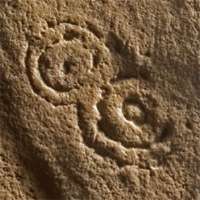
 (PhysOrg.com) -- A remarkable piece of Neolithic rock art, unlike anything previously found in Eastern England, has been unearthed in the Cambridgeshire village of Over.

The hand-sized , which could date back to 2,500 BC, was found by a participant in a geological weekend course which was being run by the University of Cambridge's Institute for Continuing Education.

It consists of a hand-sized slab of weathered with two pairs of concentric circles etched into the surface - a motif which, according to , is typical of "Grooved Ware" art from the later Neolithic era.

While examples of similar Grooved Ware art have been discovered at sites elsewhere in the UK, this is the first time that any such find has been encountered in Eastern England, which may provide more information about the connections of the communities who inhabited the area 4,500 years ago.

The motives of whoever created the design are unclear. Researchers say that it could represent the ornamental efforts of a Prehistoric Picasso, but may just as easily have been an aimless inscription.

"It really is a fantastic find; certainly we have had nothing like it from any of our sites before," Dr. Chris Evans, Director of the Cambridge Archaeological Unit, which operates out of the Department of Archaeology at the University of Cambridge, said.

"In fact, it's unique in Eastern England, with the nearest comparable example being the similar scratch patterns on a sandstone plaque from a Grooved Ware site in Leicestershire. Otherwise you would have to look to Wessex or Northern Britain and the much more formal Megalithic Art of the period."

"The big question in the case of the Over stone is whether we should actually be calling it meaningful art, or if it amounted to no more than Neolithic doodling. Either way it's a great find."

The stone will make its first public appearance since the discovery was made this Saturday (July 17th), when it will go on display at Over Village Carnival.

It was found by Susie Sinclair, who was taking part in the weekend course led by Dr Peter Sheldon (from the Department of Earth and Environmental Sciences, The Open University) at Hanson Aggregates' Needingworth Quarry. The quarry lies north and west of Over alongside the River Great Ouse.

The Cambridge Archaeological Unit has been excavating sites within the quarry for 15 years, partly in an effort to better understand the shape and nature of the landscape in prehistoric times. The remains of several settlement clusters from the late Neolithic period have already been found.

The Over stone, however, was hidden in the quarry's spoil, one of the heaps of waste geological materials discarded by quarry workers. Researchers believe it had been deposited within one of the river's ancient palaeochannels crossing the area and that, with the existing information they have about the geographical layout of the region, the point where it was found can be reconstructed with relative ease.

The area around Over and the River Great Ouse would have looked dramatically different 4,500 years ago. Huge, "S" shaped bends from the river originally meandered across the fens and efforts to tame them only really began in earnest in the late medieval period.

According to the latest research, at the time the Over stone was being carved, the countryside would have been dominated by the snaking course of the river, its tributary channels and flooding. This would essentially have broken the area up into a delta-like landscape of small islands, channels and marshlands.

More information: Further information about the Cambridge Archaeological Unit and its work in the area can be found at: http://www-cau.arch.cam.ac.uk/

Provided by University of Cambridge (news : web)

4.5 /5 (17 votes)  

Filter


Move the slider to adjust rank threshold, so that you can hide some of the comments.


Display comments: newest first

panorama
Jul 16, 2010

Rank: not rated yet
The stone will make its first public appearance since the discovery was made this Saturday (July 17th), when it will go on display at Over Village Carnival.

Did anyone else read this as if the stone was discovered in the future?
GSwift7
Jul 16, 2010

Rank: not rated yet
"been unearthed in the Cambridgeshire village of Over"

It would have made a better caption if they had said "..unearthed in Cambriedgeshire under Over"
GaryB
Jul 16, 2010

Rank: not rated yet
The stone will make its first public appearance since the discovery was made this Saturday (July 17th), when it will go on display at Over Village Carnival.

Did anyone else read this as if the stone was discovered in the future?


The grammar is correct. Archeology is getting so good today that they can predict when someone will find something and what it will look like several days in advance.
WriterSP
Jul 16, 2010

Rank: 5 / 5 (1)
One thing that always troubles me about researchers'speculations concerning carved stone artifacts is the off-hand way that the carver's effort is often suggested to be possibly just "doodling" or "scribbling"; it takes some serious, intentional effort to carve stone. It is vastly more labor-intensive than smearing ochre on a wall (no slight intended to those artists). I would venture to propose, as a rule-of-thumb, that any stone carving must have some significance and meaning, something of import lying within those etched markings that the carver believed needed to be preserved and passed down for others. Opinions?
scidog
Jul 16, 2010

Rank: 5 / 5 (1)
writer--i was thinking that also,the circles look like part and counter part.i would like to see some sort of computer work done on the image so we can get an idea of what it looked like when it was made and if possible what is up and down,left and right.
Nartoon
Jul 16, 2010

Rank: 2 / 5 (1)
WriterSP said "it takes some serious, intentional effort to carve stone." Sandstone is very soft and could be carved with a stone or stick after a relatively short time.
Husky
Jul 17, 2010

Rank: not rated yet
neolithic hooters written in stone an i am not attempting a cheap joke, because they've found venus figurines, such as the Venus of Hohle Fels dating back 35000 years, wich emphasizes the fertility of a woman by their oversized breasts and genitalia
scidog
Jul 17, 2010

Rank: not rated yet
hail stones?..just a few minutes ago we had some nasty weather around Minneapolis and the TV had viewer sent photos of the huge hail stones picked up..the look just like that,flat discs with a center knob.i would think our carver found huge hunks of ice from the sky and did a carving like we do cell phone photos.
Rank 4.5 /5 (17 votes)
Related Stories
Relevant PhysicsForums posts
  • Protease cleavage
    created5 hours ago
  • Pertubance in a model
    created11 hours ago
  • Cancer drugs and Alzheimer's, Oh my!
    created19 hours ago
  • Squishing cells
    created20 hours ago
  • Any books/articles for evolutionary stable strategy models in humans?
    createdFeb 09, 2012
  • Science behind the bore feeling?
    createdFeb 09, 2012
  • More from Physics Forums - Biology

More news stories

Employers feel no love for unscrupulous practice of 'service sweethearting'

A new study led by two Florida State University marketing professors finds that some frontline service employees who are rewarded for hikes in customer loyalty and satisfaction also may engage in "service ...

Other Sciences / Economics & Business

created 5 hours ago | popularity 4 / 5 (1) | comments 4

A frank discussion of the power law and linking correlation to causation

(PhysOrg.com) -- Michael Stumpf a mathematics professor at Imperial College in London, and Mason Porter a lecturer at Oxford have teamed together to write and publish a perspective piece in Science regarding the in ...

Other Sciences / Mathematics

created 11 hours ago | popularity 5 / 5 (2) | comments 2 | with audio podcast report

The question of life in the ancient world

There’s a general feeling that we don’t get the Greeks – ancient or modern. Many, including heads of state like Angela Merkel, visibly shake their head in exasperation, rightly or wrongly, at ...

Other Sciences / Archaeology & Fossils

created 11 hours ago | popularity 1 / 5 (1) | comments 4

Sonic Cradle lands spot in TED exhibition

A Simon Fraser University graduate student project that melds music, meditation and modern technology has landed a rare spot as an exhibit at TEDActive 2012 in Palm Springs, California this month.

Other Sciences / Other

created 7 hours ago | popularity not rated yet | comments 0

Chilean miners' rescue capsule on show in London

The capsule used to rescue Chilean miners trapped underground for two months goes on display Saturday at the Science Museum in London -- the first time it has been seen in Europe.

Other Sciences / Other

created 10 hours ago | popularity not rated yet | comments 0


Google users warned of threat to smartphone wallets

Users of Google smartphone wallets were being warned on Friday that there is a way to crack pass codes intended to thwart thieves from going on illicit shopping sprees.

Anonymous knocks CIA website offline (Update)

The website of the Central Intelligence Agency was inaccessible on Friday after the hacker group Anonymous claimed to have knocked it offline.

Complex wiring of the nervous system may rely on a just a handful of genes and proteins

Researchers at the Salk Institute have discovered a startling feature of early brain development that helps to explain how complex neuron wiring patterns are programmed using just a handful of critical genes. ...

NASA sees wide-eyed cyclone Jasmine

Cyclone Jasmine's eye has opened wider on NASA satellite imagery, as it moves through the Southern Pacific Ocean.

NASA sees Giovanna reach cyclone strength, threaten Madagascar

Tropical Storm 12S built up steam and became a cyclone on February 10, 2012 as NASA's Terra satellite passed overhead. Residents of east-central Madagascar should prepare for this cyclone to make landfall ...

Putting the squeeze on planets outside our solar system

(PhysOrg.com) -- Using high-powered lasers, scientists at Lawrence Livermore National Laboratory and collaborators discovered that molten magnesium silicate undergoes a phase change in the liquid state, abruptly ...