Chemists grow crystals with a twist -- and untwist
July 16, 2010
NYU and St. Petersburg State University chemists have discovered a wholly new phenomenon for crystal growth—a crystal that continually changes its shape as it grows.
(PhysOrg.com) -- Chemists from New York University and Russia's St. Petersburg State University have created crystals that can twist and untwist, pointing to a much more varied process of crystal growth than previously thought. Their work, which appears in the latest issue of the Journal of the American Chemical Society, may explain some of the properties of high-polymers, which are used in clothing and liquid crystal displays, among other consumer products.
Crystal growth has traditionally been viewed as a collection of individual atoms, molecules, or small clusters adding to a larger block that remains in a fixed translational relationship to the rest.
But the NYU and St. Petersburg State University chemists discovered a wholly new phenomenon for growth— a crystal that continually changes its shape as it grows.
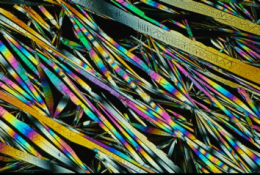
To do this, the researchers focused on crystals from hippuric acid—a derivative of the amino acid glycine. As molecules were added to the end of fine crystalline needles, stresses built up at the tips of the crystals and resulted in a helical twist—much like DNA's double helix. The process was reversed when crystals thickened from the opposite end of the growing tip—that is, the crystals stiffened, thereby undoing the twisted formations. This is because the elasticity of the crystals decreases as they become thicker, thus "squeezing out" the deformations that were induced at the growing tip.
"This competition between twisting and untwisting creates needles with a rainbow of colors, which is a characteristic of tightly wound helices, as well as ribbons that have become completely untwisted," said Bart Kahr, one of the study's co-authors and a professor in NYU's Department of Chemistry, explaining the crystals' appearance. "This is a very strange and new perspective on crystal growth."
"This dynamic has not been observed before and points to a much more active process of crystal growth than we had anticipated," added Kahr, also part of NYU's Molecular Design Institute.
-
Colluding with colloids: Scientists make liquid crystal discovery
Dec 14, 2006 |
not rated yet |
0
-
First-class protein crystals thanks to weightlessness on earth
Apr 23, 2008 |
not rated yet |
0
-
Paving the Way for Crystal Growth
Mar 07, 2007 |
not rated yet |
0
-
New type of liquid crystal identified; Holds promise of faster, lower priced liquid crystal displays
Jun 17, 2004 |
not rated yet |
0
-
Crystal to glass cooling model developed
Feb 22, 2006 |
not rated yet |
0
-
Engineers build first sub-10-nm carbon nanotube transistor
Feb 01, 2012 |
4.9 / 5 (30) |
30
-
Something old, something new: Evolution and the structural divergence of duplicate genes
Jan 31, 2012 |
4.6 / 5 (7) |
1
-
The hidden nanoworld of ice crystals: Revealing the dynamic behavior of quasi-liquid layers
Jan 30, 2012 |
5 / 5 (3) |
1
-
Stock market network reveals investor clustering
Jan 27, 2012 |
3.9 / 5 (23) |
8
-
Of microchemistry and molecules: Electronic microfluidic device synthesizes biocompatible probes
Jan 26, 2012 |
5 / 5 (1) |
0
-
Boiling and melting point of impure substances
2 hours ago
-
Safe nitrogen compound to decompose a 500 deg C in a furnace?
9 hours ago
-
[ask]electron inside drinking water
Feb 08, 2012
-
How to avoid formation of Lithium Chromate ???
Feb 08, 2012
-
how to choose a reduced or oxidated form in a redox
Feb 08, 2012
-
Mesomeric effect in acids.
Feb 08, 2012
- More from Physics Forums - Chemistry
More news stories
Hydrogen from acidic water: Researchers develop potential low cost alternative to platinum for splitting water
A technique for creating a new molecule that structurally and chemically replicates the active part of the widely used industrial catalyst molybdenite has been developed by researchers with the Lawrence Berkeley ...
12 hours ago |
5 / 5 (10) |
11
|
Flexible paper robots
(PhysOrg.com) -- These inexpensive robots can stretch, bend and twist under control, and lift objects up to 120 times their own weight. Being soft, they can apply gentle and even pressure, and adapt to varied ...
10 hours ago |
5 / 5 (5) |
2
|
Engineers find inspiration for new materials in Piranha-proof armor
(PhysOrg.com) -- Its a matchup worthy of a late-night cable movie: put a school of starving piranha and a 300-pound fish together, and who comes out the winner?
18 hours ago |
4.3 / 5 (3) |
2
|
New method makes culture of complex tissue possible in any lab
Scientists at the University of California, San Diego have developed a new method for making scaffolds for culturing tissue in three-dimensional arrangements that mimic those in the body. This advance, published online in ...
9 hours ago |
5 / 5 (4) |
0
|
Materials that shrink when heated
One common reason that people with fillings experience toothache is that their fillings expand at a different rate to the original tooth when, for example, drinking a hot drink. Contrary to intuition, however, ...
11 hours ago |
5 / 5 (2) |
1
'Dark plasmons' transmit energy
Microscopic channels of gold nanoparticles have the ability to transmit electromagnetic energy that starts as light and propagates via "dark plasmons," according to researchers at Rice University.
FDA-approved drug rapidly clears amyloid from the brain, reverses Alzheimer's symptoms in mice
Neuroscientists at Case Western Reserve University School of Medicine have made a dramatic breakthrough in their efforts to find a cure for Alzheimer's disease. The researchers' findings, published in the journal Science, show t ...
Ultraviolet protection molecule in plants yields its secrets
Lying around in the sun all day is hazardous not just for humans but also for plants, which have no means of escape. Ultraviolet (UV) radiation from the sun can damage proteins and DNA inside cells, leading ...
Soraa LED light may dim 50-watt halogen rivals
(PhysOrg.com) -- Soraa, a Fremont, California company founded in 2008, this week launched its first product, a light that uses LEDS (light emitting diodes). The "Soraa LED MR16 lamp" is the "perfect" replacement ...
Anyone can learn to be more inventive, cognitive researcher says
There will always be a wild and unpredictable quality to creativity and invention, says Anthony McCaffrey, a cognitive psychology researcher at the University of Massachusetts Amherst, because an "Aha moment" is rare and ...
Researchers weigh in on ethics of H5N1 research
(Medical Xpress) -- In a commentary on the biosecurity controversy surrounding publication of bird flu research details, a bioethicist and a vaccine expert at Johns Hopkins reaffirm that "all scientists have an affirmativ ...