Photos 'show Himalayan glaciers receding'
July 16, 2010 by Sebastian Smith
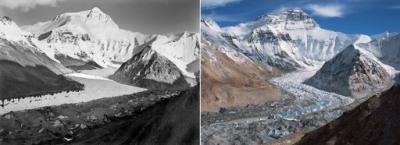
Comparing precisely matched photographs, Breashears determined that the Rongbuk had dropped some 320 feet in depth

Enlarge

A 1921 view taken by George Mallory of the Main Rongbuk Glacier (left), on the northern slope of Mount Everest and a 2007 view of the same glacier taken by David Breashears, courtesy of GlacierWorks. Decades of pollution and global warming appear to have left the glacier shrunken and withered.

When British climbing legend George Mallory took his iconic 1921 photo of Mount Everest's north face, the mighty, river-shaped glacier snaking under his feet seemed eternal.

Decades of pollution and global warming later, modern mountaineer David Breashears has reshot the picture at the same spot -- and proved an alarming reality.

Instead of the powerful, white, S-shaped sweep of ice witnessed by Mallory before he died on his conquest of Everest, the Main Rongbuk Glacier today is shrunken and withered.

The frozen waves of ice pinnacles -- many of them the size of office buildings -- are still there. But they are far fewer, lower and confined to a narrow line.

Comparing precisely matched photographs, Breashears determined that the Rongbuk had dropped some 320 feet (97 meters) in depth.

"The melt rate in this region of central and eastern Himalaya is extreme and is devastating," Breashears said Wednesday at New York's Asia Society, which is hosting the exhibition (http://sites.asias … riversofice/) July 13 to August 15.

Amid bad-tempered political debates over the causes and reality of global warming, Breashears speaks literally from the ground.

He went in the footsteps of three great early mountaineer-photographers: Mallory, Canadian-born mapping pioneer Edward Wheeler, and Italy's Vittorio Sella, whose work spanned the 19th and 20th centuries.

The result is then-and-now sets from Tibet, Nepal and near K2 in Pakistan showing seven in retreat -- not only much diminished, but in one case having dissolved into a lake.

"If this isn't evidence of the glaciers in serious decline, I don't know what is," the soft-spoken Breashears said.

The pose more than a threat to the "ultimate harmony" Mallory once described finding in these beautiful peaks.

Himalayan glaciers are the world's third largest reserve of ice after the north and south poles, and their seasonal melt water is a crucial source for Asia's great rivers, including the Ganges, Indus, Mekong and Yellow.

Asia Society's China expert Orville Schell described Nepal as "a kind of a headquarters for the hydrology of the whole of Asia."

As a result, rapid melting is triggering a "cascade of effects all downstream, whether it's animals, plants, rivers, agriculture, people," he said.

That interconnectedness also works the other way: fallout from vast smog clouds over Asian population centers is dirtying the seemingly remote glaciers, thereby hastening their destruction.

"This black carbon soot then turns the glaciers into kind of a solar collector. Rather than reflecting heat back out of the atmosphere into space, it's absorbing it," Schell said.

Addressing the problem requires data and that's proving hard to get, according to Syed Iqbal Hasnain, a top Indian glaciologist who attended the "Rivers of Ice" opening.

Hasnain knows first hand about the difficulty of informed debate.

He said he was misquoted by a magazine claiming that could disappear by 2035, a terrifying but unfounded prospect which caused uproar after slipping into a UN climate change report earlier this year.

Hasnain particularly bemoans the complications of getting authorities and scientists from India, Pakistan, China and Tibet to collaborate in their often hostile border regions.

"We should know how much the glaciers are moving," Hasnain said, "but there is a problem of security. NASA wanted to put up some aerial surveys but the government of India said you cannot.... India is so skeptical and they're not coming forward to share the data."

Breashears said his photo-climbing expedition was dangerous and exhausting as he searched for vantage points used more than half a century ago.

One glacier near K2 required three climbs of 6,000 feet before he found the same view enjoyed by Sella all those years earlier.

"We were totally in awe of the people that had been there before," Breashears said.

Future generations won't have the same problem because Breashears recorded each spot's GPS coordinates.

The question is what will be left to photograph.

"You really do have a sense of something we once felt was sort of triumphant in nature now being bested by man," Schell said. "They're kind of on the run, literally moving slowly up the valley."

(c) 2010 AFP

3.3 /5 (12 votes)  

Filter


Move the slider to adjust rank threshold, so that you can hide some of the comments.


Display comments: newest first

bbd
Jul 16, 2010

Rank: 1.3 / 5 (8)
Good Lord, this is nauseating. If there was a picture taken from the same spot in the year 20,000 BC, those valleys would have been full of ice. The glaciers have been in "serious decline" for thousands of years. There is nothing that humans can do to stop this, so get used to it.

Earth's reality extends far beyond the snapshot in time that man's presence represents. However, we are so anthropocentric in our views, we forget this.
mhenriday
Jul 16, 2010

Rank: 4.4 / 5 (7)
Those who deny the reality of global warming - and who have been strangely more silent this warm summer than they were this last cold winter - would be advised to carefully study these photos. But the PhysOrg editors could have helped them along by informing us at what time of year the 1921 and the 2007 photos, respectively, were taken, just to avoid any possible misunderstandings....

Henri
Loodt
Jul 16, 2010

Rank: 1.6 / 5 (7)
Some bad news for you mate. GPS measurements are static and the earth is dynamic and shifting, plate techtonics and all that good stuff. Only proper survey mapping with references to local beacons will ensure that 'future generations' can find that spot.

Didn't you read about the big shifts that took place during the terrible earthquake in Chile earlier this year?
Nik_2213
Jul 17, 2010

Rank: 5 / 5 (7)
"big shifts"

Uh, getting to within ~50 metres by GPS then deploying Human Eyeball#1 should do the trick for the next couple of centuries...
frenchie
Jul 19, 2010

Rank: 5 / 5 (6)
@bbd.
You sir are retarded. Let's quickly do some basic math.
Photo 1- Photo 2 taken = 2007-1921 = 86 yr span.
Delta in height = 320 ft
20000/86 as you so claim = ~232.558
total eight change thus incurred since your retarded timeline = 74418.6 ft

Once again for all the kids, the problem isn't the fact that there is change. it is the RATE OF CHANGE. the serious decline is experienced in a short period of time. Cheers.

Thank you very much and goodnight
denijane
Jul 26, 2010

Rank: 1 / 5 (1)
I have to ask, during what season did George Mallory take his pictures? Because I couldn't find the dates in wikipedia. And I think this is quite important information.
Rank 3.3 /5 (12 votes)
Related Stories
Relevant PhysicsForums posts
  • Discrepancy between oxygen and carbon-dioxide levels
    createdFeb 09, 2012
  • where gems are found in the world
    createdFeb 09, 2012
  • Wind Waves in Reservoir ~ Wind run-up and Wind set-up
    createdFeb 08, 2012
  • Balance of oxygen in the atmosphere
    createdFeb 01, 2012
  • The case for a methanol-based economy
    createdJan 30, 2012
  • Weather in a rotating cylinder
    createdJan 25, 2012
  • More from Physics Forums - Earth

More news stories

Humans may have helped the decline of African rainforests 3000 years ago

(PhysOrg.com) -- Large areas of rainforests in Central Africa mysteriously disappeared over three thousand years ago, to be replaced by savannas. The prevailing theory has been that the cause was a change ...

Space & Earth / Environment

created 23 hours ago | popularity 4.3 / 5 (13) | comments 13 | with audio podcast report

Could Venus be shifting gear?

(PhysOrg.com) -- ESA’s Venus Express spacecraft has discovered that our cloud-covered neighbour spins a little slower than previously measured. Peering through the dense atmosphere in the infrared, the ...

Space & Earth / Space Exploration

created 19 hours ago | popularity 5 / 5 (7) | comments 8 | with audio podcast

NASA budget will axe Mars deal with Europe: scientists

US President Barack Obama's budget proposal to be submitted next week for 2013 will cut NASA's budget by 20 percent and eliminate a major partnership with Europe on Mars exploration, scientists said Thursday.

Space & Earth / Space Exploration

created 22 hours ago | popularity 5 / 5 (2) | comments 19

Mars Science Laboratory computer issue resolved

(PhysOrg.com) -- Engineers have found the root cause of a computer reset that occurred two months ago on NASA's Mars Science Laboratory and have determined how to correct it.

Space & Earth / Space Exploration

created 20 hours ago | popularity 4.7 / 5 (6) | comments 4 | with audio podcast

Two new moons for Jupiter

Advances in technology have lead to the discovery of new planets outside of our Solar System, and now even new moons in our own backyard.

Space & Earth / Space Exploration

created 19 hours ago | popularity 4 / 5 (1) | comments 7


Anonymous knocks CIA website offline (Update)

The website of the Central Intelligence Agency was inaccessible on Friday after the hacker group Anonymous claimed to have knocked it offline.

New error-correcting codes guarantee the fastest possible rate of data transmission

Error-correcting codes are one of the triumphs of the digital age. They’re a way of encoding information so that it can be transmitted across a communication channel — such as an optical fiber o ...

New power source discovered

(PhysOrg.com) -- Researchers at the Massachusetts Institute of Technology (MIT) and RMIT University have made a breakthrough in energy storage and power generation.

Small modular reactor design could be a 'SUPERSTAR'

(PhysOrg.com) -- Though most of today's nuclear reactors are cooled by water, we've long known that there are alternatives; in fact, the world's first nuclear-powered electricity in 1951 came from a reactor ...

The power of estrogen -- male snakes attract other males

A new study has shown that boosting the estrogen levels of male garter snakes causes them to secrete the same pheromones that females use to attract suitors, and turned the males into just about the sexiest ...

Google users warned of threat to smartphone wallets

Users of Google smartphone wallets were being warned on Friday that there is a way to crack pass codes intended to thwart thieves from going on illicit shopping sprees.