Dutch researchers develop anthrax sensor
July 16, 2010
Nanotechnologists at University of Twente's MESA+ research institute have developed a sensor that can detect anthrax spores. The invention is more sensitive and efficient than existing detection methods. The research is being published in the leading scientific journal Angewandte Chemie.
Anthrax - notorious as the powder ingredient in letter-bombs - is an infectious and potentially fatal disease caused by the bacterium Bacillus anthracis. This bacterium produces spores - dried bacteria with a hard shell - that can survive long-term in the open air. University of Twente researchers have now designed a sensor that can detect a biomarker of the spores and thus determine their presence in a concentration one thousand times lower than the known toxic level.
Techniques for detecting anthrax spores (such as fluorescence and mass spectroscopy) already exist, but the UT sensor is much more sensitive and effective than any of them. It can also be reused in subsequent trials.
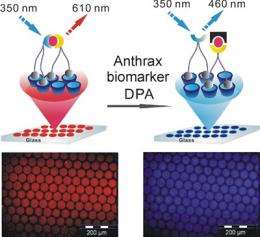
Like other detection techniques, the UT sensor measures the presence of dipicolinic acid (DPA), a substance that accounts for between five and fifteen per cent of the dry weight of the spores. The sensor consists of a glass plate to which DPA-sensitive receptors have been attached. When the receptors are brought into contact with anthrax spores, the DPA binds with them. The concentration of the spores can be calculated with fluorescence spectroscopy, by shining ultraviolet light on to the sensor.
DPA-bonded receptors will absorb this light and emit blue light, whereas receptors that have no DPA bonding will emit red light. By measuring the ratio of red to blue light in a sample, it is possible to determine the concentration of anthrax spores. The advantage of the sensor is that it does not need calibrating and is more finely tuned than other current methods. The next step for the researchers is to convert the system into a 'lab-on-a-chip' which will make it possible to measure samples using a fully automatic on-off process.
-
Scientist find chemical to stop anthrax
Apr 21, 2007 |
not rated yet |
0
-
Researchers pave the way for anthrax spore standards
Apr 15, 2008 |
not rated yet |
0
-
Anthrax Detector Developed
Aug 16, 2006 |
not rated yet |
0
-
Clemson researchers develop nanotechnology
Oct 03, 2006 |
not rated yet |
0
-
Biologists discover an extra layer of protection for bacterial spores
May 06, 2010 |
not rated yet |
0
-
Engineers build first sub-10-nm carbon nanotube transistor
Feb 01, 2012 |
4.9 / 5 (31) |
30
-
Something old, something new: Evolution and the structural divergence of duplicate genes
Jan 31, 2012 |
4.6 / 5 (7) |
1
-
The hidden nanoworld of ice crystals: Revealing the dynamic behavior of quasi-liquid layers
Jan 30, 2012 |
5 / 5 (3) |
1
-
Stock market network reveals investor clustering
Jan 27, 2012 |
3.9 / 5 (23) |
8
-
Of microchemistry and molecules: Electronic microfluidic device synthesizes biocompatible probes
Jan 26, 2012 |
5 / 5 (1) |
0
-
Stoichiometry
Feb 10, 2012
-
Boiling and melting point of impure substances
Feb 10, 2012
-
Safe nitrogen compound to decompose a 500 deg C in a furnace?
Feb 09, 2012
-
[ask]electron inside drinking water
Feb 08, 2012
-
How to avoid formation of Lithium Chromate ???
Feb 08, 2012
-
how to choose a reduced or oxidated form in a redox
Feb 08, 2012
- More from Physics Forums - Chemistry
More news stories
Fool's gold may prove an unlikely alternative to overexploited catalytic materials
Catalytic materials, which lower the energy barriers for chemical reactions, are used in everything from the commercial production of chemicals to catalytic converters in car engines. However, with current catalytic materials ...
17 hours ago |
4.4 / 5 (8) |
5
|
Unpicking HIV’s invisibility cloak
Drug researchers hunting for alternative ways to treat human immunodeficiency virus (HIV) infections may soon have a novel targetits camouflage coat. HIV hides inside a cloak unusually rich in a sugar ...
17 hours ago |
5 / 5 (5) |
0
Hydrogen from acidic water: Researchers develop potential low cost alternative to platinum for splitting water
A technique for creating a new molecule that structurally and chemically replicates the active part of the widely used industrial catalyst molybdenite has been developed by researchers with the Lawrence Berkeley ...
Feb 09, 2012 |
4.8 / 5 (14) |
15
|
No entry without protein recycling: Researchers discover new coherence in enzyme transport
The group of Prof. Dr. Ralf Erdmann at the Ruhr-Universität Bochum, Germany, discovered a connection of peroxisomal protein import and receptor export. In the Journal of Biological Chemistry, they disclo ...
17 hours ago |
not rated yet |
0
Under the microscope #7
In this video Dr Ingrid Graz shows us a thin layer of gold on top of rubber. Cracks in the gold allow it to stretch and we can use this for stretchable electronics.
19 hours ago |
not rated yet |
0
Anonymous knocks CIA website offline (Update)
The website of the Central Intelligence Agency was inaccessible on Friday after the hacker group Anonymous claimed to have knocked it offline.
New error-correcting codes guarantee the fastest possible rate of data transmission
Error-correcting codes are one of the triumphs of the digital age. Theyre a way of encoding information so that it can be transmitted across a communication channel such as an optical fiber o ...
Humans may have helped the decline of African rainforests 3000 years ago
(PhysOrg.com) -- Large areas of rainforests in Central Africa mysteriously disappeared over three thousand years ago, to be replaced by savannas. The prevailing theory has been that the cause was a change ...
Google users warned of threat to smartphone wallets
Users of Google smartphone wallets were being warned on Friday that there is a way to crack pass codes intended to thwart thieves from going on illicit shopping sprees.
New power source discovered
(PhysOrg.com) -- Researchers at the Massachusetts Institute of Technology (MIT) and RMIT University have made a breakthrough in energy storage and power generation.
The power of estrogen -- male snakes attract other males
A new study has shown that boosting the estrogen levels of male garter snakes causes them to secrete the same pheromones that females use to attract suitors, and turned the males into just about the sexiest ...