New catalyst for hydrogen fuel cells resists CO contamination
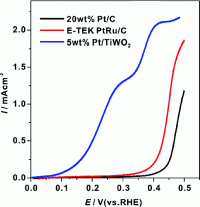
July 19, 2010 by Lin Edwards
Image credit: Journal of the American Chemical Society
(PhysOrg.com) -- Hydrogen fuel cell vehicles promise faster refueling and the ability to travel longer distances before refueling than battery-powered cars, but they are susceptible to poisoning by carbon monoxide (CO). Now, scientists in the US and Japan have created new nanoparticles catalysts that enable hydrogen fuel cells to resist CO poisoning.
Hydrogen fuel cells use platinum electrocatalysts to combine hydrogen and oxygen to produce water and generate electricity. The problem is that the hydrogen is produced from sources such as gasoline, natural gas, or ethanol, and the process often introduces carbon monoxide into the gas. Even miniscule amounts of carbon monoxide in the hydrogen are sufficient to bind to the platinum catalysts and prevent them working. Scientists at Brookhaven National Lab in New York have recently found a platinum/ruthenium catalyst that blocks CO poisoning, but since this catalyst is extremely expensive, researchers have been seeing an alternative.
The new catalyst was developed by Professor Héctor Abruña and colleagues from Cornell University, the National Institute for Materials Science in Ibaraki, Japan, and the University of Pennsylvania. They began with the knowledge that tungsten alloys resist CO poisoning. Tungsten is not used in fuel cell electrodes because it is a poor electrical conductor, so Abruña and the team added tungsten to nanoparticles of titanium dioxide, which is a good electrical conductor. The result was titanium tungsten oxide nanoparticles, which they coated with platinum to make an electrode.
The researchers tested their nanoparticles catalysts with hydrogen contaminated with two percent carbon monoxide, and found performance was reduced by only five percent compared to 30 percent for ordinary catalysts.
Abruña said he is not sure how the new catalyst works, and much more testing is required, but he thinks a likely mechanism is that hydroxide (OH-) groups bind during the reaction to the titanium tungsten oxide near to the platinum, where they are close enough to the CO molecules to react and form CO2.
If the tests prove successful and the new catalyst can be made economically, it could spark renewed interest in using liquid fuels such as gasoline in cars to make the hydrogen required to power fuel cells. This in turn could enable fuel cells cars to have a longer range than those using gaseous hydrogen and those using gasoline conventionally.
The research paper was published in the Journal of the American Chemical Society.
More information: Highly Stable and CO-Tolerant Pt/Ti0.7W0.3O2 Electrocatalyst for Proton-Exchange Membrane Fuel Cells, J. Am. Chem. Soc., Article ASAP, Publication Date (Web): July 12, 2010. http://pubs.acs.or … 21/ja102931d
© 2010 PhysOrg.com
-
Nano World: Methanol fuel cell thru nano
Feb 21, 2006 |
not rated yet |
0
-
Gold, copper nanoparticles take center stage in the search for hydrogen production catalysts
Mar 28, 2007 |
not rated yet |
0
-
Brookhaven Lab chemists receive patents for fuel-cell catalysts
May 20, 2010 |
not rated yet |
0
-
New 'biofuel cell' produces electricity from hydrogen in plain air
Mar 26, 2007 |
not rated yet |
0
-
New hydrogen production method could reduce need for fossil fuels
Jan 06, 2009 |
not rated yet |
0
-
Engineers build first sub-10-nm carbon nanotube transistor
Feb 01, 2012 |
4.9 / 5 (30) |
30
-
Something old, something new: Evolution and the structural divergence of duplicate genes
Jan 31, 2012 |
4.6 / 5 (7) |
1
-
The hidden nanoworld of ice crystals: Revealing the dynamic behavior of quasi-liquid layers
Jan 30, 2012 |
5 / 5 (3) |
1
-
Stock market network reveals investor clustering
Jan 27, 2012 |
3.9 / 5 (23) |
8
-
Of microchemistry and molecules: Electronic microfluidic device synthesizes biocompatible probes
Jan 26, 2012 |
5 / 5 (1) |
0
-
Stoichiometry
10 hours ago
-
Boiling and melting point of impure substances
11 hours ago
-
Safe nitrogen compound to decompose a 500 deg C in a furnace?
18 hours ago
-
[ask]electron inside drinking water
Feb 08, 2012
-
How to avoid formation of Lithium Chromate ???
Feb 08, 2012
-
how to choose a reduced or oxidated form in a redox
Feb 08, 2012
- More from Physics Forums - Chemistry
More news stories
Fool's gold may prove an unlikely alternative to overexploited catalytic materials
Catalytic materials, which lower the energy barriers for chemical reactions, are used in everything from the commercial production of chemicals to catalytic converters in car engines. However, with current catalytic materials ...
2 hours ago |
5 / 5 (1) |
1
|
Unpicking HIV’s invisibility cloak
Drug researchers hunting for alternative ways to treat human immunodeficiency virus (HIV) infections may soon have a novel targetits camouflage coat. HIV hides inside a cloak unusually rich in a sugar ...
2 hours ago |
5 / 5 (2) |
0
No entry without protein recycling: Researchers discover new coherence in enzyme transport
The group of Prof. Dr. Ralf Erdmann at the Ruhr-Universität Bochum, Germany, discovered a connection of peroxisomal protein import and receptor export. In the Journal of Biological Chemistry, they disclo ...
2 hours ago |
not rated yet |
0
Hydrogen from acidic water: Researchers develop potential low cost alternative to platinum for splitting water
A technique for creating a new molecule that structurally and chemically replicates the active part of the widely used industrial catalyst molybdenite has been developed by researchers with the Lawrence Berkeley ...
21 hours ago |
5 / 5 (11) |
11
|
Under the microscope #7
In this video Dr Ingrid Graz shows us a thin layer of gold on top of rubber. Cracks in the gold allow it to stretch and we can use this for stretchable electronics.
4 hours ago |
not rated yet |
0
New understanding of DNA repair could eventually lead to cancer therapy
A research group in the Faculty of Medicine & Dentistry at the University of Alberta is hoping its latest discovery could one day be used to develop new therapies that target certain types of cancers.
Zuckerberg's focus drives Facebook's ascent
When Mark Zuckerberg showed up to rent Judy Fusco's Los Altos, Calif., house in the fall of 2004, soon after he'd arrived in Silicon Valley, the landlord was immediately struck by his confidence.
Antidepressants and pregnancy: Women must consider the impact of drugs on baby, and of depression on baby, themselves
Upon learning they are pregnant, most women dutifully nix the alcohol, sushi and caffeine. But what about antidepressants?
Both maternal and paternal age linked to autism
Older maternal and paternal age are jointly associated with having a child with autism, according to a recently published study led by researchers at The University of Texas Health Science Center at Houston (UTHealth).
Night, weekend delivery OK for babies with birth defects
Weekday delivery is no better than night or weekend delivery for infants with birth defects, according to a new study presented today at The Pregnancy Meeting, the Society for Maternal-Fetal Medicine's annual conference. ...
Sonic Cradle lands spot in TED exhibition
A Simon Fraser University graduate student project that melds music, meditation and modern technology has landed a rare spot as an exhibit at TEDActive 2012 in Palm Springs, California this month.
Jul 19, 2010
Rank: 4 / 5 (4)
Jul 19, 2010
Rank: 4 / 5 (3)
Jul 19, 2010
Rank: 5 / 5 (5)
However using tungsten and platinum in many millions of vehicles seems to have materials problems. Not enough material. Platinum isn't merely expensive. It's rare and tungsten is pretty hard to get as well.
Ethelred
Jul 19, 2010
Rank: 3.5 / 5 (2)
Jul 19, 2010
Rank: 3.3 / 5 (3)
Using clean hydrogen produced with clean electricity, the hydrogen fuel cell is a direct competitor with the chemical storage battery.
Jul 19, 2010
Rank: 3 / 5 (6)
It sounds like people are just upset that this version of a solution doesn't put someone out of business. Which is silly to spurn inovation becuase someone will still make money off of it.
THis sounds like a great intermediate step... but people should understand Hydrogen is reletively expensive to produce, if you seperate it from water you are putting more energy in that you are getting out. And long hydrocarbons are a great source of the stuff. So unless someone has a great idea for stroage of hydrogen - which they are working on , and safe transportation of hydrogen, which they are working on -- using gasoline minus all the additives which ups the cost, sounds like a great idea. It uses technology we are fimiliar with and leaves room for future innovation and solves the biggest concern - emmisions.
This is the second step to atrificial fossil fuels and brings ethonol back as a possible substitute. With no emmision
Jul 19, 2010
Rank: 4 / 5 (3)
I think your problem with everyone else above is that they recognize that fossil fuels are holding the species back, we have no need for them anymore. Why hold on to an antiquated product that kills people and destroys the planet, especially when we have things far better in every way.
"The problem is that the hydrogen is produced from sources such as gasoline, natural gas, or ethanol, and the process often introduces carbon monoxide into the gas."
-absolutely rediculous. Anyone considering producing hydrogen from fossil fuels or by burning fossil fuels is either ignorant or a stooge for big oil.
These people are gangsters.
Jul 19, 2010
Rank: 1 / 5 (3)
Jul 19, 2010
Rank: 2.7 / 5 (3)
taka,
And you think gasoline is easy to handle?
Tests have occured where they intentally ignited the fuel in both a hydrogen car and a gas car. The hydrogen car ends up shooting a 4 ft flame out the back, that's all, the car still ran when refueled. The gasoline engine however, exploded.
Do your research buddy.
Jul 19, 2010
Rank: 3.7 / 5 (3)
The pressure at which hydrogen is stored depends on the amount of hydrogen you're trying to fit into the set volume that is the fuel tank. It's a pretty simple gas so it fits the ideal gas law pertty well which means its pressure increases linearly with the mass of hydrogen added to the tank.
A "4 foot flame out the back" isn't exactly as minor as you're making it seem. The direction and magnitude of this flame depends on the weakest point in the tank and the quantity of hydrogen in the tank.
Generally gas tanks don't explode because the gas/air ratio in the gas tank doesn't allow for an explosion.
I'm not saynig gasonline is safe and shouldn't be handled with care, but don't tout a highly pressurized explosive gas as any safer just because it's "green".
Jul 19, 2010
Rank: 1.3 / 5 (3)
Gasoline pools keeping the fuel in the fire. Hydrogen, being far lighter than air, escapes vertically. That creates the "4' flame" effect, but it doesn't allow for spreading explosive liquids.
Secondly, we're talking far different operating oxidation temperatures. Hydrogen diffuses much more readily, making hydrogen fumes far more difficult to combust than gasoline fumes. Couple this with the operational flame temperatures and the fact that Hydrogen cannot self oxidize and you're in a bit of a pickle if you're a gasoline proponent when it comes to safety.
Jul 19, 2010
Rank: 4.5 / 5 (2)
While the end goal is to produce hydrogen from clean sources, researchers still have to live in the real world. Only when electricity from alternative sources becomes cheaper than the fossil fuels we are currently using will people actually pay for that clean hydrogen.
That said, the above catalyst has significant value, both as a means of furthering fuel cell research by creating engines that don't die after a couple years, and as a means of centralizing CO2 emissions. It is a lot easier to sequester CO2 in an industrial plant than in a few thousand cars.
Jul 19, 2010
Rank: 5 / 5 (1)
This statement has no bearing on the rest of your arguement. Also, "oxidation temperature"? Do you mean ignition temperature?
Increased diffusion only makes combustion more difficult if you have a small amount of gas and want to disperse it easily. If you have a gas leak from a tank(large source), it makes it EASIER to ignite because the concentration gradient covers a wider area, exposing the combustible mixture (proper air/fuel mix) to a wider range of ignition sources.
The fact that hydrogen has a different flame temperature (ie. the temperature of the flame) only has a bearing in certain cases (generally, the weakening of materials exposed to the flame). Not as big an issue for a vehicle that is already in flames.
Jul 19, 2010
Rank: 5 / 5 (3)
Just as there are specific instances where gasoline is dangerous (ie. the pooling of fuel under a stationary car that catches fire), there are instances where hydrogen would be dangerous as well. Hydrogen at high pressures does not "escape vertically". It escapes in whatever the direction the hole is in and then, after the gas slows down, will rise. A 4 foot flame pointed at a passenger would finish them off pretty quick.
I'm not a gasoline proponent, but saying hydrogen is safer or easier to handle than gasoline is just incorrect.
Jul 19, 2010
Rank: 5 / 5 (2)
Gasoline cannot self-oxidize under normal circumstances. It needs an oxidizing agent. Just like hydrogen.
Also, you keep using the word "operational". Could you explain what you mean by that?
Jul 19, 2010
Rank: not rated yet
Jul 19, 2010
Rank: not rated yet
Fuelcells or Foolcells as those who really know call them, are expensive, short lived and not eff despite what they tell you. A regular ICE is more eff than a fuelcell by the time all the losses are added up.
Gunslinger, Email me again if you want. I didn't see your email from last yr until yesterday. Didn't know they had emails!!
Jul 20, 2010
Rank: not rated yet
Jul 20, 2010
Rank: not rated yet
-Nuclear is far cheaper and more profitable than fossil fuels, even with the over regulation. You only refuel every two years.
Forget fuel cells, they are still a ways away, how about the hydrogen internal combustion engine. They have been manufactured. Add hybrid technology and heat recovery and you've outperformed gasoline engines in every way.
The tests are conclusion, hydrogen is in fact safer than gasoline. Do the research, though it is hard to find.. it has been supressed...but cannot be ignored.
Jul 20, 2010
Rank: 5 / 5 (1)
Luckily you provided me with a link to help.
Anyways, it basically boils down to the fact that you have an explosive gas in a pressurized tank.
Hydrogen is safer than gas in certain circumstances? Sure.
Hydrogen is more dangerous than gas in certain circumstances? Sure.
Is gasoline safe? Of course not.
Is compressed hydrogen gas safe? Not a chance.
Unfortunately we're not there with chemical storage yet since the hydrogen equivalents that are "safe" are generally difficult or require expensive catalysts to extract the hydrogen from and the hydrogen equivalents that readily release hydrogen are pretty damn dangerous.
I definitley believe chemical storage is the way to go for future hydrogen storage. We've just got to find the right way (ie. stumble on some nice cheap catalyst or something).
Jul 20, 2010
Rank: not rated yet
There are already alternative safer designs than a bottle of compressed hydrogen, things that far outpace the safety of gas.
For example, one such design puts a special type of sponge in the hydrogen storage device. hydrogen is still pressurized, but it is prevented from escaping faster than it is supposed to by the sponge. Also, when this vessel catches fire, it burns very slowly as each pocket in the spong it ignited. Guess who owns the patten to this now- Exxon.
Sorry again about sources.. it's very hard to find once big oil gets their hands on the patents... just burried.
Jul 20, 2010
Rank: 5 / 5 (2)
From a quick google search (since that's where I'm assuming you're getting most of this information), the only stuff I could find about hydrogen "sponges" was on metal hydrides.
Metal hydrides are pretty common and are used in chemistry labs all the time.
Metal hydrides are quite expensive and generally quite violently with water to evolve hydrogen gas. Usually explosively so.
I'm not saying hydrogen is bad or that it's not the way of the future, but it's not "safe". It just isn't. As with any fuel it has to be handled carefully.
Just because the accident scenarios and mechanisms aren't the same for gasoline are different doesn't make it safer.
The "tests" you are referring to sound pretty biased or made up. I could do a test where you splash water on gasoline and splash water on a metal hydride and we'll see which one explodes. Would that mean gas is safer? Not at all. It just means you can splash water on it.
Fast is they're both dangerous.
Jul 20, 2010
Rank: not rated yet
I agree, every energy source will have it's dangers. Even hydroelectric, dams can collapse; even wind, HURRICANE!
I'm not arguing that hydrogen is as safe as water budy. But if safety is your primary concern, as many people with kids, then you can be rest assured that hydrogen CAN be SAFER than any gasoline engine implementation.
Reread the post, I was responding to taka who said "And nobody recognise that hydrogen is extremly hard to handle..."; I was correcting his ignorant brain who, like lots of others, failed to recognize that gas is also hard to handle so his is a moot point. Your response was a defense for him. H and gas are both volatile, obviously.
No, I was not refering to hydrides. It is quite litterally a sponge where you squeze out hyroden..the only perpose is to encapsulate and separate H storage so it burns very controlably. Like house insulation.
I agree with JerryD. Either H combustion w/ hybrid and heat recovery or electric are most viable.
Jul 20, 2010
Rank: not rated yet
Car gas tanks are designed how they are because it's a cheap way to mass produce gas tanks and still have them safe enough to pass safety codes. There are likely safer designs and patents for gas tanks that exist compared to those found in the cars on the road today, but since they would be more expensive to make and automakers have no need for them, they are not used.
Theoretically, these patented hydrogen storage ideas could be safer than the current gas tanks in cars, but whether they are ever actually used in hydrogen powered vehicles when they are mass produced is a different story. It will depend on safety codes, cost, public pressures (ie. if the public is scared of hydrogen, then the tank design will be marketable. People aren't scared of gas.)
Jul 20, 2010
Rank: not rated yet
None of this is my concern..
My concern is when people scream how dangerous hydrogen is, yet ignore the dangers of gasoline.
I am an engineer, systems should be designed appropriately. Tests have occured. I found a restatement of the tests (good luck finding the video, though I have seen it many years ago):
http://www.enerli..._206.htm
Rebuttal or concession?
Jul 20, 2010
Rank: 5 / 5 (1)
I'm not doing this. I'm saying they're both fuels and they're both dangerous. Which of the two is safer is completely dependant on circumstance.
I read the article you gave. It's pretty vague about the conditions of the test.
http://www.unusua...tion.pdf is a much better source of information.
For gasoline the fuel line is punctured directly in the middle of the car and is ignited from directly below the car.
For the hydrogen fuel tank, it is assumed that the tank will fail at the pressure release device (likely a rupture disk).
I see a touch of bias where the gas leak is assumed to develop in probably the worst possible place for a gas leak on a car whereas the hydrogen leak develops in a designed location... CONTINUED
Jul 20, 2010
Rank: 5 / 5 (1)
The hydrogen fuel tanks are designed to be much safer than those for gasoline (a point I mentioned in my previous post). It would be interesting to see what the experiment would be like if the gasoline tank were equipped with similar safety features or if say the hydrogen leak developed at the bottom of the tank as opposed to the top.
Regardless, the test was basically a comparison of apples and oranges and does not definitely show that hydrogen as a fuel is safer than gasoline as a fuel. I could likely design a biased experiment in which a hydrogen filled car explodes but it wouldn't prove anything other than that hydrogen is explosive is certain conditions.
My concern is when people see the benefits of a green technology and ignore the potential safety hazards.
Jul 20, 2010
Rank: not rated yet
Jul 20, 2010
Rank: not rated yet
Javinator, I agree, we are talking apples and oranges. The comparison of which is safer is rediculous, that is why it is not my concern. I was only humoring taka because he was implying that gas is somehow safer than hydrogen. The only test ever conducted on the matter shows that hydrogen is in fact safer. Show me one that says gas is safer.
This is a rediculous discussion, we both agree there are dangers with both fuels, advantages and disadvantages. But if someone, anyone, ever tries to make a claim that one is safer than the other.. it would have to be hydrogen because no test have proven otherwise while 1 test has proven that hydrogen is safer.
But I agree. they are both explosive for god sakes. Trust me I'm not ignoring this.
Jul 20, 2010
Rank: not rated yet
I still feel that's more a comparison in design of the cars/fuel tanks/fuel injection system as opposed to comparison in the safety of the fuels.
I wonder what it would cost to design cars with better safety systems. I feel like the safety features described on the hydrogen fuel tank from that article could be applied to common gas tanks.
Jul 20, 2010
Rank: not rated yet
Jul 20, 2010
Rank: not rated yet
in the hydrogen tank, and computer programming to shut off fuel supply if fuel flow exceeds that
used by the fuel cell, or fuel flow delivered drops by a predetermined amount."
These are what I'm referring to.
Jul 20, 2010
Rank: 4 / 5 (2)
Please do the math before considering gasoline must be bad -- and producing hydrogen from gas is silly.
1) the article is talking about stripping hydrogen from gas in a fuel cell -- no mention of using combustion -- but the article does not state what the by products will be
2) Electrolosis has never been an effecient way or obtaining hyrdogen - at least not on Earth - this is a matter of energy, it takes more energy to release the hydrogen that the hydrogen is worth.
3) Pv=nRt
1 kg of gasoline can be held easily in a gas tank -- but if you wanted the equivalent energy in hydrogen of 44.4 MJ in a container of similar size lets sat 15L - which is a lot bigger than you need @ around 70 Farenheit or 296K -- the equation becomes
P = ( 0.31 * 8.314472 * 296 ) / 15
= 762.93 Pascals ~ 7 atmospheres
1 kg of gas is .72 L
10 kg of gas= 444 MJ
Jul 20, 2010
Rank: 4 / 5 (2)
but just 1 kg of hydrogen needs a container that can hold 2289 Pascals of pressure -- that is not gonna fit in a car my friend. And if you put say .5kg of H in a tank you have about as much energy as 2 gallons of gas.
energy density per kg hydrogen blows everyone away at 142 MJ/kg hyrdogen pound - or kg per kg is a beast. Unfortunately NO ONE can carry around a kg of hydrogen
4)this is a viable solution - while we work on how to transport pure hydrogen, and produce it cheaply.
5)
well yes this is true -- but it is a waste of energy that could be offsetting the use of coal and oil power plants. And nuclear reactors do have a very real waste product. While I am all for creating nuclear plants like daisies all over the world -it does not deal with the issue of waste storage. Or the fact that nuclear fuel is a heck of lot more rare
Jul 20, 2010
Rank: not rated yet
Jul 21, 2010
Rank: not rated yet
I do realize electrolysis is somewhat inefficient... 60% efficiency is achievable with traditional methods... 90% is achievable with high temperature modern reactors. My point is that this will be more efficient than charging stations... you already loss 25-35% on transmission lines alone... plus, charging is an inherently inefficient process... batterys get hot, current is wasted to ground.
It doesn't matter though, we have more important issues. Either H2 or electric or both at the same time, it doesn't matter at this point... as long as we stop burning (excluding stuff that produces water like H2). Both fuel sources have advantages/disadvantages, both are perfectly good solutions if designed right.
Jul 21, 2010
Rank: 5 / 5 (1)
There are no chemical reactions that have infinite varieties of byproducts. If you know what's going into the reactor you generally know what's coming out. That's just how chemistry works. Your byproducts and their concentrations will be based on the operating parameters of the reactor (pressure, temperature, initial concentrations, etc.)
I do agree that burning methane and steam reformation are similar. In the beginning you start with CH4 and O2 and in the end you'll end with CO2, H2O (and other lesser byproducts depnding on completeness of combustion etc)
The only difference wrt environment is where the reactants (pollutants) are released. Burning methane will release the products of the combustion reaction at the source of combustion. Generating hydrogen from methane will release all of the byproducts at the refinery/plant except H2O
Jul 21, 2010
Rank: 5 / 5 (1)
First, the article is not talking about "stripping hydrogen from gas" in a fuel cell (which, btw, is an incorrect statement. Stripping is the process of using a carrier gas to remove volitile species from a liquid mixture). The article is talking about using hydrogen gas that has been previously produced from fossil fuels, and dealing with any impurities that would result from that.
Second, the idea with electrolysis is that you can use OTHER energy sources to produce hydrogen. The fact that it is not economical now does not mean it won't be in the future once fossil fuel supplies run short.
Jul 21, 2010
Rank: 5 / 5 (1)
I'm not saying that's as bad as nuclear waste pound for pound, but I don't think people realize that these things can have as big an impact on their health and well-being. Especially considering that coal ash production is measured in millions of tonnes.
Jul 21, 2010
Rank: 1 / 5 (1)
all refining processes result in impurities. long chain fatty acids, amino acids, etc are all present in the gasoline. Anthing that was once alive burns unpredictable, life just necessitates the largest and most complex of molecules. Just take a simple pile of a single protein, each time you burn it, you'll get new compounds. Infinitely is always relative budy.
Caveman,
Please realize that .02% of the weight of most types of coal is uranium and other radioactive chemicals. What this means is that a Coal plant puts more uranium into the air in a five year period than a nuke uses and stores in it's 50 year life span. Coal is actually more valuable for the uranium it contains than for burning. Which is better, uranium, mercury, large quantities of CO2, SOx, Nox, mercury, arsenic, thousands of volital organic compuns, and more, going straight into the air we breath... or a nice discrete flask of contained and controllable uranium every 2 years?
Jul 21, 2010
Rank: 5 / 5 (2)
No, "infinite" isn't relative. Secondly if you burn a pile of proteins you will not receive an infinite number of compounds nor will the concentrations change. Chemistry isn't up to the observer, there are rules, and with those rules, predictable results.
Jul 21, 2010
Rank: 3 / 5 (1)
Gasoline does not burn differently with different reaction products every time. If it did then cars running on wouldn't work very well because of how unpredictable the energy of combustion of the fuel would be (different products means a different exothermic reaction which means a different energy output).
WRT nuclear:
There's a HUGE difference between the natural uranium that occurs in the ground and the radioactive fission products that are produced in a nuclear reactor. U-238 from the ground is an alpha emitter. That basically means don't eat it and it won't hurt you. Fission products emit high energy beta/gamma radiation. You'd never get close enough to spent fuel for the alpha to be an issue.
I actually support nuclear, but you're giving some pretty inaccurate info
Jul 21, 2010
Rank: 2 / 5 (1)
Nuclear waste is simply nuclear fuel for another reactor type. Our nuclear policies and bad propaganda give the false impressions above that you're trying to dismiss but accidentally reinforcing.
Jul 21, 2010
Rank: 5 / 5 (2)
Jul 21, 2010
Rank: not rated yet
Infinite numbers do not exist, there is no value associated with infinity in the real world. It just means more than we can count, more than we can observe or more than we know. It's a theoretical concept to make up for unknown extremely large quantities in physics.
your right, a pile of proteins won't produce a number of compounds that continues forever, but it will produce different things... hell forget about the pile.. forget proteins. Lets assume you burn DNA. There are 100 billion rungs in a humans DNA, each containing 2 of four aminio acids which are highly complex molecules in themselves. When you start attaching oxygen to the rungs, they will break off in an unpredictable manner, unless you happen to be controlling exactly where and when the oxygen is attached to the long chain which you do not do for a fuel. Even hydrogen burning: nitrogen in the air is also oxidized to produce NOx. The air contains microbes which burn, etc. We're not in the lab here.
Jul 21, 2010
Rank: 5 / 5 (2)
We all are on the same side. It's difficult to get ones point across on a thread, especially with the boss right around the corner.
I'm out. See you next thread.
Jul 21, 2010
Rank: not rated yet
You seem to think I was arguing against nuclear. I was not. HOWEVER, your statements are not necessarily correct.
Nuclear waste is not *just* uranium. It is a mixture of fission products of varying activities, most of which are unpleasant in some regard, in addition to any uranium that does not fission or transmute.
Most of the ash and crap from coal is contained (at least it has been since the 80's). Yes there is still lots that comes out. In principle, coal waste is easier to deal with. The catch is that there is a lot more.
I agree with you about preferring what a nuclear reactor puts out, but your hyperbole gives the wrong impression that nuclear waste is safer than coal waste.
Jul 21, 2010
Rank: not rated yet
U-238 is not fissile, but will absorb neutrons in a reactor and will eventually beta decay into plutonium which IS fissile.
When a fission event occurs in a high mass atom (uranium, plutonium), fission products are formed. The ratio of neutrons to protons in stable U and Pu nuclei is actually higher than that of the nuclei of the daughter products (Xe for example). When a fission event occurs, the high n:p ratio from U or Pu remains in the daughter products resulting in unstable (or radioactive) nuclei. It's these fission products that release the high energy gamma and beta radioation as they decay.
The reason nuclear is still better in spite of the dangerous waste is because of the ridiculously low volumes of waste for the energy made.
Jul 21, 2010
Rank: 5 / 5 (1)
Here's the problem. DNA is not a single molecule or collection of molecules. It is a moniker used to depict billions of different molecules so of course you'll get billions of different products from combustion of "DNA".
Gasoline is a combination of a fixed quantity of particular hydrocarbons. Those hydrocarbons react in a particular way based upon the environment they are reacting in. When you combust gasoline under standard conditions you receive H2O, CO, CO2, and a few other reactants in fixed quantities. No grand hypothetical needed.
Jul 21, 2010
Rank: 1 / 5 (2)
So even if there is available green and cheap hydrogen the wisest thing will be to use it to synthesize gas from it... Or may be sugar, but something tenser anyway. The energy density on normal pressure is what matters.
Jul 21, 2010
Rank: not rated yet
Jul 21, 2010
Rank: 1 / 5 (1)
What the topic by the way, I read comments and forget what about the original article was.
Jul 21, 2010
Rank: 1 / 5 (1)
Jul 21, 2010
Rank: not rated yet
Apparently you do.
Jul 21, 2010
Rank: not rated yet
So go ahead and tell me what will result from the below chemical reaction.
H3PO4 plus C5H10O4 plus C6H14N2O2 plus C5H5N5 plus C5H5N5O plus C5H6N2O2 plus C4H5N3O plus O2.
Make sure you account for your percentages based on the composition of each within your own DNA code and adjust the ratios for each based upon their presences within each cell.
Jul 22, 2010
Rank: 1 / 5 (1)
Skeptic_Heretic, this jour reaction will give really simple result - H2O, CO2, NO3. Of curse, if there is not enough heat or O2 it will give also a lot of intermediate things, but these things you will get independently of from what you start with.