'The friend of my enemy is my enemy': Virtual universe study proves 80-year-old theory on how humans interact
July 19, 2010
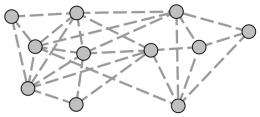
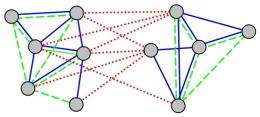
Social networks are made up of different types of social interactions. This multi-relational aspect is usually neglected in the analysis of large social networks. A monochrome representation, such as provided by mobile phone data (see figure 1), leads to a gross representation of the system. The richness of the interactions can only be uncovered by identifying the nature of the links between people (represented by the different colours in figure 2). Because players are immersed in a virtual world in online games, all their actions/communications are stored in log files, resulting in rich data.
A new study analysing interactions between players in a virtual universe game has for the first time provided large-scale evidence to prove an 80 year old psychological theory called Structural Balance Theory. The research, published today in PNAS, shows that individuals tend to avoid stress-causing relationships when they develop a society, resulting in more stable social networks.
Today's study, carried out at Imperial College London, the Medical University of Vienna and the Santa Fe Institute, analyses relationships between 300,000 players in an online game called Pardus. In this open-ended game, players act as spacecraft exploring a virtual universe, where they can make friends and enemies, and communicate, trade and fight with one another.
Scientists currently study data from people's electronic interactions, such as emails, mobile phones and online retail behaviour, to improve our understanding of human societies. Online games such as Pardus produce vast amounts of data that scientists can also use to study interactions between players, applying their findings to understanding the way that people interact in society.
Structural Balance Theory is an 80 year old psychological theory that suggests some networks of relationships are more stable than others in a society. Specifically, the theory deals with positive and negative links between three individuals, where 'the friend of my enemy is my enemy' is more stable (and therefore more common) than 'the friend of my friend is my enemy'.
In today's study, information about interactions between players in the game is more detailed than that from other electronic sources, because it includes data on the types of relationship and whether the interactions are positive or negative. This has enabled the authors of the study to show that positive relationships form stable networks in society, proving Structural Balance Theory for the first time.
Dr Renaud Lambiotte, one of the authors of the study from the Institute for Mathematical Sciences at Imperial College London, said: "I find it fascinating to understand how we all interact with one another to form complex social networks. I think it is astounding that I'm this tiny point in such an enormous network of people. Our new study reveals in more detail than ever before the key ingredients that make these networks stable."
In today's study, mathematicians looked at six types of interaction between players in an online game: friendship, communication, trade, hostility, aggression and punishment. Each one defines a network on its own; all six together combine to form one large network. A unique aspect of the data is that some of the links have a positive connotation (friendship, communication and trade), while others correspond to negative interactions (hostility, aggression and punishment).
The researchers analysed data from the game on two levels: first by analysing individual networks; and then by looking at the interplay between all the networks.
The authors found that in positive relationships, players are more likely to reciprocate actions and sentiments than in negative ones. For example, if player A declares player B to be their friend, player B is likely to do the same. If player A declares player B to be their enemy, however, player B is not likely to reciprocate.
The research also revealed strong interactions between different types of links, with some networks overlapping extensively, as players are likely to engage in similar interactions, and others tending to exclude each other. For example, friendship and communication networks overlap: as we would expect, friends tend to talk to each other. However, trade and hostility did not overlap at all, showing that enemies tend not to trade with one another.
Dr Renaud Lambiotte said: "This may seem like an obvious finding, as we would all prefer to communicate more with people we like. However, nobody has shown the evidence for this theory on such a large scale before."
The researchers are currently developing their mathematical tools for large, complex networks in order to study patterns of communication between millions of people from mobile phone data and also to examine biological problems such as the way different regions of the brain communicate with each other.
More information: “Trade, conflict, and sentiments: Multirelational organization of large-scale social networks” PNAS, 19 July 2010. Corresponding author: Stefan Thurner
-
Surprising results: Virtual games players stick close to home
Feb 14, 2009 |
not rated yet |
0
-
Physics Model Determines Dynamics of Friends and Enemies
Dec 02, 2009 |
not rated yet |
0
-
Tracking the digital traces of social networks
Feb 14, 2009 |
not rated yet |
0
-
Some online video games found to promote 'sociability,' researchers say
Aug 17, 2006 |
not rated yet |
0
-
Game theoretic machine learning methods can help explain long periods of conflict
May 13, 2010 |
not rated yet |
0
-
Engineers build first sub-10-nm carbon nanotube transistor
Feb 01, 2012 |
4.9 / 5 (31) |
30
-
Something old, something new: Evolution and the structural divergence of duplicate genes
Jan 31, 2012 |
4.6 / 5 (7) |
1
-
The hidden nanoworld of ice crystals: Revealing the dynamic behavior of quasi-liquid layers
Jan 30, 2012 |
5 / 5 (3) |
1
-
Stock market network reveals investor clustering
Jan 27, 2012 |
3.9 / 5 (23) |
8
-
Of microchemistry and molecules: Electronic microfluidic device synthesizes biocompatible probes
Jan 26, 2012 |
5 / 5 (1) |
0
-
Can I forget a language?
14 hours ago
-
The Biggest Lie Ever
Feb 09, 2012
-
What are the limits of learning?
Feb 06, 2012
-
Isn't that grammatically wrong?
Feb 06, 2012
-
What does it mean when traders are indifferent?
Feb 04, 2012
-
Peak of Our Civilization
Feb 04, 2012
- More from Physics Forums - Social Sciences
More news stories
A frank discussion of the power law and linking correlation to causation
(PhysOrg.com) -- Michael Stumpf a mathematics professor at Imperial College in London, and Mason Porter a lecturer at Oxford have teamed together to write and publish a perspective piece in Science regarding the in ...
Employers feel no love for unscrupulous practice of 'service sweethearting'
A new study led by two Florida State University marketing professors finds that some frontline service employees who are rewarded for hikes in customer loyalty and satisfaction also may engage in "service ...
Other Sciences / Economics & Business
11 hours ago |
4 / 5 (1) |
5
The question of life in the ancient world
Theres a general feeling that we dont get the Greeks ancient or modern. Many, including heads of state like Angela Merkel, visibly shake their head in exasperation, rightly or wrongly, at ...
Other Sciences / Archaeology & Fossils
17 hours ago |
1.3 / 5 (3) |
4
Sonic Cradle lands spot in TED exhibition
A Simon Fraser University graduate student project that melds music, meditation and modern technology has landed a rare spot as an exhibit at TEDActive 2012 in Palm Springs, California this month.
13 hours ago |
not rated yet |
0
Do we no longer care about the collective good?
The Transformation of Solidarity, a book co-edited by University of Queensland sociologist Dr Mara Yerkes, tackles the subject of globalisation of national economies and societies where we put a high value ...
Other Sciences / Social Sciences
Feb 06, 2012 |
3.9 / 5 (8) |
39
Anonymous knocks CIA website offline (Update)
The website of the Central Intelligence Agency was inaccessible on Friday after the hacker group Anonymous claimed to have knocked it offline.
Google users warned of threat to smartphone wallets
Users of Google smartphone wallets were being warned on Friday that there is a way to crack pass codes intended to thwart thieves from going on illicit shopping sprees.
New error-correcting codes guarantee the fastest possible rate of data transmission
Error-correcting codes are one of the triumphs of the digital age. Theyre a way of encoding information so that it can be transmitted across a communication channel such as an optical fiber o ...
Humans may have helped the decline of African rainforests 3000 years ago
(PhysOrg.com) -- Large areas of rainforests in Central Africa mysteriously disappeared over three thousand years ago, to be replaced by savannas. The prevailing theory has been that the cause was a change ...
New power source discovered
(PhysOrg.com) -- Researchers at the Massachusetts Institute of Technology (MIT) and RMIT University have made a breakthrough in energy storage and power generation.
The power of estrogen -- male snakes attract other males
A new study has shown that boosting the estrogen levels of male garter snakes causes them to secrete the same pheromones that females use to attract suitors, and turned the males into just about the sexiest ...

Jul 19, 2010
Rank: 5 / 5 (1)
Now why does anyone think that this game play is any different? It isn't ~ people know they are playing and modify their behaviour accordingly.
Question: how many children, who would faint at the site of blood, play games that show blood? How many people, who would never exceed the speed limit, race cars in the street in game play? My 81 year old mother enjoys playing 'Road Rash' but refused an offer to ride in the side car of a Harley Davidson motorbike on the occasion of her 80th birthday ~ too dangerous for her...