Computer program predicts MRSA's next move
July 19, 2010
Computer program predicts  MRSA's next move

Enlarge

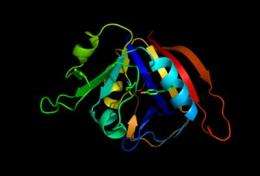
This image is a visualization of the 3-D crystal structure of the top-scoring DHFR protein mutant, determined from experimental data. DHFR is a likely molecule for attack by a drug to stop MRSA bacteria infections. The new K* Algorithm predicted both the structures of the mutants and affinity, how well the mutants would interact both with the inhibitor drug molecule and the native substrate. Scientists' next step would be to redesign the inhibitor or design a new inhibitor that better binds to the mutant DHFR protein, as predicted by Algorithm K*, as well as to the wild-type MRSA bacterium DHFR. Alternately, they may try to design a new inhibitor that would bind better to the mutant DHFR proteins predicted by K*, and use a combination therapy of the Old inhibitor (which binds well to the wild-type MSRA DHFR) plus the New inhibitor, to block mutants that may come along over time. These mutations (shown as stick residues) cause an 18-fold loss in affinity, and crystal structures show a conformation with significantly reduced protein:inhibitor interactions. The mutations are the colored (green and red) sticks that stick out of the rainbow-colored ribbon drawing of the DHFR protein. The mutations are in two places because the mutant has two amino acid mutations. Credit: Image Courtesy of Bruce R. Donald, Duke Univ. Medical Center

Researchers at Duke University Medical Center are using computers to identify how one strain of dangerous bacteria might mutate in the same way a champion chess player tries to anticipate an opponent's strategies.

The predictive software could result in better drug design to beat antibiotic-resistant mutations.

"This work shows a way to predict to antibiotics under development, before research progresses and tests of the antibiotics begin in people, and even before doing laboratory procedures to explore potential resistance," said Bruce Donald, Ph.D., Duke's William and Sue Gross Professor of Computer Science and Biochemistry. "The protein-design algorithms that predict mutations could be used in a drug-design strategy against any pathogen target that could gain resistance through mutation. It's very expensive and labor-intensive to go back to square one and redesign a drug when a bacterium gains resistance to a drug's existing structure."

A paper describing the work will appear in the the week of Monday, July 19.

Certain bacteria, like MRSA () are dangerous because they mutate swiftly and cleverly to evade drugs designed to block the pathogen's essential biological pathways. In this study, the researchers examined mutations in a MRSA enzyme called dihydrofolate reductase (DHFR), which is targeted by several drugs. Almost every has a version of DHFR, because it is an enzyme needed at a critical step in a pathway that takes folic acid and turns it into thymidine, one of the four building blocks of DNA—the "T" in the A-C-G-T nucleotides.

"We are excited about the prediction power we have, in this case with MRSA, because we used a sophisticated algorithm that models protein and drug flexibility while searching for mutants," Donald said. "We used our algorithm to find mutation candidates that satisfy both a positive design - structures that still allow the bacterial enzyme to do its work - and also negative design - they block the ability of a brand new antibiotic drug to do its job. The algorithm found candidates that would be able to block the antibiotic while at the same time allowing the native reaction of the bacterial enzyme to occur."

"We're basically trying to do a pre-emptive strike, and this study is a step toward identifying antibiotics that can pre-emptively deal with possible resistance in nature," said lead author Ivelin Georgiev, Ph.D., who did the work while he was a graduate student in the Donald lab and has since moved to the National Institutes of Health.

Donald said that some bacteria, such as MRSA, escape antibiotics by evolving mutations to change the shape of the active site of their enzymes. "Our algorithm tries to predict that process," he said.

The authors will provide their algorithm freely and publish the open-source software they devised.

Donald added: "My kids are now 9 and 11, and when I ask about the they took 10 years ago, I'm now told these are not strong enough to treat the same illnesses, which is a real-life example of drug resistance," Donald said.

Working with longtime collaborators from the University of Connecticut under Amy Anderson, the Duke team built on its computer program for designing enzyme structures to uncover the possible "chess moves" that MRSA might make to evade a drug that binds to DHFR to slow or stop its actions.

That algorithm features a "dead-end elimination" feature that can process all of the possible chemical interactions to sort through outcomes that would not work well for the bacterium. Last year, Donald, Georgiev, Duke student Cheng-Yu Chen and Anderson published a paper in PNAS about this K* (K Star) algorithm, which can search through all the possible shapes and changes of a desired enzyme.

For the MRSA study, the Connecticut team tested its new inhibitor molecule with four promising potential enzyme mutants predicted by the Donald lab using K*. Three of the mutants maintained activity but also displayed lower affinity for the drug molecule, a propargyl-linked antifolate inhibitor. When team members determined the crystal structure of the top-ranked mutant enzyme bound to the inhibitor drug, the structure showed that the drug clearly had significantly fewer interactions with the protein, providing insight into the reasons why this mutant DHFR evades the drug.

Provided by Duke University Medical Center (news : web)


Rank 5 /5 (10 votes)
Related Stories
Relevant PhysicsForums posts
  • Stoichiometry
    createdFeb 10, 2012
  • Boiling and melting point of impure substances
    createdFeb 10, 2012
  • Safe nitrogen compound to decompose a 500 deg C in a furnace?
    createdFeb 09, 2012
  • [ask]electron inside drinking water
    createdFeb 08, 2012
  • How to avoid formation of Lithium Chromate ???
    createdFeb 08, 2012
  • how to choose a reduced or oxidated form in a redox
    createdFeb 08, 2012
  • More from Physics Forums - Chemistry

More news stories

Fool's gold may prove an unlikely alternative to overexploited catalytic materials

Catalytic materials, which lower the energy barriers for chemical reactions, are used in everything from the commercial production of chemicals to catalytic converters in car engines. However, with current catalytic materials ...

Chemistry / Materials Science

created 17 hours ago | popularity 4.4 / 5 (8) | comments 5 | with audio podcast

Unpicking HIV’s invisibility cloak

Drug researchers hunting for alternative ways to treat human immunodeficiency virus (HIV) infections may soon have a novel target—its camouflage coat. HIV hides inside a cloak unusually rich in a sugar ...

Chemistry / Biochemistry

created 17 hours ago | popularity 5 / 5 (5) | comments 0

Hydrogen from acidic water: Researchers develop potential low cost alternative to platinum for splitting water

A technique for creating a new molecule that structurally and chemically replicates the active part of the widely used industrial catalyst molybdenite has been developed by researchers with the Lawrence Berkeley ...

Chemistry / Materials Science

created Feb 09, 2012 | popularity 4.8 / 5 (14) | comments 15 | with audio podcast

No entry without protein recycling: Researchers discover new coherence in enzyme transport

The group of Prof. Dr. Ralf Erdmann at the Ruhr-Universität Bochum, Germany, discovered a connection of peroxisomal protein import and receptor export. In the Journal of Biological Chemistry, they disclo ...

Chemistry / Biochemistry

created 17 hours ago | popularity not rated yet | comments 0

Under the microscope #7

In this video Dr Ingrid Graz shows us a thin layer of gold on top of rubber. Cracks in the gold allow it to stretch and we can use this for stretchable electronics.

Chemistry / Other

created 19 hours ago | popularity not rated yet | comments 0


Anonymous knocks CIA website offline (Update)

The website of the Central Intelligence Agency was inaccessible on Friday after the hacker group Anonymous claimed to have knocked it offline.

New error-correcting codes guarantee the fastest possible rate of data transmission

Error-correcting codes are one of the triumphs of the digital age. They’re a way of encoding information so that it can be transmitted across a communication channel — such as an optical fiber o ...

Humans may have helped the decline of African rainforests 3000 years ago

(PhysOrg.com) -- Large areas of rainforests in Central Africa mysteriously disappeared over three thousand years ago, to be replaced by savannas. The prevailing theory has been that the cause was a change ...

Google users warned of threat to smartphone wallets

Users of Google smartphone wallets were being warned on Friday that there is a way to crack pass codes intended to thwart thieves from going on illicit shopping sprees.

New power source discovered

(PhysOrg.com) -- Researchers at the Massachusetts Institute of Technology (MIT) and RMIT University have made a breakthrough in energy storage and power generation.

The power of estrogen -- male snakes attract other males

A new study has shown that boosting the estrogen levels of male garter snakes causes them to secrete the same pheromones that females use to attract suitors, and turned the males into just about the sexiest ...