Tour de France Stresses Riders' Bodies to the Limit
July 19, 2010 By Chris Gorski
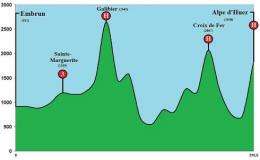
The Tour de France has 20 stages, some of which go through mountainous territory. Pictured here is a graph of the elevations encountered during stage 17. Credit: Rubietje88
Glancing at the elevation profiles of the stages of the 2010 Tour de France is enough to tire a couch potato. The mountainous race is legendarily strenuous, but beyond short-term discomforts such as road rash and bruised egos, some impacts could last long after racers retire.
Cyclists tend to have relatively low bone density, but it's not exactly clear why. Inadequate nutrition or abnormal hormonal status could be causes, but so could the time spent on a bicycle. Recent research shows that proper nutrition appears to be enough to protect bones from harm during days-long stage races, of which the famously mountainous Tour de France is an extreme example.
Even with young and otherwise healthy competitors, low bone density can be a bad sign, because the measurement commonly decreases as people age, putting those with below average values for their ages at a higher risk for osteoporosis.
Cyclists are supported in a seat, leaving their bones less stressed by their activity than other endurance athletes such as runners, whose activity directly impacts their bones.
"If your skeleton isn't being stressed, then your body doesn't put energy into maintaining bone mass that's not needed," said Pamela Hinton, a cyclist, nutritionist and exercise physiologist at the University of Missouri in Columbia.
It's clear that nutrition is a significant factor. Under race conditions, athletes produce large amounts of sweat, which contains calcium. If athletes don't replenish those losses with calcium from their diets, their bodies may steal calcium from bones.
Cyclists must maintain an overall energy balance -- offsetting the herculean number of calories burned by greatly increasing consumption. This balance affects bone mass by altering the processes of bone breakdown and formation. Hinton’s study was part of a larger investigation that examined cyclists to see how well they maintain energy balance under strenuous conditions.
Hinton's experiment measured the energy input and output of riders in the Tour of Southland, a multi-day, multi-stage race in New Zealand. She collected blood and tested it for biomarkers that indicate bone formation and bone breakdown.
"What we saw was that [the cyclists] did a good job of consuming enough calories to meet their energy requirements," said Hinton. "We just saw a large increase in a bone formation marker and a smaller increase in a bone breakdown marker."
Keeping the bone formation marker elevated is crucial, because strenuous exercise will cause bone to break down and a possible loss of bone mass over time. Increasing the body's bone formation efforts to match the rise in breakdown requires fuel.
Cyclists must eat food before, during and after each ride -- and lots of it. Identifying a competitor's basic needs in terms of carbohydrates, proteins, and fats can be done during training and customized to what works best for the individual, but no one trains with the kind of intensity the Tour de France demands -- over three weeks of racing with just two days of rest.
"You're not going to be able to stay on top of the calories that you need," said Phil Cutti, a triathlete and the director of the Human Performance Laboratory at Stanford University in Palo Alto, California. "[Your body] is going to be getting those calories from somewhere -- breaking down bone, breaking down muscle."
During the Tour de France, racers might lose 10 pounds from already trim bodies. Cyclists aren't built like linebackers; that represents a significant amount of weight loss.
"It's not fat," said Cutti. "It's lean body mass including muscle and bone."
Within the sport, understanding of the exact combination of calories and nutrients that the body needs to perform at its best has greatly advanced in the last decade or two, said Cutti, especially the idea that individual riders may differ in their needs.
An ironic symptom of excessively strenuous exercise is appetite suppression. Riders may understand the need to consume a certain amount of calories to maintain their performance and their bones. But if they don't feel hungry, it can be a struggle to ingest the calories they need to avoid breaking down the muscles and bones they need to perform.
"I've talked to people who've done the race [the Tour de France]," said Cutti. "They have the food in front of them, but they can't make themselves eat."
Food is fuel, everyone knows, but forcing down yet another plate of pasta isn't always appetizing -- even if your bones depend on it.
Provided by Inside Science News Service
-
Maintaining energy balance during races may protect cyclists' bones, researcher says
May 05, 2010 |
not rated yet |
0
-
Accelerated bone turnover remains after weight loss
Jul 28, 2008 |
not rated yet |
0
-
Building strong bones: Running may provide more benefits than resistance training
Feb 27, 2009 |
not rated yet |
0
-
Weight-bearing exercise does not prevent increased bone turnover during weight loss
Mar 11, 2010 |
not rated yet |
0
-
Calorie restriction does not appear to induce bone loss in overweight adults
Sep 22, 2008 |
not rated yet |
0
-
Engineers build first sub-10-nm carbon nanotube transistor
Feb 01, 2012 |
4.9 / 5 (30) |
30
-
Something old, something new: Evolution and the structural divergence of duplicate genes
Jan 31, 2012 |
4.6 / 5 (7) |
1
-
The hidden nanoworld of ice crystals: Revealing the dynamic behavior of quasi-liquid layers
Jan 30, 2012 |
5 / 5 (3) |
1
-
Stock market network reveals investor clustering
Jan 27, 2012 |
3.9 / 5 (23) |
8
-
Of microchemistry and molecules: Electronic microfluidic device synthesizes biocompatible probes
Jan 26, 2012 |
5 / 5 (1) |
0
-
Classical and Quantum Mechanics via Lie algebras
Apr 15, 2011
- More from Physics Forums - Independent Research
More news stories
Seeing colors in music, tasting flavors in shapes may happen in life's early months
Famed violinist Itzhak Perlman sees a deep forest green whenever he plays a B-flat on his Stradivarius' G string. The A on the E string is red.
Medicine & Health / Psychology & Psychiatry
12 minutes ago |
5 / 5 (1) |
0
|
Study suggests girls can 'rewire' brains to ward off depression
(Medical Xpress) -- What if you could teach your brain to respond differently to things that make you feel sad, down or stressed out? What if doing that helped ward off depression?
Medicine & Health / Psychology & Psychiatry
39 minutes ago |
not rated yet |
0
UNC investigator issues call to action for schizophrenia research
(Medical Xpress) -- Much of medical research is aimed at figuring out what role a single gene or molecule plays in the development of disease.
Medicine & Health / Psychology & Psychiatry
34 minutes ago |
5 / 5 (1) |
0
What does love look like?
What does love look like? A dozen roses delivered on an ordinary weekday? Breakfast in bed? Or just a knowing glance between lovers?
Medicine & Health / Psychology & Psychiatry
33 minutes ago |
not rated yet |
0
Numeracy: The educational gift that keeps on giving?
(Medical Xpress) -- Cancer risks. Investment alternatives. Calories. Numbers are everywhere in daily life, and they figure into all sorts of decisions. A new article published in Current Directions in Psychological Science, a journal of the Association for Psychological Science, examin ...
Medicine & Health / Psychology & Psychiatry
26 minutes ago |
not rated yet |
0
|
New error-correcting codes guarantee the fastest possible rate of data transmission
Error-correcting codes are one of the triumphs of the digital age. Theyre a way of encoding information so that it can be transmitted across a communication channel such as an optical fiber o ...
A frank discussion of the power law and linking correlation to causation
(PhysOrg.com) -- Michael Stumpf a mathematics professor at Imperial College in London, and Mason Porter a lecturer at Oxford have teamed together to write and publish a perspective piece in Science regarding the in ...
Mars Science Laboratory computer issue resolved
(PhysOrg.com) -- Engineers have found the root cause of a computer reset that occurred two months ago on NASA's Mars Science Laboratory and have determined how to correct it.
Advanced power-grid model finds low-cost, low-carbon future in West
(PhysOrg.com) -- The least expensive way for the Western U.S. to reduce greenhouse gas emissions enough to help prevent the worst consequences of global warming is to replace coal with renewable and other ...
Small modular reactor design could be a 'SUPERSTAR'
(PhysOrg.com) -- Though most of today's nuclear reactors are cooled by water, we've long known that there are alternatives; in fact, the world's first nuclear-powered electricity in 1951 came from a reactor ...
Clam fields found at deep, low-temperature Mariana vents
(PhysOrg.com) -- Scientists have marveled at the unusual life forms thriving at high temperature hydrothermal vents of the deep ocean.
Jul 20, 2010
Rank: not rated yet