Biophysicist explores the science behind the mind-body practice of tai chi
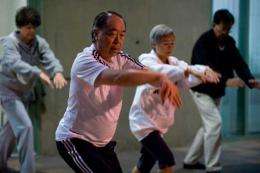
(PhysOrg.com) -- Shin Lin moves with a measured grace that comes from years of practicing tai chi, the centuries-old Chinese martial art that emphasizes serenity and calm over combat. When practicing tai chi, his hands slowly push the air and his body sways like "seaweed that's gently carried by the water."
"Tai chi's almost like a dance," he says. "I breathe in, I breathe out. I visualize myself on the beach, with gentle waves rolling onto the sand and rolling back out. It's a moving meditation."
Watching Lin perform tai chi is like seeing Kobe shoot hoops or Mickelson swing a club: He's at the top of his game and makes even difficult steps look easy.
The UC Irvine professor of developmental & cell biology and biomedical engineering has become an internationally recognized expert in tai chi as well as qigong — a more diverse family of Chinese mind-body practices — and he has advanced training in several major styles of kung fu.
Like a sports star, Lin has graced the cover of Tai Chi magazine, the Sports Illustrated of the international tai chi community. He's been featured in an "NBC Nightly News" segment on mind-body medicine. And he's one of only a few "indoor disciples" — the exclusive inner circle in the U.S. — of Grandmaster Chen Zheng Lei, the 19th-generation family heir of Chen-style tai chi (the oldest parent form of the practice).
"Tai chi means the ultimate harmony of yin and yang. Where there's softness, there's also hardness within; and where there's hardness, there's softness within," Lin says. "It's primarily a gentle martial art, but there are fast and slow movements. I could use it to hit somebody. I could be like Arnold Schwarzenegger and lock onto someone's wrist and break his elbow."
Interest in tai chi has soared as more stressed-out Americans seek relief through yoga, meditation and other Eastern practices. When Lin first volunteered to teach tai chi five years ago through UCI's Susan Samueli Center for Integrative Medicine, his class attracted only a small band of followers. Now he teaches six sessions, from beginning to advanced, with a typical one drawing about 20 students outside Hewitt Research Hall.
Lin, who began studying martial arts as a teenager in his native Hong Kong, has developed a new method of teaching tai chi to help students realize its benefits earlier in their training.
"Tai chi is not a simple dance. In traditional tai chi, you first memorize up to 108 of these beautiful but difficult moves, like 'the white crane spreads its wings' or 'parting the wild horse's mane,'" he says. "It can take a year to learn them all. Most people quit before they begin to coordinate the moves with the breathing and meditative concentration to achieve full mind-body relaxation. We have a new approach: We learn one move and begin incorporating the breathing and meditation right away. It's a lot more accessible."
Lin calls this "science-based" tai chi because he chooses movements that enhance mind-body functions, which he measures at his Laboratory for Mind/Body Signaling & Energy Research with biomedical instruments like heart rate and brain wave monitors, an infrared camera that records changes in body temperature, a photon counter that gauges light emission from the body, and a laser Doppler device that calculates blood flow.
"We don't just randomly pick moves to teach. We're studying each to see its effect on the body," says Lin, past chair of biophysics at Johns Hopkins University and former dean of biological sciences at UCI, which he joined in 1997.
"Studies have shown that tai chi and qigong can boost body flexibility and balance, as well as lower blood pressure and cholesterol. Others suggest these practices can enhance serotonin and endorphins," he says. "Our lab has found that tai chi and qigong can increase blood flow and body energy levels measured as heat, light and electricity. In the past, there's been no scientific data to prove this. We're leaders in this field of research."
Because of his work and expertise, Lin was appointed in 2007 by the U.S. secretary of health & human services to the National Advisory Council for Complementary & Alternative Medicine, which offers recommendations to the National Institutes of Health on where to focus research funds. He's also permanent co-chair of the World Congress on Qigong & Traditional Chinese Medicine and a co-creator of the annual World Tai Chi & Qigong Day, which is celebrated in major cities in 75 countries. This year's Orange County event, presented by the Samueli Center last April, attracted hundreds of participants to Aldrich Park.
"Tai chi is a very profound exercise. It increases your body energy instead of burning it up and triggers the relaxation response," Lin says. "I'm trying to make it accessible to everyone."


