CSI at the service of cellulose synthesis
July 20, 2010
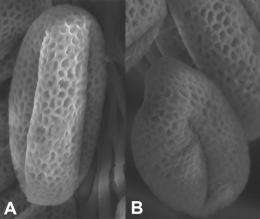
Electron microscope image of Arabidopsis pollen: A: Typical pollen grain from an Arabidopsis model plant with normal cellulose production B: Deformed pollen grain from a cellulose-deficient mutant, e.g. lacking CSI1. Image: Staffan Persson
(PhysOrg.com) -- Grains, vegetables and fruit taste delicious and are important sources of energy. However, humans cannot digest the main component of plants - the cellulose in the cell wall. Even in ruminants, animals that can metabolise cellulose, the digestibility of the cell wall plays a crucial role in feed utilisation. Scientists are therefore looking for ways of increasing the digestibility of animal feed, and of utilising plant cell walls to generate energy. To do this they must first understand how plant cells develop their cell walls from cellulose and identify the genes and proteins involved.
Scientists at the Max Planck Institute of Molecular Plant Physiology in Potsdam, working in collaboration with colleagues from the USA, have now discovered a hitherto unknown protein required for cellulose production. (PNAS, July 1, 2010, prepublished online)
Unlike animal cells, plant cells have a cell wall made of various sugar polymers, the main component of which is cellulose. This gives the plant its stability, protects it against pathogens and is involved in seed germination and fruit maturity. Cellulose accounts for between 35% and 50% of the dry weight of plants, making it the most common biopolymer on earth.
Cellulose is synthesized directly at the plasma membrane by a protein complex. Up to now, cellulose synthase (CESA) was the only known component of this complex. This enzyme arises in plant cells in different forms that vary in structure. Genetic studies indicate that three of these forms, CESA1, CESA3 and CESA6, are required for the synthesis of the primary cell wall, while CESA4, CESA7 and CESA8 are necessary for the synthesis of the secondary cell wall. The primary cell wall forms during cell growth and is particularly flexible and ductile. In contrast, the secondary cell wall forms when the cell is fully grown and is thicker and more rigid than the primary cell wall.
It was not previously known how many forms of CESA exist in the protein complex and whether it contains other proteins. Scientists working with Staffan Persson at the Max Planck Institute of Molecular Plant Physiology and their colleagues in the USA have now identified the Cellulose Synthase-Interactive Protein - CSI1 - which is involved in cellulose synthesis. CSI1 appears to be associated with the CESA complex as it interacts with the cellulose synthases of the primary cell wall (CESA1, 3 and 6). The researchers succeeded in demonstrating that the protein plays an important role in the formation of cellulose. "Plants that cannot form any CSI1 due to a mutation demonstrably produce less cellulose. They have short and swollen roots, and their pollen grains collapse," explains Dr. Staffan Persson.
The scientists have yet to discover the precise role played by CSI1 in cellulose synthesis. They suspect that the protein influences the speed of cellulose production and the spatial orientation of the individual cellulose fibrils. The researchers would thus now like to examine the precise role of CSI1. The insights gained from these more detailed studies will contribute to a better understanding of the biosynthesis of cell walls. This knowledge could increase the chances of achieving better cell wall digestibility in animal feed, and enable the utilisation of cell walls to generate energy.
More information: Ying Gu, Nick Kaplinsky, Martin Bringmann, Alex Cobb, Andrew Carroll, Arun Sampathkumar, Tobias I. Baskin, Staffan Persson und Chris R. Somerville, Identification of a cellulose synthase-associated protein required for cellulose biosynthesis, PNAS, July 1, 2010, prepublished online (doi: 10.1073/pnas.1007092107)
-
Advance in understanding cellulose synthesis
Jun 14, 2009 |
not rated yet |
0
-
Formation of cellulose fibers tracked for the first time
Apr 20, 2006 |
not rated yet |
0
-
Drilling down to the nanometer depths of leaves for biofuels
Jul 19, 2010 |
not rated yet |
0
-
Scaling the Plant Cell Wall
Feb 14, 2005 |
not rated yet |
0
-
Protein power for Jack and the beanstalk
May 17, 2010 |
not rated yet |
0
-
Engineers build first sub-10-nm carbon nanotube transistor
Feb 01, 2012 |
4.9 / 5 (31) |
30
-
Something old, something new: Evolution and the structural divergence of duplicate genes
Jan 31, 2012 |
4.6 / 5 (7) |
1
-
The hidden nanoworld of ice crystals: Revealing the dynamic behavior of quasi-liquid layers
Jan 30, 2012 |
5 / 5 (3) |
1
-
Stock market network reveals investor clustering
Jan 27, 2012 |
3.9 / 5 (23) |
8
-
Of microchemistry and molecules: Electronic microfluidic device synthesizes biocompatible probes
Jan 26, 2012 |
5 / 5 (1) |
0
-
Protease cleavage
3 hours ago
-
Pertubance in a model
9 hours ago
-
Cancer drugs and Alzheimer's, Oh my!
18 hours ago
-
Squishing cells
18 hours ago
-
Any books/articles for evolutionary stable strategy models in humans?
Feb 09, 2012
-
Science behind the bore feeling?
Feb 09, 2012
- More from Physics Forums - Biology
More news stories
The power of estrogen -- male snakes attract other males
A new study has shown that boosting the estrogen levels of male garter snakes causes them to secrete the same pheromones that females use to attract suitors, and turned the males into just about the sexiest ...
8 hours ago |
5 / 5 (3) |
0
|
Grass to gas: Researchers' genome map speeds biofuel development
Researchers at the University of Georgia have taken a major step in the ongoing effort to find sources of cleaner, renewable energy by mapping the genomes of two originator cells of Miscanthus x giganteus, a large perenn ...
5 hours ago |
3.7 / 5 (3) |
0
|
Experts reveal how plants don't get sunburn
(PhysOrg.com) -- Experts at the University of Glasgow have discovered how plants survive the harmful rays of the sun.
8 hours ago |
5 / 5 (2) |
0
|
Protein libraries in a snap
(PhysOrg.com) -- A Rice University undergraduate will depart with not only a degree but also a possible patent for his invention of an efficient way to create protein libraries, an important component of biomolecular ...
11 hours ago |
5 / 5 (2) |
0
|
Miami battling invasion of giant African snails
No one knows how they got there. But an invasion of African giant snails has southern Florida in a panic over potential crop damage, disease and general yuckiness surrounding the slimy gastropods.
12 hours ago |
not rated yet |
2
Google users warned of threat to smartphone wallets
Users of Google smartphone wallets were being warned on Friday that there is a way to crack pass codes intended to thwart thieves from going on illicit shopping sprees.
NASA sees wide-eyed cyclone Jasmine
Cyclone Jasmine's eye has opened wider on NASA satellite imagery, as it moves through the Southern Pacific Ocean.
NASA sees Giovanna reach cyclone strength, threaten Madagascar
Tropical Storm 12S built up steam and became a cyclone on February 10, 2012 as NASA's Terra satellite passed overhead. Residents of east-central Madagascar should prepare for this cyclone to make landfall ...
CIA website offline, Anonymous takes credit
The website of the Central Intelligence Agency was unresponsive on Friday after the hacker group Anonymous claimed to have knocked it offline.
Complex wiring of the nervous system may rely on a just a handful of genes and proteins
Researchers at the Salk Institute have discovered a startling feature of early brain development that helps to explain how complex neuron wiring patterns are programmed using just a handful of critical genes. ...
Putting the squeeze on planets outside our solar system
(PhysOrg.com) -- Using high-powered lasers, scientists at Lawrence Livermore National Laboratory and collaborators discovered that molten magnesium silicate undergoes a phase change in the liquid state, abruptly ...