HIV's sugar coating offers new vaccine approach
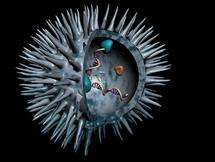
July 20, 2010
(PhysOrg.com) -- Oxford research suggests the chains of sugar molecules, or carbohydrates, that cover the outside of the highly variable HIV virus remain constant, are different from those found on human cells, and could form the basis of a promising new approach to an AIDS vaccine.
The chains of sugar molecules, or carbohydrates, that cover the outside of the highly variable HIV virus remain constant, are different from those found on human cells, and could form the basis of a promising new approach to an AIDS vaccine, according to research led by the University of Oxford.
The researchers suggest that a vaccine based on synthetic versions of the HIV carbohydrate coat, because it is so unchanging, could prime the body’s immune system to recognise the otherwise rapidly changing HIV virus and fight off any infection.
‘We’re used to flu vaccines being reformulated every year because new strains come along,’ said Dr Chris Scanlan of the Department of Biochemistry at the University of Oxford, who led the research. ‘Yet you will see more viral diversity develop in a single HIV patient in a single day than you will in the whole flu season this year across the whole of the UK. That is some challenge for developing a vaccine against HIV.
’We’re cautiously optimistic that this research could lead to a promising new approach for a vaccine against HIV/AIDS,’ said Dr Scanlan. ‘We’ve found something that doesn’t change across all classes of HIV - from viruses found in the USA to those in Uganda - and it’s something that can be made and manufactured.’
The team from Oxford University, The Scripps Research Institute in La Jolla, California, and the Ragon Institute in Boston, Massachusetts report their findings in the journal Proceedings of the National Academy of Sciences (PNAS).
The researchers were able to isolate the carbohydrate coating from different samples of live HIV-1 virus, representing typical viruses found in different parts of the world, and analyse their chemical structures for the first time. They found that the carbohydrates are unique and are found across all classes or ‘clades’ of HIV-1. Importantly, these carbohydrates are completely different to the patterns of sugars found on human cells.
The researchers also showed that existing vaccines being developed against HIV will not have the same carbohydrate structures within their formulations as the native HIV virus and so may not mimic this element of the virus adequately.
'The dense cloud of carbohydrates covering the virus has been called its ‘carbohydrate camouflage’ because the carbohydrate chains look like those on the outside of the body’s own cells, and so they aren’t normally recognised by the immune system,’ explained Dr Scanlan.
‘We’ve shown that HIV’s camouflage may be flawed. The carbohydrates on an HIV virus are different to the body’s own cells, and that might give us an opportunity to attack.
‘It is possible to educate the immune system to these differences. You can include danger signals in your vaccine formulation to force the immune system to take notice of particular carbohydrate structures. Some cancer vaccines in development use this approach, for example,’ he added.
The team now aim to come up with ways of making synthetic versions in the lab of the particular carbohydrates found on the outside of HIV. These could then be combined with an adjuvant - a factor that enhances the body’s immune response - to give a completely new vaccine candidate for evaluation.
The researchers have already shown in their PNAS paper that it is possible to modify a human cell line to produce the gp120 HIV protein with the correct carbohydrates attached. This is one way that the carbohydrates for any future vaccine could be produced.
-
Vaccine to cope with viral diversity in HIV
Apr 27, 2007 |
not rated yet |
0
-
How HIV vaccine might have increased odds of infection
Nov 03, 2008 |
not rated yet |
0
-
Virus used to create experimental HIV vaccines directly impairs the immune response
Nov 15, 2007 |
not rated yet |
0
-
HIV isolate from Kenya provides clues for vaccine design
Jan 02, 2008 |
not rated yet |
0
-
Exhausted B cells hamper immune response to HIV
Jul 14, 2008 |
not rated yet |
0
-
Engineers build first sub-10-nm carbon nanotube transistor
Feb 01, 2012 |
4.9 / 5 (30) |
30
-
Something old, something new: Evolution and the structural divergence of duplicate genes
Jan 31, 2012 |
4.6 / 5 (7) |
1
-
The hidden nanoworld of ice crystals: Revealing the dynamic behavior of quasi-liquid layers
Jan 30, 2012 |
5 / 5 (3) |
1
-
Stock market network reveals investor clustering
Jan 27, 2012 |
3.9 / 5 (23) |
8
-
Of microchemistry and molecules: Electronic microfluidic device synthesizes biocompatible probes
Jan 26, 2012 |
5 / 5 (1) |
0
-
Stoichiometry
10 hours ago
-
Boiling and melting point of impure substances
11 hours ago
-
Safe nitrogen compound to decompose a 500 deg C in a furnace?
18 hours ago
-
[ask]electron inside drinking water
Feb 08, 2012
-
How to avoid formation of Lithium Chromate ???
Feb 08, 2012
-
how to choose a reduced or oxidated form in a redox
Feb 08, 2012
- More from Physics Forums - Chemistry
More news stories
Fool's gold may prove an unlikely alternative to overexploited catalytic materials
Catalytic materials, which lower the energy barriers for chemical reactions, are used in everything from the commercial production of chemicals to catalytic converters in car engines. However, with current catalytic materials ...
1 hour ago |
5 / 5 (1) |
1
|
Unpicking HIV’s invisibility cloak
Drug researchers hunting for alternative ways to treat human immunodeficiency virus (HIV) infections may soon have a novel targetits camouflage coat. HIV hides inside a cloak unusually rich in a sugar ...
1 hour ago |
5 / 5 (2) |
0
Hydrogen from acidic water: Researchers develop potential low cost alternative to platinum for splitting water
A technique for creating a new molecule that structurally and chemically replicates the active part of the widely used industrial catalyst molybdenite has been developed by researchers with the Lawrence Berkeley ...
21 hours ago |
5 / 5 (11) |
11
|
No entry without protein recycling: Researchers discover new coherence in enzyme transport
The group of Prof. Dr. Ralf Erdmann at the Ruhr-Universität Bochum, Germany, discovered a connection of peroxisomal protein import and receptor export. In the Journal of Biological Chemistry, they disclo ...
1 hour ago |
not rated yet |
0
Flexible paper robots
(PhysOrg.com) -- These inexpensive robots can stretch, bend and twist under control, and lift objects up to 120 times their own weight. Being soft, they can apply gentle and even pressure, and adapt to varied ...
19 hours ago |
5 / 5 (5) |
3
|
Netflix light on flicks as viewers soak up TV shows
Like most fresh faces that arrive in Hollywood, Netflix wanted to be a movie star. But now it's learning what many in Tinseltown have known for decades: Movies are sexy, but the real money is in television.
Antidepressants and pregnancy: Women must consider the impact of drugs on baby, and of depression on baby, themselves
Upon learning they are pregnant, most women dutifully nix the alcohol, sushi and caffeine. But what about antidepressants?
Curry spice component may help slow prostate tumor growth
Curcumin, an active component of the Indian curry spice turmeric, may help slow down tumor growth in castration-resistant prostate cancer patients on androgen deprivation therapy (ADT), a study from researchers ...
The power of estrogen -- male snakes attract other males
A new study has shown that boosting the estrogen levels of male garter snakes causes them to secrete the same pheromones that females use to attract suitors, and turned the males into just about the sexiest ...
Humans may have helped the decline of African rainforests 3000 years ago
(PhysOrg.com) -- Large areas of rainforests in Central Africa mysteriously disappeared over three thousand years ago, to be replaced by savannas. The prevailing theory has been that the cause was a change ...
Experts reveal how plants don't get sunburn
(PhysOrg.com) -- Experts at the University of Glasgow have discovered how plants survive the harmful rays of the sun.
Jul 20, 2010
Rank: not rated yet
Just as an aside - is that picture another artistic rendering of an HIV virus or is it a highly souped-up electon microscope image? I think the former. Will the writer(s) of these articles please indicate that?
Please correct me if I'm wrong.
Jul 22, 2010
Rank: not rated yet
The wishful thinking of a heterosexual epidemic in the West 20 years ago failed to come to fruition. Instead all we hear about is "AIDS" in Africa. The thought occurred: Do Africans really have that much sex and so many partners. I decided to go and find out. I went to Uganda in 2004 and ended up spending most of the time there since then.
How can this go on in Uganda and nobody know or care?
Most of all the "AIDS" NGOs need to be exposed. Like the one this lab technicia works for called Mildmay (one of over 7000 AIDS NGOs in Uganda). I interviewed him last year in Kampala. Ugandan children exploited as guinea pigs with toxic drugs by prominent "AIDS" NGOs:
http://vimeo.com/10401254