Next generation surgical robots: Where's the doctor? (w/ Video)
July 20, 2010
Next generation surgical robots: Where's the doctor?

Enlarge

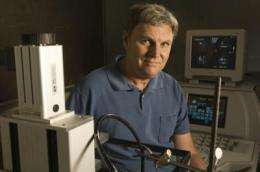
This is Stephen Smith of Duke University. Credit: Duke University Photography

As physician-guided robots routinely operate on patients at most major hospitals, the next generation robot could eliminate a surprising element from that scenario -- the doctor.

Feasibility studies conducted by Duke University bioengineers have demonstrated that a -- without any human assistance -- can locate a man-made, or phantom, lesion in simulated human organs, guide a device to the lesion and take multiple samples during a single session. The researchers believe that as the technology is further developed, autonomous robots could some day perform many more simple surgical tasks.

"Earlier this year we demonstrated that a robot directed by artificial intelligence can on its own locate simulated calcifications and cysts in simulated breast tissue with high repeatability and accuracy," said Kaicheng Liang, a former student in the laboratory of Stephen Smith, director of the Duke University Ultrasound Transducer Group at the Pratt School of Engineering and senior member of the research team. "Now we have shown that the robot can sample up to eight different spots in simulated human prostate tissue."

The results of the Duke research appear in the current issue of the journal Ultrasonic Imaging. An earlier study reported in the January issue of the journal Ultrasound in Medicine and Biology described the Duke team's results on simulated breast tissue. In both experiments, whole turkey breasts were used. Raw turkey breasts are commonly used in medical research because the tissue closely resembles that of humans in texture and density, and appear similar when scanned by ultrasound.

This video is not supported by your browser at this time.

The Duke team combined a "souped-up" version of an existing with an ultrasound system of its own design. The ultrasound serves as the robot's "eyes" by collecting data from its scan and locating its target. The robot is "controlled" not by a physician, but by an artificial intelligence program that takes the real-time 3-D information, processes it and gives the robot specific commands to perform. The robot arm has a mechanical "hand" that can manipulate the same biopsy plunger device that physicians use to reach a lesion and take samples.

In the latest series of experiments, the robot guided the plunger to eight different locations on the simulated prostate tissue in 93 percent of its attempts. This is important because multiple samples can also determine the extent of any lesion, Smith said.

Smith believes that routine medical procedures, such as biopsies in other tissues in the body, will be performed in the future with minimal human guidance, and at greater convenience and less cost to patients.

An important challenge to be overcome is the speed of data acquisition and processing, though the researchers are confident that faster processors and better algorithms will address that issue. To be clinically useful, all of the robot's actions would need to be in real time, the researchers said.

"One of the beauties of this system is that all of the hardware components are already on the market," Smith said. "We believe that this is the first step in showing that with some modifications, systems like this can be built without having to develop a new technology from scratch."

Advances in ultrasound technology have made these latest experiments possible, the researchers said, by generating detailed, 3-D, moving images in real-time. The Duke team has a long track record of modifying traditional 2-D ultrasound -- like that used to image babies in utero -- into the more advanced 3-D scans. The Duke lab invented the technique in 1991.

"We're now testing the robot on a human mannequin seated at the examining table whose breast is constrained in a stiff bra cup," Smith said. "The breast is composed of turkey breast tissue with an embedded grape to simulate a lesion. Our next step is to move to an excised human breast."

Provided by Duke University (news : web)


Rank 5 /5 (5 votes)
Related Stories
Relevant PhysicsForums posts
  • Is Everyday Technology Killing Us?
    createdFeb 08, 2012
  • Exercise and weight loss
    createdFeb 08, 2012
  • Why do we have head aches? Our brains can't feel anything.
    createdFeb 07, 2012
  • "The end of diseases" by David Agus, interview from Daily Show with Jon Stewart
    createdFeb 04, 2012
  • Oncolytic adenovirus
    createdFeb 04, 2012
  • Nutrition label stuffs and diets
    createdFeb 02, 2012
  • More from Physics Forums - Medical Sciences

More news stories

FDA-approved drug rapidly clears amyloid from the brain, reverses Alzheimer's symptoms in mice

Neuroscientists at Case Western Reserve University School of Medicine have made a dramatic breakthrough in their efforts to find a cure for Alzheimer's disease. The researchers' findings, published in the journal Science, show t ...

Medicine & Health / Neuroscience

created 13 hours ago | popularity 4.9 / 5 (32) | comments 14 | with audio podcast

Anyone can learn to be more inventive, cognitive researcher says

There will always be a wild and unpredictable quality to creativity and invention, says Anthony McCaffrey, a cognitive psychology researcher at the University of Massachusetts Amherst, because an "Aha moment" is rare and ...

Medicine & Health / Psychology & Psychiatry

created 9 hours ago | popularity 4.7 / 5 (7) | comments 1 | with audio podcast

Researchers weigh in on ethics of H5N1 research

(Medical Xpress) -- In a commentary on the biosecurity controversy surrounding publication of bird flu research details, a bioethicist and a vaccine expert at Johns Hopkins reaffirm that "all scientists have an affirmativ ...

Medicine & Health / Other

created 11 hours ago | popularity not rated yet | comments 0 | with audio podcast

Cell biologists describes mechanism by which some people may be more susceptible to colon cancer

An international research team led by cell biologists at the University of California, Riverside has uncovered a new insight into colon cancer, the third leading cause of cancer-related deaths in the United ...

Medicine & Health / Cancer

created 9 hours ago | popularity 5 / 5 (3) | comments 0 | with audio podcast

To perform with less effort, practice beyond perfection

Whether you are an athlete, a musician or a stroke patient learning to walk again, practice can make perfect, but more practice may make you more efficient, according to a surprising new University of Colorado Boulder study.

Medicine & Health / Neuroscience

created 12 hours ago | popularity 4.6 / 5 (9) | comments 3 | with audio podcast


'Dark plasmons' transmit energy

Microscopic channels of gold nanoparticles have the ability to transmit electromagnetic energy that starts as light and propagates via "dark plasmons," according to researchers at Rice University.

Hydrogen from acidic water: Researchers develop potential low cost alternative to platinum for splitting water

A technique for creating a new molecule that structurally and chemically replicates the active part of the widely used industrial catalyst molybdenite has been developed by researchers with the Lawrence Berkeley ...

Ultraviolet protection molecule in plants yields its secrets

Lying around in the sun all day is hazardous not just for humans but also for plants, which have no means of escape. Ultraviolet (UV) radiation from the sun can damage proteins and DNA inside cells, leading ...

Soraa LED light may dim 50-watt halogen rivals

(PhysOrg.com) -- Soraa, a Fremont, California company founded in 2008, this week launched its first product, a light that uses LEDS (light emitting diodes). The "Soraa LED MR16 lamp" is the "perfect" replacement ...

Flexible paper robots

(PhysOrg.com) -- These inexpensive robots can stretch, bend and twist under control, and lift objects up to 120 times their own weight. Being soft, they can apply gentle and even pressure, and adapt to varied ...

Engineers find inspiration for new materials in Piranha-proof armor

(PhysOrg.com) -- It’s a matchup worthy of a late-night cable movie: put a school of starving piranha and a 300-pound fish together, and who comes out the winner?