Laser shoots down drones at sea (w/ Video)
July 21, 2010 by Lin Edwards report
Laser shoots down drones at sea

Enlarge

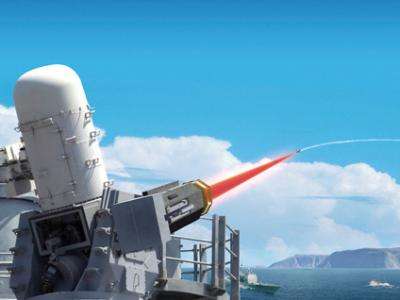
The Phalanx Close-in Weapon System. (Credit: Raytheon)

(PhysOrg.com) -- An infrared laser developed by Arizona company Raytheon Missile Systems has been demonstrated shooting down incoming drones over the ocean off the coast of California.

The video of the demonstration, taken at an off-shore US Navy test range 120 km west of Los Angeles, was released on July 19th at the biennial International Air Show at Farnborough in the UK. The 32-kilowatt solid-state was mounted on a warship gun turret and was shown blasting a remotely piloted (UAV) until it caught fire, lost control, and plummeted into the sea. In all, four UAVs were shot down in the seagoing tests.

’s vice president Mike Booen said the demonstration was a world first with ship-borne lasers shooting down threats from the air at “military significant distances.” Firing a laser at sea is much more difficult than firing from land because it is mounted on a ship, which is moving and rolling with the waves, and it is also in a humid environment heavily laden with salt air.

This video is not supported by your browser at this time.

The US Navy and coastguard's standard defense system, the Phalanx Close-In Weapon System, currently overcomes the problem by using a high caliber, radar-guided Gatling gun that is able to counteract the ship’s movements to track and shoot down incoming objects. The Gatling has been used for over 30 years and is capable of firing up to 4,500 rounds of 20-mm ammunition per minute.

The Navy’s new system for defeating close-in air and surface missiles or drones is known as LaWS (Laser Weapon System) and is paired with Raytheon’s Phalanx. The system comprises six lasers that focus on the target simultaneously, delivering energy high enough to cause it to catch fire. Range data is provided to the laser system by Phalanx radio-frequency sensors, and Phalanx electro-optical sensors acquire the targets and track them.

This video is not supported by your browser at this time.

Editor of Jane’s Defense Weekly, Peter Felstead, said the laser marks the beginning of a new era in missile defense technology, since lasers are becoming smaller and more effective and can be used to destroy a wide range of threats from the air, from mortars to missiles.

Raytheon said the laser system tests are continuing, but the system is unlikely to be ready for deployment until 2016.

© 2010 PhysOrg.com

4.6 /5 (22 votes)  

Filter


Move the slider to adjust rank threshold, so that you can hide some of the comments.


Display comments: newest first

CreepyD
Jul 21, 2010

Rank: 1 / 5 (1)
This is quite a weapon! If you got in range of it, you're basically doomed unless you can destroy the laser turret or get out of range.
I assume a nuclear powered warship would have quite a supply of energy to power these too?
Very sci-fi.
BloodSpill
Jul 21, 2010

Rank: 3.3 / 5 (3)
What happens when the lasers are mounted on the drones themselves and we start having automated laser wars?

Okay that's less of a question and more of a hilarious idea.
Jimbaloid
Jul 21, 2010

Rank: 4.6 / 5 (9)
Bring on the mirrors and reflective paint!
frajo
Jul 21, 2010

Rank: 3 / 5 (2)
The red beam in the picture looks very much photoshopped.
Bob_B
Jul 21, 2010

Rank: 1 / 5 (2)
@frajo:
Infrared is not visible, so an image with no beam would not be interesting would it!?!
danman5000
Jul 21, 2010

Rank: 1 / 5 (1)
Well yeah, it is an infared laser after all. You couldn't see the beam even if it was visible light anyway.
getgoa
Jul 21, 2010

Rank: 3.3 / 5 (4)
The video was black and white? in this day and age.
Oxensraiser?
Jul 21, 2010

Rank: 4.3 / 5 (6)
@getgoa pray tell what what is out of range for a laser? Over the horizon of course. And what shoots over the horizon? Missiles and drones. Which the laser is designed to take out. Its probably really hard to make a traveling salt cloud around a missile. Besides, air-to-air lasers have a amazing distortion reduction system based on using 3 lasers pr shot.

One laser tracks the object to be destroyed.
Another laser reads the distortion in the air between the laser and the target.
And the "kill" laser is then fired, reflecting of a amorphous mirror that distorts the beam initially, and the distortion in the air actually straightens the laser back out. Quite a feat of engineering.
degojoey
Jul 21, 2010

Rank: 3 / 5 (3)
if its an infared laser, the object its hitting must be in size of its wavelengths, which are quite large.
Grallen
Jul 21, 2010

Rank: 1 / 5 (2)
What happens when the lasers are mounted on the drones themselves and we start having automated laser wars?

Okay that's less of a question and more of a hilarious idea.


Sadly this will not happen ad the ground/sea based weapon platform has significant armor and the flying thing does not...

If this technology proliferates, then future wars will not involve aircraft or missiles. Explosive artillery wouldn't really work well either.

Foot soldiers may also not work if computer and imaging tech grow to the level where an automated turret could recognize a gun.
theknifeman
Jul 21, 2010

Rank: 3 / 5 (2)
Technology is going to get so advanced only poor countries will be able to enjoy a good war.
frajo
Jul 21, 2010

Rank: 1 / 5 (1)
Infrared is not visible, so an image with no beam would not be interesting would it!?!
Sure. But I prefer no image to a fake image.
Whom do the fake picture distributors want to impress? Politicians?
M_N
Jul 21, 2010

Rank: 4.3 / 5 (4)
if its an infared laser, the object its hitting must be in size of its wavelengths, which are quite large.

Um, no. The wavelengths are at most a few microns, which is MUCH smaller than the objects they are shooting down...
yyz
Jul 21, 2010

Rank: 5 / 5 (3)
Interesting that there is no explicit mention of the threat this system was primarily designed to counter....cruise missiles. Supersonic cruise missiles, specifically. The Indian BrahMos cruise missile is currently the fastest (~Mach 2.5) and a hypersonic version (~Mach 5) is under development. Countering this threat requires engaging it at greater ranges and with greater speed than is possible with the Gatling gun. As Jimbaloid points out, countermeasures (like reflective surfaces) may be employed to negate the laser heating, but this remains to be seen.

Oxensraiser? makes a good point about beam stability in the open air (and mentions the beam protocol for the Airborne Laser). While this is not addressed in the article, possibly the use of 6 lasers makes up for some of the atmospheric distortions of the individual beams.

I'm also curious how this system operates in inclement weather?
Skultch
Jul 21, 2010

Rank: 1 / 5 (1)
Was I the only one who heard the Death Star theme in my mind as I watched the video? Or maybe you thought of "Everybody wants to rule the world" from the end of Real Genius. :)

Cool tech. Has there been a demonstration yet of an airborne laser hitting multiple targets simultaneously?
alq131
Jul 21, 2010

Rank: 4 / 5 (3)
@theknifeman,

Yes, the evolultion of war reminds me of an episode of the old Star Trek, where war machines evolved to the point that it just made more sense for people to report to extermination chambers. The computers fought the "simulated" wars and assessed casualties, which each side agreed to and certain portions of their populations would report to be vaporized...much "cleaner" wars and SO much more civilized than devoting time and material to creating bombs and missiles...
yyz
Jul 21, 2010

Rank: 5 / 5 (2)
"Whom do the fake picture distributors want to impress?"

Future potential customers.
yyz
Jul 21, 2010

Rank: 5 / 5 (3)
"Has there been a demonstration yet of an airborne laser hitting multiple targets simultaneously?"

No simultaneous engagements, but in Feb. 2010 the ABL shot down a liquid-fueled booster and engaged a second, solid-fueled missile in under an hour (a problem with the beam alignment cut short the second engagement, preventing a shoot down in that case).

Source: http://en.wikiped...#Testing
GaryB
Jul 21, 2010

Rank: 5 / 5 (3)
The video was black and white? in this day and age.

Yes, monochrome cameras have higher resolution and dynamic range for a single sensor and so a tracking video might be done in gray scale even in this day and age.
GaryB
Jul 21, 2010

Rank: 1 / 5 (1)
@theknifeman,

Yes, the evolultion of war reminds me of an episode of the old Star Trek, where war machines evolved to the point that it just made more sense for people to report to extermination chambers. ...SO much more civilized than devoting time and material to creating bombs and missiles...


Maybe we could just fight pure virtual wars in the future. But, we already know how to end all wars, we just have to design an effective and maximally free world government.
PinkElephant
Jul 21, 2010

Rank: not rated yet
@yyz,
As Jimbaloid points out, countermeasures (like reflective surfaces) may be employed to negate the laser heating, but this remains to be seen.
My thoughts as well. Potential responses could include development of lasers with dynamically and rapidly tunable wavelength, or developing x-ray (or at least EUV) lasers (for which there is no known reflective material that works at low angles of incidence.) Or just dispense with lasers, and instead design particle guns or rapid-fire small-caliber railguns...
dirk_bruere
Jul 21, 2010

Rank: not rated yet
Countermeasures will be simple.
I have held a thin carbon fiber mat in a 1kW laser beam with a power density of 1kW per sq cm - a higher density than the beam hitting the drone. The mat glowed brilliant white but did not burn.
rgwalther
Jul 21, 2010

Rank: not rated yet
"Has there been a demonstration yet of an airborne laser hitting multiple targets simultaneously?"

It depends on what you mean by 'simultaneously'? One every 1000th of a second?
rgwalther
Jul 21, 2010

Rank: not rated yet
Maybe we could just fight pure virtual wars in the future. But, we already know how to end all wars, we just have to design an effective and maximally free world government.

And then assassinate the new leaders..."Here comes the new boss, same as the old boss...We won't get fooled again.."
rgwalther
Jul 21, 2010

Rank: not rated yet
Countermeasures will be simple.
I have held a thin carbon fiber mat in a 1kW laser beam with a power density of 1kW per sq cm - a higher density than the beam hitting the drone. The mat glowed brilliant white but did not burn.

What happened to your hand?
purringrumba
Jul 21, 2010

Rank: 5 / 5 (2)
@getgoa pray tell what what is out of range for a laser?


There are a number of things that will limit effective range of a laser weapon in atmosphere. 1) electro-magnetic wave propagation (this is what light is) occurs in what's known as 'Gaussian' beam mode, which says that the laser beam will eventually spread out to very low intensity. 2) scattering by air and particulates in atmosphere. 3) absorption by air. 4) non-linear interaction between laser and air - laser heats air causing it to expand, and become lower density than surrounding, which leads to lower optical index in beam path, which causes light to spread out.
Husky
Jul 22, 2010

Rank: not rated yet
i think lasers mounted on large blimps/jumbos etc are more effective, because they can shoot down through thinner atmosphere, also due to their position, radar sense, engage targets that are past horizon from a ships point of view, i think the navy would fair well with a couple of flying laser guardians around the fleet
Husky
Jul 22, 2010

Rank: not rated yet
ideally you want to have some type of laser AWAC that not only gives a large battle theater view but is able to defend itselves and friendly units in the area. it wouldn't need a squadron of fighter jets in front of it to protect the AWAC
mrlewish
Jul 23, 2010

Rank: not rated yet
useless. Just put a nice ceramic covering on the projectile.. think spaceshuttle tile... up to 21st century standards... or ablative shielding (evaporates when hit with heat thus cooling the craft)
plasticpower
Jul 24, 2010

Rank: 3 / 5 (2)
Something that can reflect the laser and point it back at the source is really all you need.
raffi12
Jul 25, 2010

Rank: 5 / 5 (1)
Even if you had a perfect mirror, water droplets, dust landing on it would quickly turn into a plasma under the laser and scorch everything, removing the reflectivity. The best you could do is slow it down a little. And armor would add weight, reducing the payload, increasing costs.
antialias_physorg
Jul 26, 2010

Rank: not rated yet
Something that can reflect the laser and point it back at the source is really all you need.


Exactly - an IR-transparent dome with a cat eye reflector should do the trick.

Alternatively you could just have the missile rotate which would distribute the heat to the point where shooting anything down becomes much harder. Together with an ablative substance or standard fire retardant coating you can give the projectile ample time to strike its target before that laser burns anything vital.
Skultch
Jul 26, 2010

Rank: not rated yet
"Has there been a demonstration yet of an airborne laser hitting multiple targets simultaneously?"


It depends on what you mean by 'simultaneously'? One every 1000th of a second?


Practically simultaneous that would allow a ship to defend itself from a two-pronged attack.
antialias_physorg
Jul 27, 2010

Rank: not rated yet
Will it work when it's raining?

Bullets do.

Will it work at ranges exceeding line of sight?

Bullets do.
rgwalther
Aug 18, 2010

Rank: not rated yet
Will it work when it's raining?
Bullets do.
Will it work at ranges exceeding line of sight?
Bullets do.


Bullets do, people don't.
Rank 4.6 /5 (22 votes)
Related Stories
Relevant PhysicsForums posts
  • feed hold button on CNC lathe
    created4 hours ago
  • Mechanics of Solids ( Final exam question) plz help!
    created6 hours ago
  • RFAC in Fortran
    created8 hours ago
  • dynamics 2/32
    created14 hours ago
  • dynamics
    created14 hours ago
  • Vibration Absorbtion Problem
    created19 hours ago
  • More from Physics Forums - General Engineering

More news stories

Oracle to pay $1.9B for Taleo, extends SAP rivalry

(AP) -- Oracle Corp. is escalating its rivalry with German business-software maker SAP AG and plans to pay $1.9 billion for Taleo Corp., a company that helps businesses hire and manage their employees.

Technology / Business

created 1 hour ago | popularity not rated yet | comments 0

NFC aid for the visually and hearing impaired

As the proportion of senior citizens grows, their special needs are gaining momentum. Human eyesight, for example, weakens with age. VTT Technical Research Centre of Finland has been developing new NFC-based applications ...

Technology / Engineering

created 15 minutes ago | popularity not rated yet | comments 0

Google launches Chrome browser for Android smartphones

With more and more people connecting to the Internet through a phone or a tablet instead of a PC, Google Inc. is bringing its fast-growing browser, Chrome, to the newest Android-powered mobile devices.

Technology / Software

created 1 hour ago | popularity 5 / 5 (2) | comments 0

Soraa LED light may dim 50-watt halogen rivals

(PhysOrg.com) -- Soraa, a Fremont, California company founded in 2008, this week launched its first product, a light that uses LEDS (light emitting diodes). The "Soraa LED MR16 lamp" is the "perfect" replacement ...

Technology / Semiconductors

created 4 hours ago | popularity 5 / 5 (6) | comments 3 | with audio podcast report

Kodak to stop making cameras, digital frames

Kodak says it will stop making digital cameras, pocket video cameras and digital picture frames in order to focus on its more profitable businesses.

Technology / Business

created 1 hour ago | popularity not rated yet | comments 1


Tidal forces could squeeze out planetary water

Alien planets might experience tidal forces powerful enough to remove all their water, leaving behind hot, dry worlds like Venus, researchers said.

Can indigenous insects be used against the light brown apple moth?

The light brown apple moth (LBAM), Epiphyas postvittana (Walker), an invasive insect from Australia, was found in California in 2006. The LBAM feeds on apples, pears, stonefruits, citrus, grapes, berries and many other plants ...

Physics research suggests new pathways for cancer progression

Observing that certain cancer cells may exhibit greater flexibility than normal cells, some scientists believe that this capability promotes rapid tumor growth. Now computer simulations developed by Boston University Biomedical ...

NASA sees Tropical Cyclone Jasmine over Vanuatu and New Caledonia

NASA's Aqua satellite passed over Tropical Cyclone Jasmine on Feb. 8, 2012 as it was passing between Vanuatu and New Caledonia. NASA imagery showed Jasmine had a 20 nautical mile-wide eye.

Physically abused children report higher levels of psychosomatic symptoms

Children who display multiple psychosomatic symptoms, such as regular aches and pains and sleep and appetite problems, are more than twice as likely to be experiencing physical abuse at home than children who do not display ...

Heavy lifting for cancer research

Many patients with advanced cancer suffer from cachexia, a condition also called body-wasting or wasting syndrome, which causes significant weight loss, extreme fatigue and reduces quality of life.