July 21, 2010 feature
Quick jolt of energy could improve energy harvesting by a factor of 40
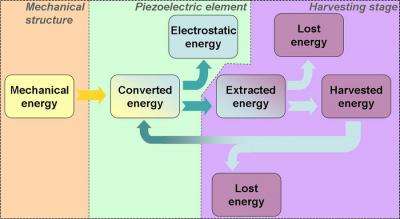
(PhysOrg.com) -- Harvesting mechanical energy from the environment and converting it into electrical energy has recently become a viable method for powering low-energy electronics, such as sensors and actuators. But the major drawback of energy harvesting is how little energy it generates, which limits its potential applications. In a new study, Mickael Lallart and Daniel Guyomar from the LGEF Laboratory at the University of Lyon have proposed that an initial energy injection extracted from the harvested energy itself could greatly increase the total energy output; specifically, this method could generate 20 times more energy than normal when using off-the-shelf components, and up to 40 times more when using low-loss devices.
Energy harvesting often uses piezoelectric materials, which have the property of generating an electric field in the presence of an applied mechanical strain. As Lallart and Guyomar explain, piezoelectric materials usually have a low global coupling coefficient, corresponding to a low conversion ability. Although the coupling coefficient is an inherent property of a material, the scientists explained that they can artificially enhance the conversion abilities of piezoelectric materials by using a pulsed initial energy injection.
In the proposed scheme, harvested energy is first extracted from the piezoelectric element via a microgenerator. The energy is then injected as a quick pulse back into the piezoelectric element through either its top or bottom electrode, resulting in a positive or negative voltage, respectively. The energy injection creates an “energy resonance” effect due to the pulsed energy feedback to the piezoelectric material.
Due to this energy resonance effect, the initial energy injection to the piezoelectric material creates an overall energy gain that is higher than the energy initially extracted from the piezoelectric material. The researchers identified an optimal energy injection value, after which higher values create a damping effect on the piezoelectric material that results in a significant decrease in the mechanical energy available for harvesting. When optimized, the proposed design could allow a device to use much less piezoelectric material than a standard design, and still harvest the same amount of energy.
“The main contribution of this work is to demonstrate that taking energy from the storage stage and transferring it to the source, although it seems counter-productive because of the losses in the transfer mechanism, can lead to outstanding performance in terms of power output,” Lallart told PhysOrg.com. “In particular, performing these operations in a pulsed fashion (i.e., providing initial energy to the active material) makes the technique easy to implement. One of the most remarkable things about this technique is its ability to bypass the power limit of all other techniques when considering the damping effect induced by the scavenging process (constant force magnitude case).”
As the scientists explained, most previous methods for energy conversion enhancement have been “unidirectional,” meaning they don’t take advantage of using the energy generated from the device itself as input energy. The few previous methods that were “bidirectional” like the current design, using output energy for input energy, required constant driving of the device, resulting in a complex implementation and requiring a significant amount of energy for driving the system, which made them barely realistic.
In contrast, the fact that the new method only requires quick pulses allows for an easier implementation and greatly reduces the driving energy. The energy extraction and injection processes are so much quicker than the device’s vibration time period that they can be considered instantaneous. For these reasons, the scientists predict that this approach could improve the amount of energy harvested by two, three, or four times compared with other methods aiming at increasing the power output, even at low energy extraction efficiencies.
“The main motivations in energy harvesting research are explained by the growth of small-scale, low-power electronic devices, as well as the limitations of primary batteries that raise maintenance issues because of their limited lifespan and environmental problems due to their complex recycling process,” Lallart said. “Although the viability of self-powered systems has already been demonstrated, the functions of such devices are still limited by the available energy. Hence, the aim of research on energy harvesting is twofold. First, increasing the power output of microgenerators allows for implementing more functions in the self-powered device. Second, improvements in the conversion abilities of active materials would permit a significant reduction of the amount of material required to harvest a given amount of energy, allowing for the disposal of small-scale, embeddable devices.”
More information: Mickaël Lallart and Daniel Guyomar. “Piezoelectric conversion and energy harvesting enhancement by initial energy injection.” Applied Physics Letters 97, 014104 (2010). DOI: 10.1063/1.3462304
Copyright 2010 PhysOrg.com.
All rights reserved. This material may not be published, broadcast, rewritten or redistributed in whole or part without the express written permission of PhysOrg.com.


