A mutation that frustrates DNA repair likely contributes to Fanconi anemia
July 21, 2010
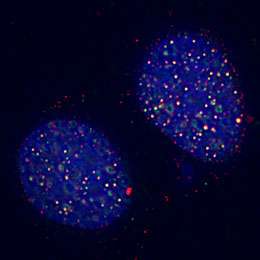
DNA damage. Researchers identified the protein FAN1 (red) as part of the pathway involving other proteins such as FANCD2 (green) that rush to sites of DNA damage in cells and work together (yellow) to fix the problem.
(PhysOrg.com) -- After more than a century of technological refinements, zippers still get stuck. So do the molecular machines that routinely unzip the double helix of DNA in our cells after billions of years of evolution, and the results can be lethal.
In research published last week in Molecular Cell, scientists at Rockefeller University and colleagues show how a previously uncharacterized protein associated with the cancer-causing disorder Fanconi anemia might aid in repairing the broken zippers in our genes. When two strands of DNA remain stuck together, they cannot replicate themselves or produce the transcripts they are supposed to make.
This sticking point is one of the most deadly genetic perils, called an inter-strand crosslink, which threatens an average cell about 10 times a day.
“Repairing the inter-strand crosslink is a very complicated process,” says Agata Smogorzewska, head of the Laboratory of Genome Maintenance at Rockefeller, who led the research. “It takes lots of players, and if they don’t work correctly, the consequences can be terrible.”
Thirteen proteins are known to be involved in the Fanconi anemia pathway, which repairs inter-strand crosslinks. If any one of them is damaged, the result is Fanconi anemia, a disorder that leads to bone marrow failure and leukemia, among other cancers, as well as many developmental abnormalities.
Seeking other proteins that may play a part in the disease, Smogorzewska and colleagues developed a test to screen thousands of genes for those that might be involved in repairing DNA damage. Using a vast library of small hairpin RNAs, which can silence genes by preventing their transcripts from being translated into proteins, the team eliminated each of more than 32,000 human proteins from cells in the test tube. The researchers bombarded the defective cells with a molecule that causes crosslinks to test whether the missing protein impaired the cells' ability to survive after the damage.
These tests winnowed the list to 2,000 genes. "Then we had to narrow it down," Smogorzewska says. "So we did additional assays, looked at the domain architecture of candidate proteins and found one that is particularly interesting." A gene, which they dubbed FAN1, had two properties that suggested it could be important to DNA repair. One region of the gene coded for what’s called a nuclease, an enzyme that cuts nucleic acids, the stuff that makes up DNA. "It also had a UBZ domain - which usually binds proteins that are embellished by ubiquitin, a very common modification found during DNA damage response generally that is essential during crosslink repair."
The team wanted to confirm FAN1's role in DNA damage response, so they tagged the gene with a fluorescent protein and studied what happened when they damaged DNA, both by using a laser to cut the DNA and a molecule that induced inter-strand crosslinks. FAN1 glommed onto sites of the DNA damage. The researchers found that when they induced a mutation in the UBZ domain of the gene, it was rendered useless, meaning its restorative ability likely lies in its capacity to interact with ubiquitinated proteins in the Fanconi anemia pathway. As predicted, the nuclease domain of FAN1 was able to cut DNA, activity that is essential repairing the broken zippers.
Versions of the gene are present in distantly related organisms, from yeast to flies to humans, Smogorzewska says, suggesting a role in life’s fundamental machinery for repairing DNA. The team’s results make FAN1 a strong candidate to add to the list of the 13 mutations currently known to disrupt the DNA damage response in Fanconi anemia patients. Because it is also associated with a group of genes that predispose women for breast cancer, the researchers recommend that FAN1 be investigated for a role in that disease as well.
More information: Molecular Cell 39: 36-41 (July 9, 2010). A Genetic Screen Identifies FAN1, a Fanconi Anemia-Associated Nuclease Necessary for DNA Interstrand Crosslink Repair. Agata Smogorzewska, et al.
http://www.cell.co … 10%2900464-8
-
Two proteins act as molecular tailors in DNA repair
Nov 13, 2009 |
not rated yet |
0
-
Replication at DNA damage sites highlights Fanconi anemia and breast cancer proteins
Sep 10, 2009 |
not rated yet |
0
-
DNA 'molecular scissors' discovered
Jul 09, 2010 |
not rated yet |
0
-
Newly identified proteins critical to FA pathway DNA repair function
Mar 25, 2010 |
not rated yet |
0
-
Most carriers of Fanconi anemia genes are not at a higher risk of cancer
Dec 12, 2007 |
not rated yet |
0
-
Engineers build first sub-10-nm carbon nanotube transistor
Feb 01, 2012 |
4.9 / 5 (31) |
30
-
Something old, something new: Evolution and the structural divergence of duplicate genes
Jan 31, 2012 |
4.6 / 5 (7) |
1
-
The hidden nanoworld of ice crystals: Revealing the dynamic behavior of quasi-liquid layers
Jan 30, 2012 |
5 / 5 (3) |
1
-
Stock market network reveals investor clustering
Jan 27, 2012 |
3.9 / 5 (23) |
8
-
Of microchemistry and molecules: Electronic microfluidic device synthesizes biocompatible probes
Jan 26, 2012 |
5 / 5 (1) |
0
-
Mitosis
4 hours ago
-
Stem cell question.
5 hours ago
-
Protease cleavage
11 hours ago
-
Pertubance in a model
18 hours ago
-
Cancer drugs and Alzheimer's, Oh my!
Feb 09, 2012
-
Squishing cells
Feb 09, 2012
- More from Physics Forums - Biology
More news stories
The power of estrogen -- male snakes attract other males
A new study has shown that boosting the estrogen levels of male garter snakes causes them to secrete the same pheromones that females use to attract suitors, and turned the males into just about the sexiest ...
16 hours ago |
4.8 / 5 (6) |
1
|
Grass to gas: Researchers' genome map speeds biofuel development
Researchers at the University of Georgia have taken a major step in the ongoing effort to find sources of cleaner, renewable energy by mapping the genomes of two originator cells of Miscanthus x giganteus, a large perenn ...
13 hours ago |
3.8 / 5 (5) |
0
|
Miami battling invasion of giant African snails
No one knows how they got there. But an invasion of African giant snails has southern Florida in a panic over potential crop damage, disease and general yuckiness surrounding the slimy gastropods.
20 hours ago |
4 / 5 (1) |
4
Experts reveal how plants don't get sunburn
(PhysOrg.com) -- Experts at the University of Glasgow have discovered how plants survive the harmful rays of the sun.
16 hours ago |
4.8 / 5 (5) |
0
|
Protein libraries in a snap
(PhysOrg.com) -- A Rice University undergraduate will depart with not only a degree but also a possible patent for his invention of an efficient way to create protein libraries, an important component of biomolecular ...
19 hours ago |
4.8 / 5 (4) |
1
|
Anonymous knocks CIA website offline (Update)
The website of the Central Intelligence Agency was inaccessible on Friday after the hacker group Anonymous claimed to have knocked it offline.
Google users warned of threat to smartphone wallets
Users of Google smartphone wallets were being warned on Friday that there is a way to crack pass codes intended to thwart thieves from going on illicit shopping sprees.
New error-correcting codes guarantee the fastest possible rate of data transmission
Error-correcting codes are one of the triumphs of the digital age. Theyre a way of encoding information so that it can be transmitted across a communication channel such as an optical fiber o ...
Humans may have helped the decline of African rainforests 3000 years ago
(PhysOrg.com) -- Large areas of rainforests in Central Africa mysteriously disappeared over three thousand years ago, to be replaced by savannas. The prevailing theory has been that the cause was a change ...
New power source discovered
(PhysOrg.com) -- Researchers at the Massachusetts Institute of Technology (MIT) and RMIT University have made a breakthrough in energy storage and power generation.
Small modular reactor design could be a 'SUPERSTAR'
(PhysOrg.com) -- Though most of today's nuclear reactors are cooled by water, we've long known that there are alternatives; in fact, the world's first nuclear-powered electricity in 1951 came from a reactor ...