Egypt scours bed of Lake Qarun in search of antiquities
July 21, 2010
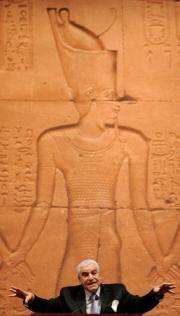
Zahi Hawass

Enlarge

Egyptian experts have begun to explore the depths of Lake Qarun south of Cairo using remote sensing radars in search of sunken artefacts, antiquities officials told AFP on Wednesday. Antiquities supremo Zahi Hawass, pictured in April 2010, said the work was launched a few days ago. "It is the first time ever that the antiquities department carries out an archaeological mission in Lake Qarun."

Egyptian experts have begun to explore the depths of Lake Qarun south of Cairo using remote sensing radars in search of sunken artefacts, antiquities officials told AFP on Wednesday.

Antiquities supremo Zahi Hawass said the work was launched a few days ago. "It is the first time ever that the antiquities department carries out an archaeological mission in Lake Qarun."

Khaled Saeed, who heads the department of pre-historic affairs at the Supreme Council of , said the team under his supervision hopes to pinpoint "huge basalt rocks" at the bottom of Lake Qarun.

According to Saeed, the discovery of the rocks was first made by Egyptian-American scientist Faruq al-Baz, a veteran of NASA's Apollo programme, five years ago.

Baz, who now runs the Centre for Space Studies at Boston University, was carrying out a satellite survey of Egypt's Western Desert when he and his team discovered in the Lake Qarun area "a large number of huge blocks of rock."

"I believe that these huge slabs are made of basalt () which were eventually moved upstream to the Giza plateau for the construction of the Great Pyramid," Saeed said.

Teams of divers are examining a 10-kilometre (6.2 mile) long stretch of in Lake Qarun, Saeed added.

The lake is the third largest in Egypt and is part of the Fayyum Oasis, more than 100 kilometres (62 miles) south of Cairo, and part of the ancient Moeris, once a body of sweet water.

Fayyum is known for a series of colourful funerary portraits -- masks painted on wood tablets and dating from the Roman period (1st to 3rd centuries AD) which were used to cover the face of the deceased.

(c) 2010 AFP

4.6 /5 (5 votes)  

Filter


Move the slider to adjust rank threshold, so that you can hide some of the comments.


Display comments: newest first

Paradox
Jul 23, 2010

Rank: 1 / 5 (1)
Calling Zahi Hawass an "expert" is quite a stretch. He is just an attention seeking moron who regularly destroys historical evidence because he is too busy show-boating in front of the camera.
Rank 4.6 /5 (5 votes)
Related Stories
Relevant PhysicsForums posts
  • Squishing cells
    created1 hour ago
  • Any books/articles for evolutionary stable strategy models in humans?
    created12 hours ago
  • Science behind the bore feeling?
    created19 hours ago
  • Homo Sapien vs. Chimpanzee - Divergence Timeline
    created23 hours ago
  • a single mRNA strand is attached to sevaral ribosomes?
    createdFeb 08, 2012
  • Oestrogen and FSH
    createdFeb 07, 2012
  • More from Physics Forums - Biology

More news stories

US workers are 'giving away the store,' costing firms billions

Nearly 70 percent of the nation's service employees give away free goods and services – from hamburgers to cable TV – costing companies billions of dollars a year, according to a groundbreaking study.

Other Sciences / Economics & Business

created 10 hours ago | popularity not rated yet | comments 6

Storm warning: Financial tsunami heading this way

In today's global village, national coffers are more interconnected than ever before. And as the current economic crisis has proven, a downturn in one country can travel in a wave across the globe, like a financial tsunami. ...

Other Sciences / Economics & Business

created 11 hours ago | popularity 3 / 5 (2) | comments 5

Prague gets hold of modern genetics founder Mendel's papers

Germany has handed to the Czech Republic a manuscript of Johann Gregor Mendel, founder of modern genetics, on his plant hybridization experiments, the Czech foreign minister said Thursday.

Other Sciences / Other

created 7 hours ago | popularity not rated yet | comments 1

Kids show cultural gender bias

(PhysOrg.com) -- Talk about gender confusion! A recent study by University of Alberta researchers Elena Nicoladis and Cassandra Foursha-Stevenson in the Journal of Cross-Cultural Psychology into whether speaki ...

Other Sciences / Social Sciences

created 16 hours ago | popularity 2 / 5 (1) | comments 2

'Flipped classroom' teaching model gains an online community

Researchers at Harvard University have launched the Peer Instruction (PI) Network, a new global social network for users of interactive teaching methods.

Other Sciences / Social Sciences

created 11 hours ago | popularity 5 / 5 (2) | comments 0


'Dark plasmons' transmit energy

Microscopic channels of gold nanoparticles have the ability to transmit electromagnetic energy that starts as light and propagates via "dark plasmons," according to researchers at Rice University.

FDA-approved drug rapidly clears amyloid from the brain, reverses Alzheimer's symptoms in mice

Neuroscientists at Case Western Reserve University School of Medicine have made a dramatic breakthrough in their efforts to find a cure for Alzheimer's disease. The researchers' findings, published in the journal Science, show t ...

Hydrogen from acidic water: Researchers develop potential low cost alternative to platinum for splitting water

A technique for creating a new molecule that structurally and chemically replicates the active part of the widely used industrial catalyst molybdenite has been developed by researchers with the Lawrence Berkeley ...

Ultraviolet protection molecule in plants yields its secrets

Lying around in the sun all day is hazardous not just for humans but also for plants, which have no means of escape. Ultraviolet (UV) radiation from the sun can damage proteins and DNA inside cells, leading ...

Anyone can learn to be more inventive, cognitive researcher says

There will always be a wild and unpredictable quality to creativity and invention, says Anthony McCaffrey, a cognitive psychology researcher at the University of Massachusetts Amherst, because an "Aha moment" is rare and ...

New method makes culture of complex tissue possible in any lab

Scientists at the University of California, San Diego have developed a new method for making scaffolds for culturing tissue in three-dimensional arrangements that mimic those in the body. This advance, published online in ...