Boeing unveils its commercial capsule spacecraft
July 22, 2010 by Lin Edwards report
Boeing unveils its commercial capsule spacecraft

Enlarge

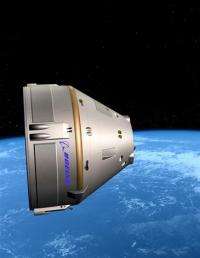
An artist rendering of Boeing's CST-100. Credit: Boeing

(PhysOrg.com) -- Boeing unveiled its plans for a capsule spacecraft for ferrying astronauts and cargo to space stations at the biennial Farnborough International Air Show in the UK on July 19th. The craft is designed to fill the gap that will be left when the NASA space shuttles are retired from service next year.

Boeing won an award worth $18 million from NASA under the Commercial Crew Development (CCDev) Space Act Agreement, which was intended to help in the development of new commercial systems for transporting to the and any future private space stations.

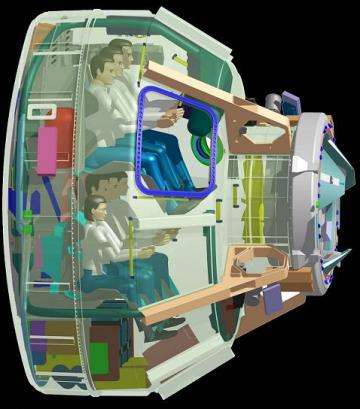
The Boeing low-cost craft, Crew Space Transportation-100 (CST-100), is designed to carry up to seven astronauts on short missions up to 100 kilometers above the Earth’s surface. The craft resembles the Apollo spacecraft that transported astronauts to the moon in the 1960s and 70s, but is larger.

The craft will be able to remain docked to a in orbit up to seven months and will be protected during re-entry by an ablative heat shield. It will then descend with the aid of parachutes to an airbag-cushioned landing on dry ground. The heat shield would be replaced to allow the craft to fly again. The design allows for up to 10 missions for each craft.
Boeing unveils its commercial capsule spacecraft
Enlarge


Boeing said the first CST-100 will be launched from Florida, possibly as early as 2014 if enough funding is available. The design is compatible with a range of rockets including the Atlas V, Delta IV or SpaceX’s Falcon 9 rocket, but the final choice of rocket is not yet decided.

NASA will not be Boeing’s only customer, as the company has also partnered with Bigelow Aerospace, which joined the Commercial Spaceflight Federation in June. According to Boeing, Bigelow Aerospace will contribute their expertise in designing and constructing space facilities, as well as being a user of the CST-100.

Robert Bigelow said the idea of the alliance was to make space travel commercial “the way air travel became commercial a century ago.” Boeing’s vice president Brewster Shaw agreed, saying the company’s vision was to become the Boeing commercial aircraft of space flight.
Boeing unveils its commercial capsule spacecraft

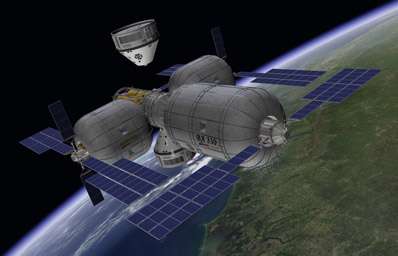
The CST-100 spacecraft approaching a Bigelow space station. Credit: Boeing

Bigelow Aerospace is building two types of space module — the Sundancer and BA330 — that will form part of the world’s first commercial space station, called the Orbital Space Complex, which the company hopes to be in orbit and operational by 2015. Bigelow said three-quarters of their revenue from space station customers would go towards the space transportation provider.

Exploration Technologies (SpaceX) and Orbital Sciences Corporation are also developing similar , with the help of NASA funding.

© 2010 PhysOrg.com

4.9 /5 (20 votes)  

Filter


Move the slider to adjust rank threshold, so that you can hide some of the comments.


Display comments: newest first

antialias
Jul 22, 2010

Rank: 4.4 / 5 (7)
That computer graphic seems like an awful lot of people (without spacesuits!) with very little space for support systems. Is this a joke?
Bob_Kob
Jul 22, 2010

Rank: 4.7 / 5 (3)
Not sure, its not like they will be travelling for very long, probably only a few hours from launch to docking, so i guess it doesnt have to be too large.
Birger
Jul 22, 2010

Rank: not rated yet
Typo: "Short missions up to 100 km abovethe Earth's surface" -minimum parking orbit is at 185 km, space stations need to be at 350km minimum.
Birger
Jul 22, 2010

Rank: 1 / 5 (3)
Good luck sitting crammed into that capsule when the other six passengers get space-sick (a common phenomenon during the first day in microgravity)
Adriab
Jul 22, 2010

Rank: not rated yet
Typo: "Short missions up to 100 km abovethe Earth's surface" -minimum parking orbit is at 185 km, space stations need to be at 350km minimum.


I'm not sure about the typo-ness of this statement, it was reported as 100km at space.com as well. I hope its not the true ability of the craft.

Perhaps they just gave out the wrong number? 100 miles is only just under 161km, so I don't think they mixed up the units. Maybe the 100km mark is just for testing...
david_42
Jul 22, 2010

Rank: not rated yet
The Boeing press release gives the same number, so I guess they'll get the rest of the way on unicorn burgers. But, unless the design is grossly overweight, any of those three boosters would have no problem making ISS orbit.
Nik_2213
Jul 22, 2010

Rank: not rated yet
Could be they're wearing 'elastic' pressure suits rather than the current 'bag & ring' variety...
DaveGee
Jul 22, 2010

Rank: 4.9 / 5 (8)
As someone who saw the lunar launch as a very young child... Fast forward forty one years into the future and I'm quite saddened to see the current state of the art in space travel. :(
antialias_physorg
Jul 22, 2010

Rank: 3.5 / 5 (2)
If you look at the new design for the russian capsule to transfer people to space stations:
http://www.bbc.co...10725093
You might notice the marked differences in the ratio of people-to-volume-of-support-systems.

Since the russians (and especially Roskosmos) have a little experience in these things (and Boeing doesn't) I'd say that the Boeing design is a PR gag targetted at garnering government capital.
Mayday
Jul 22, 2010

Rank: 2 / 5 (1)
This is not real. The crew will need to survive at least two days in orbit, in the event of a missed docking or space debris evasion. This ship is either way too small or the people shown inside are way too big. But a video of an emergency egress drill would be an instant YouTube hit.
thetruechaos
Jul 22, 2010

Rank: 2.6 / 5 (5)
Sounds like a bunch of people who should have no opinion are having one. Spacecraft design degrees please? Oh wait, those guys are building spacecraft right now, the rest are commenting based on a figurative expertise. This parallels the United States political system. So voter whats your views on mercantilism, Marxism, and soft power.
Buyck
Jul 22, 2010

Rank: 3 / 5 (2)
At last... at last!!! We have waiting decades for a commercial capsule like this! Yes, finally people can go into space.

Now they have to develop it better (more comfort) and lower prices. But thats gonna take a dedace and more i think. But... yes finally something!
Soulless49er
Jul 22, 2010

Rank: 1 / 5 (1)
It looks like a flying saucer. When people see this in the sky they will mistakenly think it's aliens.
Shootist
Jul 22, 2010

Rank: 2 / 5 (1)
NASA, so much promise, so little success.

The bureaucracy has struck, Pournelle's Iron Law in action.
Soulless49er
Jul 22, 2010

Rank: 1 / 5 (1)
So I guess our future spacecraft will not look like the shuttle, they will look like flying saucers?

I've read some articles stating that they plan to eventually put in the nuclear powered VASPIR engine in these capsule/flying saucer space crafts to allow them to fly to Mars and other planetary bodies, which would mean they would be similar to the flying saucer Bob Lazar said he worked on at Area 51 S4.

Bob Lazar said he worked on a crashed alien flying saucer that originated from the star system Zeta Reticuli that used a nuclear powered engine and anti-gravity technology.
kevinrtrs
Jul 23, 2010

Rank: 1 / 5 (1)
Mmmmhhhh, looks like a knee-jerk response to the Russian announcement???? Maybe I'm just cynical.
alq131
Jul 23, 2010

Rank: not rated yet
The only news is that it has taken Boeing so long to do this. The Dragon X has funding along with other contenders who aren't the big names in Aerospace. Just like we don't see Burlington-Northern or Canada-Pacific airlines, we won't see Boeing Spacelines...the big names are too big to be innovative and will miss the new markets. The Dragon X and a spacestation from Bigelow Aerospace will usher in a new era of space exploration.

It will probably be a private company that sends tourists for a spin around the moon...Space Adventures is already mulling the idea of a modified Soyuz to take a couple customers on a lunar orbit insertion and return to Earth (no landing on moon) for about $100M
DaveGee
Jul 24, 2010

Rank: not rated yet
To all those making a flying saucer connection.... You do realize that this is a capsule that will be placed atop a traditional rocket and launched off into space just as they were 40+ years ago... Allthough I guess this model will have that 'new capsule smell' and third row seating for that comfortable ride and maybe a bit more legroom.

But as far a flying saucers go.... This will only plummet back to the earth and be slowed/landed by a combination of parachutes and inflatable cushions. This has only the most limited built in propulsion necessary for docking with a space station.
jmcenanly
Jul 25, 2010

Rank: not rated yet
I've noticed that the crew member in the lower row, closest to us, is on the small side. Is Boeing simply showing the range of sizes it can accommodate, or are they proposing children into space?
RobertKLR
Jul 25, 2010

Rank: 1 / 5 (1)
I don't see any black people. Why not?
fixer
Jul 25, 2010

Rank: not rated yet
Why are they seated in rows?
Built in gravity generator?
james11
Jul 26, 2010

Rank: 1 / 5 (1)
What happens when they get up there and someone starts flipping out?
bottomlesssoul
Jul 26, 2010

Rank: not rated yet
I'm not sure about the economics since every launch vehicle listed is about $400 million. Allow for one crew and 6 passengers and total cost of $420M gives a cost of $70M per passenger before any risk or profit is considered.

The cost is clearly dominated by the non-reusable launch vehicle requirements.

On the other hand if a smaller and cheaper vehicle could be used a $25M 3 week holiday for one would be possible.

And yes, if someone could afford to lift an entire family I don't see any immediate concerns for at least young adults.

Who would pay these prices for memories for their children if they knew when (if) it was remembered in adulthood it could at best be interpreted as a dream they maybe had?
Rank 4.9 /5 (20 votes)
Related Stories
Relevant PhysicsForums posts

More news stories

Astronomy team discovers nearby dwarf galaxy

(PhysOrg.com) -- A team led by UCLA research astronomer Michael Rich has used a unique telescope to discover a previously unknown companion to the nearby galaxy NGC 4449, which is some 12.5 million light years ...

Space & Earth / Astronomy

created 12 hours ago | popularity 4.3 / 5 (4) | comments 5 | with audio podcast

Amasia: As next supercontinent forms, Arctic Ocean, Caribbean will vanish first

(PhysOrg.com) -- Geologists at Yale University have proposed a new theory to describe the formation of supercontinents, the epic process by which Earth’s major continental blocks combine into a single ...

Space & Earth / Earth Sciences

created 13 hours ago | popularity 4.1 / 5 (11) | comments 4 | with audio podcast

In scientific coup, Russians reach Antarctic lake

After more than two decades of drilling in Antarctica, Russian scientists have reached a gigantic freshwater lake hidden under miles of ice for some 20 million years - a pristine body of water that may hold ...

Space & Earth / Earth Sciences

created 13 hours ago | popularity 4.8 / 5 (6) | comments 6

Chandra finds Milky Way's black hole grazing on asteroids

(PhysOrg.com) -- The giant black hole at the center of the Milky Way may be vaporizing and devouring asteroids, which could explain the frequent flares observed, according to astronomers using data from NASA's ...

Space & Earth / Astronomy

created 13 hours ago | popularity 5 / 5 (5) | comments 5 | with audio podcast

Study shows global glaciers, ice caps, shedding billions of tons of mass annually

Earth's glaciers and ice caps outside of the regions of Greenland and Antarctica are shedding roughly 150 billion tons of ice annually, according to a new study led by the University of Colorado Boulder.

Space & Earth / Earth Sciences

created 16 hours ago | popularity 5 / 5 (5) | comments 5 | with audio podcast


Amazing skin gives sharks a push

Shark skin has long been known to improve the fish's swimming performance by reducing drag, but now George Lauder and Johannes Oeffner from Harvard University show that in addition, the skin generates thrust, giving the fish ...

Fruit flies drawn to the sweet smell of youth

Aging takes its toll on sex appeal and now an international team of researchers led by Baylor College of Medicine and the University of Michigan find that in fruit flies, at least, it even diminishes the come-hither ...

Life in Antarctic lake? It's everywhere else

If scientists find microbes in a frigid lake two miles beneath the thick ice of Antarctica, it will illustrate once again that somehow life finds a way to survive in the strangest and harshest places.

New study shows high cost of defensive medicine

Vanderbilt University Medical Center researchers estimate that U.S. orthopaedic surgeons create approximately $2 billion per year in unnecessary health care costs associated with orthopaedic care due to the practice of defensive ...

Continental mosquito with 'vector' potential found breeding in UK after 60 year absence

A species of mosquito has been discovered breeding in the UK that has not been seen in the country since 1945. Populations of the mosquito, found across mainland Europe and known only by its Latin name Culex modestus, were r ...

Presdisposition to common heart disease 'passed on from father to son'

A common heart disease which kills thousands each year may be passed genetically from father to son, according to a study led by the University of Leicester.