Simpler method for building varieties of nanocrystal superlattices
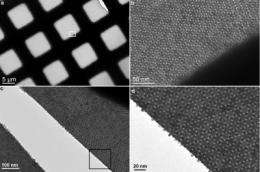
Collaboration by chemists, physicists and materials scientists at the University of Pennsylvania has created a simple and inexpensive method to rapidly grow centimeter-scale membranes of binary nanocrystal superlattices, or BNSLs, by crystallizing a mixture of nanocrystals on a liquid surface.
The study demonstrates a new and spontaneous way to grow long-range-ordered BNSL membranes with rigorous control of nanocrystal size, shape and concentration by combining two types of nanocrystals and assembling them during a drying stage at the surface of a liquid under normal conditions.
The method overcomes several limitations of the existing assembly strategies and produces large, free-standing membranes that can be transferred to any desired substrate such as silicon wafers, glass slides and plastic substrates, allowing the nanocryatalline films to be introduced at any stage in the device fabrication process.
The team demonstrated the potential for integrating these novel materials by growing millimeter-scale superlattice membranes containing iron oxide nanocrystals of two different sizes and incorporating the membranes into magnetoresistive devices. Measurements showed that the magnetoresistance of the resulting device was dependent on the structure of the BNSL and therefore controllable.
The physical properties intrinsic in these nanocrystals -- nanometer sized crystalline building blocks — offer a modern twist on the studies of interfacial assembly that reach as far back as Penn founder Benjamin Franklin and his studies of oil spreading on water in the 1770s.
Single and multi-component nanocrystal films are already under intense investigation by researchers as enablers of novel optical technologies that range from low-cost solar cells, light-emitting diodes and photo detectors and also in electronic systems that include field-effect transistors and solid-state thermoelectric coolers and generators and magnetic technologies that include magnetic recording materials and magnetic sensors and even as tailored electrocatalytic and photocatalytic films.
Co-assembly of two types of nanocrytals into BNSLs provides a low-cost, modular route to program the self assembly of materials with a precisely controlled combinations of properties. Advances in these complex interfacial assemblies and improvements in the transfer of single-component nanocrystal membranes in the past few years have heightened anticipation that this control could be extended to much more complex systems.
This Penn study establishes a route to free-standing large-area BNSLs membranes with the added ability to laminate them on any arbitrary substrate.
"Fundamentally, growing BNSLs on a liquid surface will shed light on the mechanisms of multi-component nanocrystal assembly, which are critical to new concepts in self-assembly based nanomanufacturing," said Christopher B. Murray, the Richard Perry University Professor of Chemistry and Material Science and Engineering at Penn.
The research, funded by the U.S. Army Research Office and a National Science Foundation Materials Research Science and Engineering Centers Award, is published in this week's Nature.
Existing strategies for growing BNSLs involve a more complex process of evaporating a two-nanocrystal solution on a solid substrate under carefully regulated temperature and pressure that influence BNSL formation. The method suffers from several limitations, most notably a limited choice of substrate, nucleation of irregular micrometer-sized, isolated islands of BNSLs on the substrates and an inability to transfer them once formed.
"Given the fact that this novel assembly strategy is general for different nanocrystal combinations, we anticipate that membranes of quasicrystalline BNSLs and ternary nanocrystal superlattices will also be grown by this method, greatly expanding the systems that can be explored" Murray said. "Our dream is to program the organization of materials on all lengths scales for nanometers to millimeters combining the desirable physical properties multiple nanoscale systems. Fundamentally we are focused on identifying, understanding and optimizing new synergistic interactions in nanomaterials and in exploiting these emergent properties in new devices and systems."
Provided by University of Pennsylvania


