'Cradle of Hope' earns patent for FSU creators
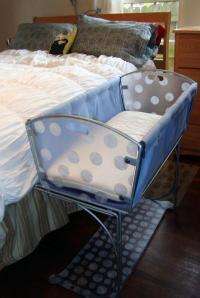
An alumna of the interior design program and a facilities engineer from the National High Magnetic Field Laboratory at The Florida State University have received a patent for their prototype of a portable cradle perfect for infants in family homeless shelters.
But while this space-saving, environmentally sensitive baby bed was designed and constructed especially for a homeless mother and infant living at Tallahassee's HOPE Community shelter, it combines form and function in a novel way that safely brings parent and child closer together, no matter what their circumstances.
The aptly named "Cradle of Hope" is the brainchild of Rachelle McClure (Master of Fine Arts '08, Interior Design) and magnet lab employee Sean Coyne. Their collaboration began in the summer of 2007, when they were classmates in a Graduate Furniture Design class led by Associate Professor Jill Pable, whose research and instructional focus had long included projects for the homeless.
"I am proud of Rachelle and Sean for many reasons, but first and foremost, their project holds the potential to literally avert a premature accidental death," Pable said. "Shelter staff tell us how often parents sleep with their children, and how smothering is a clear and immediate danger.
"It is exciting to see the power of a good idea, especially from my students. Design has the potential to make the 'built environment' a better place for everyone, and this cradle is a prime example of that."
The goal now, said Pable, is to locate a manufacturer that could make the Cradle of Hope a reality for shelters across the country, and even the world.
"We couldn't have reached this point without Jill, who awed us with her expertise on projects that bring design to the community level," McClure said. "Her approach opens up lots of opportunities that designers may not consider because we are so accustomed to thinking about design from a commercial aspect -- which usually requires large budgets.
"Being able to give back to your community and design to solve real problems for everyday people touches the humanitarian residing within many designers," McClure said.
As project partners, Coyne and McClure began by studying the conditions in the bedrooms at the HOPE Community transitional shelter. They noted the tight, communal quarters that families shared while participating in job counseling and other services geared to helping them get back on their feet.
"Based on their observations, Rachelle and Sean designed a cradle atop a unique cantilever base, which can slide underneath a shelter bunk and out of the way," Pable said. "The cradle itself is suspended immediately above the parent's bed, making for a design that occupies very little floor space, a particularly vital consideration in shelter quarters."
More significantly, said Pable, the design serves to position the cradle immediately next to the parent, so that he or she can easily comfort the baby while both are resting in their respective "bunks."
"In a shelter, absent these design features, parents must care for their infant while it is sleeping in a car seat -- obviously not ideal -- or sleep together with the infant in a single adult bed -- which tragically can lead to accidental smothering," she said.
Eco-friendly sustainable materials are a major design component. Organic, cotton-canvas fabric softens the sides of the stainless steel-framed cradle, while at each end recycled, translucent resin panels (donated by global corporation "3form") adorned with whimsical circles allow filtered light in. All the materials can be easily cleaned, an essential feature in a shelter with a constant flow of new residents.
And, because socialization is important -- both for parent and child -- the Cradle of Hope can be detached from the hideaway cantilever base and carried into the shelter's communal areas.
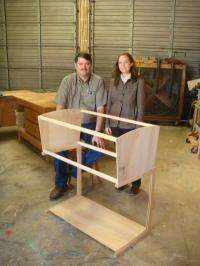
McClure is the business manager of Onyx Group, a design firm in Tallahassee, but she used to work in Denver, analyzing mortgage-backed securities before her growing interest in sustainable design overtook her longstanding passion for economics. She returned to hometown Tallahassee and, in 2008, earned her MFA degree from Florida State with a thesis on the economic advantages of green building. McClure serves on the board of Rainbow Rehab, which recently completed its first "LEED for Home" renovation for a low-income family. She has also applied her financial acumen to volunteer work for Habitat for Humanity at its international headquarters in Americus, Georgia, where she created a database to organize donations.
Meanwhile, Coyne also returned home to Tallahassee about five years ago, after three decades away. He is serious about furniture. Coyne crafts both traditional and modern pieces in his shop -- Sean Coyne & Daughters Cabinetmakers -- at Tallahassee's Railroad Square Art Park. That's where he and McClure constructed the Cradle of Hope prototype, and where he has assisted some of Pable's other furniture design students by allowing them access to his shop to work on their projects. Coyne's full-time duties at the National High Magnetic Field Laboratory include helping to plan and oversee construction, recycling programs and other day-to-day operations.
"Rachelle and I have complementary skill sets, but parenthood might be the key to a patent-winning cradle design," Coyne said. "Maybe the deck was stacked against the rest of the class when we became project partners."
"That Rachelle and Sean wound up collaborating in my class was most fortunate, because it combined the empathy of both with Rachelle's persistence in solution-finding and Sean's long experience with prototyping full-size mockups and solving fabrication issues," Pable said. "Obviously, it's also terrific that both are parents with experience nurturing an infant."
Across the Florida State community the Cradle of Hope project received creative and practical support as it made its three-year-long journey from conception to prototype to "design patent." Those who helped include the College of Visual Arts, Theatre and Dance -- home to the School of Art and Design and the Interior Design program; the Council for Research and Creativity, which awarded a grant to Pable in 2007 that funded construction of the prototype; the former Department of Textiles and Consumer Sciences (now "Retail Merchandising and Product Development"), in the College of Human Sciences, where Associate Instructor Wanda Brown stitched together the organic fabric; the Office of Graduate Studies, where McClure was encouraged to apply for a patent; and the Office of Intellectual Property Development and Commercialization (OIPDC), where IP Manager Eric McNair and staff coordinated the patent application process that was successfully concluded in 2010.
A Tallahassee business also lent a helping hand.
"We used steel that was welded by Bettinger Welding," McClure said. "Mr. Bettinger donated his time, and we paid him for materials with our grant. We connected over this project because he happened to volunteer in the kitchen at the HOPE Community, and his daughter, Ivy, who had recently graduated from Florida State, had taken an interior design class with me. They gave a lot of time to manufacturing the cradle's frame. It's a great example of support from both the Tallahassee and FSU communities."
McClure and Coyne recalled Kay Freeman's enthusiasm and appreciation. Freeman, who died in 2009, was the executive director of HOPE Community when the idea for the Cradle of Hope was born three summers ago at Florida State.
Provided by Florida State University


