Mosses use 'mushroom clouds' to spread spores (w/ Video)
July 23, 2010 by Lin Edwards
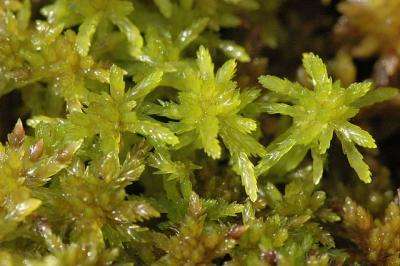
Sphagnum flexuosum. Image credit: Wikipedia
(PhysOrg.com) -- Scientists in the US have solved the mystery of how peat mosses manage to get their spores high enough to catch the wind, discovering that they produce vortex rings of air, like miniature "mushroom clouds" to boost the spores along -- the first time plants have been shown to be capable of creating such rings.
Sphagnum mosses (also known as peat mosses) are among the commonest plants, with over 285 species. They all use the wind to disperse their spores, but they have a slight problem: they grow flat on the ground where the air is still. They need to get their spores 10 cm into the air to reach the "turbulent boundary layer" where the wind can catch the spores and carry them far away, but until now scientists have not understood how they could do it.
Some species have stalks, but these are only around a centimeter long. The spores are extremely light, which enables them to be blown long distances, but this also means they should decelerate quickly and not be able to reach the required height.

Spores explode from a Sphagnum capsule. Credit: Joan Edwards and Dwight Whitaker
Physicist Dwight Whitaker from Pomona College, California and botanist Joan Edwards from Williams College, Massachusetts, solved the mystery by filming the mosses firing spores from the stalks, using ultra-high speed cameras shooting up to 100,000 frames a second. Their films revealed that a tiny “mushroom cloud” or vortex ring accompanies each firing, and it is the vortex rings that give the spores the extra boost required to reach a good height to catch the wind.
This video is not supported by your browser at this time.
Explosion of the Sphagnum capsule. (Recorded at 10,000 fps with a 0.020 ms exposure; displayed at 15 fps.) The vortex bubble and trailing wake are visible. The spores in the wake move upwards at a slower rate than those in the bubble. The vortex overtakes and moves past the cap. Credit: Science, DOI:10.1126/science.1190179
The tip of each stalk contains from 20-250,000 spores in a spherical, waterlogged capsule that dehydrates on sunny days. As it dries out the capsule collapses in on itself to form a cylinder, with the air compressed inside it. When the air pressure reaches a critical point the capsule blows its top off, shooting spores and air upwards to reach the turbulent layer at about 10 cm high. The process takes under one hundredth of a millisecond.The vortex ring is produced as the air trapped in the capsule explodes outwards. The leading edge pushes against the atmosphere but then rolls back to form a donut-shaped ring. Several animals are known to make vortex rings, but until now no plant has been known to do so. Dolphins produce water vortex rings; jellyfish and squid use water rings to push themselves along, the human heart pushes blood from one chamber to another using vortex rings, and of course humans who smoke can produce smoke rings.
This video is not supported by your browser at this time.
Explosion of a Sphagnum palustre capsule. (Recorded at 10,000 fps with a 0.097 ms exposure; displayed at 15 fps.) A clear "mushroom cloud" vortex ring forms and reaches a nearly fixed width within 0.5 ms. Spores are carried upward within the vortex ring and its wake. Credit: Science, doi:10.1126/science.1190179
A vortex ring is a very efficient way to move through air or water because it moves as a single unit. The vortex ring formed by the exploding spore capsule enables the spores to keep together as they rise. Without the ring individual spores would slow down and disperse before reaching the turbulent layer, and most would fall back to the ground. Edwards said they had witnessed spore clouds reaching as high as 17 cm, but even the average height of 11 cm gets the spores well into the turbulence.The findings are published in today’s edition of the journal Science.
This video is not supported by your browser at this time.
Science journal Podcast: an interview with Dwight Whitaker on how Sphagnum mosses use "air guns" and vortex rings to aid reproductive success. Credit: Science, DOI:10.1126/science.1190179
More information: Sphagnum Moss Disperses Spores with Vortex Rings, Dwight L. Whitaker and Joan Edwards, Science 23 July 2010: Vol. 329. no. 5990, p. 406, DOI: 10.1126/science.1190179
© 2010 PhysOrg.com
-
Biologists discover an extra layer of protection for bacterial spores
May 06, 2010 |
not rated yet |
0
-
Hay fever season peaking
Sep 03, 2007 |
not rated yet |
0
-
Climate Change Could Make Allergy Season More Miserable for Millions, Researchers Find
May 18, 2010 |
not rated yet |
0
-
Scientist find chemical to stop anthrax
Apr 21, 2007 |
not rated yet |
0
-
The fastest flights in nature: High-speed spore discharge mechanisms among fungi
Sep 17, 2008 |
not rated yet |
0
-
Engineers build first sub-10-nm carbon nanotube transistor
Feb 01, 2012 |
4.9 / 5 (30) |
30
-
Something old, something new: Evolution and the structural divergence of duplicate genes
Jan 31, 2012 |
4.6 / 5 (7) |
1
-
The hidden nanoworld of ice crystals: Revealing the dynamic behavior of quasi-liquid layers
Jan 30, 2012 |
5 / 5 (3) |
1
-
Stock market network reveals investor clustering
Jan 27, 2012 |
3.9 / 5 (23) |
8
-
Of microchemistry and molecules: Electronic microfluidic device synthesizes biocompatible probes
Jan 26, 2012 |
5 / 5 (1) |
0
-
Cancer drugs and Alzheimer's, Oh my!
6 hours ago
-
Squishing cells
6 hours ago
-
Any books/articles for evolutionary stable strategy models in humans?
18 hours ago
-
Science behind the bore feeling?
Feb 09, 2012
-
Homo Sapien vs. Chimpanzee - Divergence Timeline
Feb 09, 2012
-
a single mRNA strand is attached to sevaral ribosomes?
Feb 08, 2012
- More from Physics Forums - Biology
More news stories
Miami battling invasion of giant African snails
No one knows how they got there. But an invasion of African giant snails has southern Florida in a panic over potential crop damage, disease and general yuckiness surrounding the slimy gastropods.
23 minutes ago |
not rated yet |
0
Fighting crimes against biodiversity: How to catch a killer weed
Invasive species which have the potential to destroy biodiversity and influence global change could be tracked and controlled in the same way as wanted criminals, according to new research from Queen Mary, University of London.
1 hour ago |
not rated yet |
0
Ultraviolet protection molecule in plants yields its secrets
Lying around in the sun all day is hazardous not just for humans but also for plants, which have no means of escape. Ultraviolet (UV) radiation from the sun can damage proteins and DNA inside cells, leading ...
14 hours ago |
5 / 5 (5) |
0
|
Deadly bird parasite evolves at exceptionally fast rate
A new study of a devastating bird disease that spread from poultry to house finches in the mid-1990s reveals that the bacteria responsible for the disease evolves at an exceptionally fast rate. What's more, ...
13 hours ago |
5 / 5 (2) |
0
|
Decoding the molecular machine behind E. coli and cholera
Scientists from Queen Mary, University of London have discovered the workings behind some of the bacteria that kill hundreds of thousands every year, possibly paving the way for new antibiotics that could treat infections ...
13 hours ago |
not rated yet |
0
|
Humans may have helped the decline of African rainforests 3000 years ago
(PhysOrg.com) -- Large areas of rainforests in Central Africa mysteriously disappeared over three thousand years ago, to be replaced by savannas. The prevailing theory has been that the cause was a change ...
Japan scientist makes 'Avatar' robot
A Japanese-developed robot that mimics the movements of its human controller is bringing the Hollywood blockbuster "Avatar" one step closer to reality.
Metastatic breast cancer hitches a free ride from the immune system
Inflammatory breast cancer (IBC) is the most lethal form of breast cancer . It spreads easily through the lymphatic and blood vessels, forming metastasis which can lead to multi-organ failure. New research published in BioMed ...
Sleep breathing machine shows clear benefits in children with sleep apnea
Children and adolescents with obstructive sleep apnea had substantial improvements in attention, anxiety and quality of life after treatment with positive airway pressure (PAP)a nighttime therapy in which a machine ...
Neurologic improvement detected in rats receiving stem cell transplant
In a study to be presented today at the Society for Maternal-Fetal Medicine's annual meeting, The Pregnancy Meeting, in Dallas, Texas, researchers will report that early transplantation of human placenta-derived mesenchymal ...
India's global pharmacy role threatened by EU pact
(AP) -- Efforts by India and the European Union to strengthen trade are threatening India's ability to deliver lifesaving medicines to the world's poorest, analysts say as the two sides push through protracted ...
