DIY micro-technology for SMEs
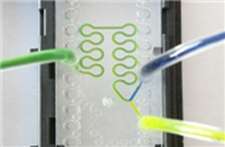
A European project has developed a one-stop shop to support companies, especially SMEs, in the rapid design and manufacture of novel micro-devices for use in applications ranging from medical diagnosis to mobile phones.
No one relishes the long wait between a doctor taking a medical sample and getting back the results. Medical diagnostics is still a job for specialists in a diagnostics lab and sometimes it can take weeks for results to be returned.
But that tortuous waiting time could soon be cut to just a few minutes, thanks to intense research and development on point-of-care diagnostics. Soon it will be commonplace for a doctor or nurse to take a drop of blood, put it on a slide which then slots into a small device. Within seconds you find out your results.
This transformation of medical diagnosis is being driven by tremendous progress in the area of micro-fluidics. It is now possible to form, typically using lasers or precisely milled moulds for polymers, tiny channels within materials through which fluids - such as your blood - can flow. Mere micro-litres of a sample can be mixed, reacted and analysed. Many biosensors are now available, often integrated into silicon chips, to detect target molecules or make a variety of other measurements.
Miniaturisation gets big
Micro-fluidic devices and other microscopic electro-mechanical devices - tiny switches, motors, pistons, etc. - have come a long way since their early development in the 1980s. The demand for miniaturisation is relentless, and companies are finding it necessary to design and develop increasingly intricate micro-components.
SMEs, however, are finding themselves at a distinct disadvantage because they do not have the capital or resources to invest in the development of micro-devices. Even if an SME can design a micro-device and produce a functional prototype, it is then extremely difficult to scale up production to the volume necessary for commercial viability.
The EU-funded microBUILDER project was established with these SMEs in mind. It brought together partners from every stage of micro-device production to develop a one-stop shop for any company wishing to produce a micro-device.In simple terms, the partners have established a set of rules and standard procedures to smooth out the problems that tend to occur when a design moves to prototyping and the prototype enters commercial production.
“We have created a set of tools that should reduce the time it takes to get from a good idea for a micro-device to a commercial, sellable product,” says Liv Furuberg, the project's coordinator. The microBUILDER system supports companies, especially SMEs, in designing prototypes and then launching commercial production of highly innovative micro-devices, she explains.
Material challenge
One of the hardest obstacles for developing novel devices is finding ways to integrate different materials into a single device. For example, a blood sample may first flow through channels in a polymer slide and react with a labelled antibody. But the detection of the target molecule may involve a silicon-based sensor. You therefore need to continue the channel through silicon, without any perturbation to the flow.
“A lot of sensors are based on silicon, but silicon is much more expensive than polymer,” explains Furuberg. “To keep micro-devices as cheap as possible you want to minimise the amount of silicon. So you need to find ways to plug different modules made of different materials together.”
Starting with a commercial micro-fluidics polymer prototyping kit (from ThinXXS), the project successfully developed a 'template' polymer system into which silicon components can be simply 'plugged in'.
The partners also developed standard procedures for designing and manufacturing other devices made from several materials, including silicon and glass, and fluid channels coated with reactive molecules.
The partners had particular success in the integration of a material known as piezoelectric thin film (PZT) into micro-structures. PZT bends when a voltage is put across it; it also produces a voltage when it is bent or distorted. PZT is ideal for microscopic valves, switches and sensors. A follow-up research project, PiezoVolume, funded under the Seventh Framework Programme (FP7, NMP) for research, is seeking to automate this PZT thin film manufacturing process.
Flexible manufacturing
The integration of different materials and the application of PZT are just two examples of a diverse portfolio of advances made by the project. The partners produced several prototype devices to demonstrate the project's achievements, including a cell counter, a gas detector, a DNA extractor and a flow sensor. The PZT technology has already been used by a Norwegian firm to build a tiny auto-focusing lens for small CCD cameras.
But perhaps the most important output from the project is the accompanying 500-page handbook and training materials which will make the development of micro-devices accessible to European SMEs.
“We are making it possible for small firms to build much more functional, intricate and innovative micro-devices. They can mix and match the materials to optimise functionality and they now have standardised procedures and components for their designs which can be rapidly prototyped and then commercially manufactured. microBUILDER should help SMEs in this domain regain a competitive position.”
More information: microBUILDER project - www.sintef.no/Projectweb/Microbuilder/
Provided by ICT Results


