Clean Genes: Chemists Cull the Good Synthetic DNA from the Bad
July 23, 2010 By Marcia Goodrich
Clean Genes: Chemists Cull the Good Synthetic DNA from the Bad

Enlarge

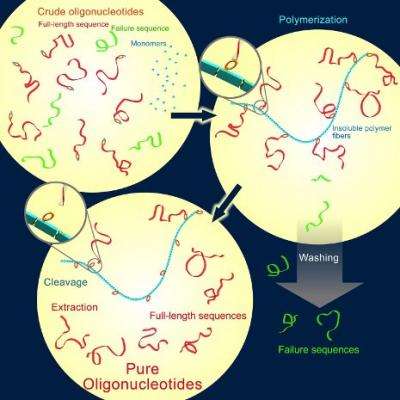
Synthetic DNA purification process developed by Shiyue Fang, Michigan Tech Chemistry Department image

(PhysOrg.com) -- Birds do it, bees do it. Even scientists in labs do it. But the scientists can't hold a candle to the birds and the bees, who can make gobs of primo DNA without even thinking about it.

DNA is a critical element of , and scientists working to develop cures for diseases make it with synthesizers. Unfortunately, synthesizers don’t do nearly as good a job as cells in stringing together to make DNA, and many of the resulting sequences—called truncated DNA—are too short and must be discarded.

Isolating perfect DNA sequences is very expensive, so expensive that some clinical trials for gene therapy drugs have been put on hold for lack of funding. A discovery by Shiyue Fang, an assistant professor of chemistry at Michigan Technological University, could change that.

“Our method can provide high-quality, pure by the kilogram at a much lower cost,” he says. It could also be used to purify RNA and other biological molecules such as peptides that have potential as pharmaceuticals.

Fang adds —molecules that can link together into polymers—to the nucleic acids in a stock DNA synthesizer. Truncated DNA won’t attach to the monomers, but all other strands of DNA will. Then, once the synthesis is complete, the monomers join together to form a long polymer hanging with perfect DNA sequences, like clean laundry on a clothesline. “Then we just snip them off,” says Fang. “It’s a nice trick.”

Fang’s process does not weed out those few that are too long or are missing a nucleic acid. “Fortunately, these impurities exist only in minute quantities,” he says.

Fang is now tweaking the process so that the monomers attach only to the truncated DNA. It’s relatively easy to wash the polymers out of solution, leaving behind the perfect strands.

Fang has filed a patent application on the process and hopes it can soon be put to good use by medical researchers. And, as DNA drugs enter the market, his purification method could drastically reduce manufacturing costs, benefiting patients with genetic and many other diseases and their insurers, including Medicare.Fang’s work has been funded by the National Science Foundation and published in the American Chemical Society Journal -- Organic Letters as a rapid communication.

PhD student Suntara Fueangfung is a coauthor on the paper, “Scalable Synthetic Oligodeoxynucleotide Purification with Use of a Catching by Polymerization, Washing, and Releasing Approach.”

Provided by Michigan Technological University (news : web)


Rank 5 /5 (5 votes)
Relevant PhysicsForums posts
  • Stoichiometry
    createdFeb 10, 2012
  • Boiling and melting point of impure substances
    createdFeb 10, 2012
  • Safe nitrogen compound to decompose a 500 deg C in a furnace?
    createdFeb 09, 2012
  • [ask]electron inside drinking water
    createdFeb 08, 2012
  • How to avoid formation of Lithium Chromate ???
    createdFeb 08, 2012
  • how to choose a reduced or oxidated form in a redox
    createdFeb 08, 2012
  • More from Physics Forums - Chemistry

More news stories

Fool's gold may prove an unlikely alternative to overexploited catalytic materials

Catalytic materials, which lower the energy barriers for chemical reactions, are used in everything from the commercial production of chemicals to catalytic converters in car engines. However, with current catalytic materials ...

Chemistry / Materials Science

created 17 hours ago | popularity 4.4 / 5 (8) | comments 6 | with audio podcast

Unpicking HIV’s invisibility cloak

Drug researchers hunting for alternative ways to treat human immunodeficiency virus (HIV) infections may soon have a novel target—its camouflage coat. HIV hides inside a cloak unusually rich in a sugar ...

Chemistry / Biochemistry

created 17 hours ago | popularity 5 / 5 (5) | comments 0

Hydrogen from acidic water: Researchers develop potential low cost alternative to platinum for splitting water

A technique for creating a new molecule that structurally and chemically replicates the active part of the widely used industrial catalyst molybdenite has been developed by researchers with the Lawrence Berkeley ...

Chemistry / Materials Science

created Feb 09, 2012 | popularity 4.8 / 5 (14) | comments 15 | with audio podcast

No entry without protein recycling: Researchers discover new coherence in enzyme transport

The group of Prof. Dr. Ralf Erdmann at the Ruhr-Universität Bochum, Germany, discovered a connection of peroxisomal protein import and receptor export. In the Journal of Biological Chemistry, they disclo ...

Chemistry / Biochemistry

created 17 hours ago | popularity not rated yet | comments 0

Under the microscope #7

In this video Dr Ingrid Graz shows us a thin layer of gold on top of rubber. Cracks in the gold allow it to stretch and we can use this for stretchable electronics.

Chemistry / Other

created 19 hours ago | popularity not rated yet | comments 0


Anonymous knocks CIA website offline (Update)

The website of the Central Intelligence Agency was inaccessible on Friday after the hacker group Anonymous claimed to have knocked it offline.

New error-correcting codes guarantee the fastest possible rate of data transmission

Error-correcting codes are one of the triumphs of the digital age. They’re a way of encoding information so that it can be transmitted across a communication channel — such as an optical fiber o ...

Humans may have helped the decline of African rainforests 3000 years ago

(PhysOrg.com) -- Large areas of rainforests in Central Africa mysteriously disappeared over three thousand years ago, to be replaced by savannas. The prevailing theory has been that the cause was a change ...

New power source discovered

(PhysOrg.com) -- Researchers at the Massachusetts Institute of Technology (MIT) and RMIT University have made a breakthrough in energy storage and power generation.

Google users warned of threat to smartphone wallets

Users of Google smartphone wallets were being warned on Friday that there is a way to crack pass codes intended to thwart thieves from going on illicit shopping sprees.

Small modular reactor design could be a 'SUPERSTAR'

(PhysOrg.com) -- Though most of today's nuclear reactors are cooled by water, we've long known that there are alternatives; in fact, the world's first nuclear-powered electricity in 1951 came from a reactor ...