Graphene organic photovoltaics, or, will joggers' t-shirts someday power their cell phones?
July 23, 2010
Graphene organic photovoltaics, or, will joggers' t-shirts someday power their cell phones?

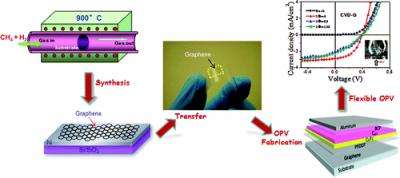
A flow of methane and hydrogen gas mixture deposits carbon atoms as graphene on a nickel plate. The graphene later is then transferred to a plastic sheet, which is then incorporated into an organic photo voltaic (OPV) cell. Credit: USC Viterbi School of Engineering

A University of Southern California team has produced flexible transparent carbon atom films that the researchers say have great potential for a new breed of solar cells.

"Organic photovoltaic (OPV) cells have been proposed as a means to achieve low cost energy due to their ease of manufacture, light weight, and compatibility with flexible substrates," wrote Chongwu Zhou, a professor of electrical engineering in the USC Viterbi School of Engineering, in a paper recently published in the journal .

The technique described in the article describes progress toward a novel OPV cell design that has significant advantages, particularly in the area of physical flexibility.

A critical aspect of any OPV photo-electronic device is a transparent conductive electrode through which light can couple with active materials to create electricity. The new work indicates that graphene, a highly conductive and highly transparent form of carbon made up of atoms-thick sheets of carbon atoms, has high potential to fill this role.

While graphene's existence has been known for decades, it has only been studied extensively since 2004 because of the difficulty of manufacturing it in high quality and in quantity.

The Zhou lab reported the large scale production of graphene films by three years ago. In this process, the USC engineering team creates ultra thin graphene sheets by first depositing carbon atoms in the form of graphene films on a nickel plate from .

Then they lay down a protective layer of thermo plastic over the graphene layer, and then dissolve the nickel underneath in an acid bath. In the final step they attach the plastic-protected graphene to a very flexible polymer sheet, which can then be incorporated into a OPV cell. (see diagram)

The USC team has produced graphene/polymer sheets ranging in sizes up to 150 square centimeters that in turn can be used to create dense arrays of flexible OPV cells.

These OPV devices convert solar radiation to electricity, but not as efficiently as silicon cells. The power provided by sunlight on a sunny day is about 1000 watts per meter square. "For every 1000 watts of sunlight that hits a one square meter area of the standard silicon solar cell, 14 watts of electricity will be generated," says Lewis Gomez De Arco, a doctoral student and a member of the team that built the graphene OPVs. "Organic are less efficient; their conversion rate for that same one thousand watts of sunlight in the graphene-based solar cell would be only 1.3 watts."

But what graphene OPVs lack in efficiency, they can potentially more than make for in lower price and, greater physical flexibility. Gomez De Arco thinks that it may eventually be possible to run printing presses laying extensive areas covered with inexpensive solar cells, much like newspaper presses print newspapers.

"They could be hung as curtains in homes or even made into fabric and be worn as power generating clothing. I can imagine people powering their cellular phone or music/video device while jogging in the sun," he said.

The USC researchers say graphene OPVs would be major advance in at least one crucial area over a rival OPV design, one based on Indium-Tin-Oxide (ITO). In the USC team's tests, ITO cells failed at a very small angle of bending, while the graphene-based cells remained operational after repeated bending at much larger stress angles. This would give the graphene solar cells a decided advantage in some uses, including the printed-on-fabric applications proposed by the USC team.

Zhou and the other researchers on the USC team - which included Yi Zhang, Cody W. Schlenker, Koungmin Ryu, and Mark E. Thompson in addition to Gomez de Arco — are excited by the potential for this technology.

Their paper concludes that their approach constitutes a significant advance toward the production of transparent conductive electrodes in solar cells. "CVD graphene meets the most important criteria of abundance, low cost, conductivity, stability, electrode/organic film compatibility, and flexibility that are necessary to replace ITO in organic photovoltaics, which may have important implications for future organic optoelectronic devices."

Provided by University of Southern California (news : web)

Filter


Move the slider to adjust rank threshold, so that you can hide some of the comments.


Display comments: newest first

trekgeek1
Jul 25, 2010

Rank: not rated yet
14 Watts from a potential of 1 KW? that's an efficiency of 1.4 percent. I think his numbers are incorrect. Their new cells would only get 0.13 percent if they only harvest 1.3 Watts.
Rank 5 /5 (7 votes)
Relevant PhysicsForums posts
  • polymer nanocomposites
    created1 hour ago
  • Corrosion Tests on Magnesium
    created14 hours ago
  • polyethylene copper nanocomposite
    created20 hours ago
  • Output of xrd analysis
    createdFeb 08, 2012
  • Transport phenomena problem based on problems 18.B11 and 19B.6 from Bird, stewart, lw
    createdFeb 06, 2012
  • Help with material selection - Car Piston
    createdFeb 05, 2012
  • More from Physics Forums - Materials & Chemical Engineering

More news stories

'Dark plasmons' transmit energy

Microscopic channels of gold nanoparticles have the ability to transmit electromagnetic energy that starts as light and propagates via "dark plasmons," according to researchers at Rice University.

Nanotechnology / Nanophysics

created 10 hours ago | popularity 5 / 5 (4) | comments 0 | with audio podcast

Nanotube therapy takes aim at breast cancer stem cells

Wake Forest Baptist Medical Center researchers have again proven that injecting multiwalled carbon nanotubes (MWCNTs) into tumors and heating them with a quick, 30-second laser treatment can kill them.

Nanotechnology / Bio & Medicine

created 15 hours ago | popularity 5 / 5 (1) | comments 0 | with audio podcast

Inspired by steel, nanomanufacturing gets wear-resistant carbide tip

(PhysOrg.com) -- Scientists at the University of Pennsylvania, the University of Wisconsin-Madison and IBM Research - Zurich have fabricated an ultrasharp silicon carbide tip possessing such high strength ...

Nanotechnology / Nanophysics

created 20 hours ago | popularity 5 / 5 (3) | comments 1 | with audio podcast

New kind of solar cell could capture significantly more energy than current cells

New solar cells could increase the maximum efficiency of solar panels by over 25%, according to scientists from the University of Cambridge.

Nanotechnology / Nanophysics

created Feb 08, 2012 | popularity 4.5 / 5 (11) | comments 14 | with audio podcast

New technology platform for molecule-based electronics

Researchers at the Nano-Science Center at the University of Copenhagen have developed a new nano-technology platform for the development of molecule-based electronic components using the wonder material graphene. At the same ...

Nanotechnology / Nanomaterials

created 17 hours ago | popularity 5 / 5 (2) | comments 0


FDA-approved drug rapidly clears amyloid from the brain, reverses Alzheimer's symptoms in mice

Neuroscientists at Case Western Reserve University School of Medicine have made a dramatic breakthrough in their efforts to find a cure for Alzheimer's disease. The researchers' findings, published in the journal Science, show t ...

Hydrogen from acidic water: Researchers develop potential low cost alternative to platinum for splitting water

A technique for creating a new molecule that structurally and chemically replicates the active part of the widely used industrial catalyst molybdenite has been developed by researchers with the Lawrence Berkeley ...

Ultraviolet protection molecule in plants yields its secrets

Lying around in the sun all day is hazardous not just for humans but also for plants, which have no means of escape. Ultraviolet (UV) radiation from the sun can damage proteins and DNA inside cells, leading ...

Soraa LED light may dim 50-watt halogen rivals

(PhysOrg.com) -- Soraa, a Fremont, California company founded in 2008, this week launched its first product, a light that uses LEDS (light emitting diodes). The "Soraa LED MR16 lamp" is the "perfect" replacement ...

Anyone can learn to be more inventive, cognitive researcher says

There will always be a wild and unpredictable quality to creativity and invention, says Anthony McCaffrey, a cognitive psychology researcher at the University of Massachusetts Amherst, because an "Aha moment" is rare and ...

Engineers find inspiration for new materials in Piranha-proof armor

(PhysOrg.com) -- It’s a matchup worthy of a late-night cable movie: put a school of starving piranha and a 300-pound fish together, and who comes out the winner?