Odds for Life Better in Photosynthesis Zones
July 23, 2010 by Charles Q. Choi
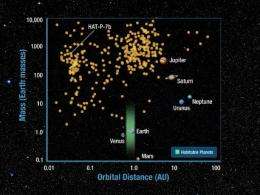
Distributions of mass and orbit size for the extrasolar planets so far discovered. The habitable zone is marked in green. Credit: NASA
By calculating where photosynthesis might be possible around the galaxy, scientists are developing a new way to figure out where Earth-like planets with life might be located.
When seeking to figure out where life might evolve, researchers have often focused on the "habitable zones" around stars, where the heat from the star is at the perfect level for liquid water to exist on the surface of a planet in that zone. The reasoning there is that wherever there is water on Earth, there is a chance for life.
Another strategy that physicist Werner von Bloh at the Potsdam Institute for Climate Impact Research in Germany and his colleagues suggest is to focus on the zones around stars where photosynthesis might be possible, since nearly all life on Earth depends on it one way or another for energy.
Although primitive life can exist without photosynthesis, the researchers argue it would be necessary for more complex multi-cellular organisms to emerge. This is because the main source for oxygen on Earth comes from photosynthetic life, and oxygen is thought to be necessary for multi-cellular life to arise.
To find such "photosynthesis-sustaining habitable zones" around stars, the researchers explain one should concentrate on where the global average surface temperature of a world in the zone stays between the freezing and boiling points of water (0 to 100 degrees Celsius).
They also say to look for planets where there are sufficient levels of carbon dioxide in the atmosphere, which photosynthetic life would consume to make oxygen and create organic matter. They assume these planets experience plate tectonics to help replenish vital supplies of key minerals.
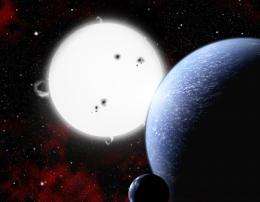
A hypothetical alien world and its moon orbit a hot, massive, type B star. Due to the short lifetime of such a star, photosynthetic life is not likely to be found there. Credit: David A. Aguilar, CfA
Stars of a Certain SizeWhen analyzing worlds for their photosynthetic sustainability, looking at their stars is key. Stars grow in luminosity as they age, destroying some photosynthesis-sustaining habitable zones while potentially creating others.
For instance, after small- and mid-sized stars consume all their hydrogen fuel, they become red giants, increasing 1,000 to 10,000 times in luminosity. This would be too much heat for any life that developed in their original photosynthesis-sustaining habitable zones, but could result in a new such zone for planets farther away. This new, more distant habitable zone could last up to 1 billion years, until these red giants sputtered out to become white dwarfs.
Using this logic, the researchers suggest there is no point considering stars larger than 2.2 solar masses since they would become red giants in less than 800 million years. Larger stars evolve more quickly, and life might need more time to emerge. Still, other scientists have suggested life could develop in as little as 500 million years, which means stars smaller than 2.6 solar masses might do.
Spotting Suitable Worlds
Given these limitations, von Bloh and his colleagues estimated our galaxy might host up to 2.5 million worlds suitable for complex multi-cellular photosynthetic life. Moreover, they calculated that up to 690 million worlds could host more basic single-celled life that could also be photosynthetic, similar to cyanobacteria on Earth. They detailed their findings in the June issue of the journal Plant Science.
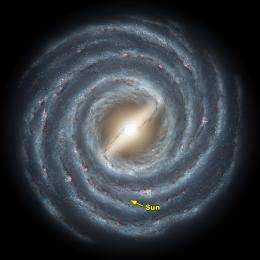
Artist’s conception of our Milky Way galaxy, with the location of our star, the Sun, noted. Where else in the galaxy might there be life capable of performing photosynthesis? Image credit: NASA
The researchers note their calculations as to the prevalence of complex life might get narrowed down even further if other factors are considered. For instance, large moons around planets in these zones might help the planets stabilize their tilt, leading to a stable climate. In addition, the presence of giant worlds elsewhere in these systems could help shield habitable planets from cosmic impacts.On the other hand, their assumptions might be a bit conservative. For example, the researchers focused just on roughly Earth-sized planets.
"Doing the simulations with planetary masses ranging from 0.1 with 10 Earth masses might be interesting," von Bloh noted. Moreover, "defining habitability based on carbon-based photosynthesis-performing life forms might be too Earth-centric. There might exist other life forms different from Earth life."
In any case, it could be a while before scientists can endeavor to look for signs of photosynthesis on alien worlds. Although the NASA Terrestrial Planet Finder and ESA Darwin missions would have aimed to look for oxygen or ozone as hints of photosynthetic life, Terrestrial Planet Finder has been indefinitely postponed, and studies have ended for Darwin.
"Finding signs of life on other planets might be the most challenging goal in astrobiology," von Bloh said.
Source: Astrobio.net
-
Starring Intelligent Aliens
Nov 05, 2009 |
not rated yet |
0
-
Planet-Finding by Numbers
Oct 18, 2006 |
not rated yet |
0
-
Kepler Planet Finding Mission Set for March 5 Launch
Feb 19, 2009 |
not rated yet |
0
-
New definition could further limit habitable zones around distant suns
Jun 10, 2009 |
not rated yet |
0
-
Avatar's moon Pandora could be real
Dec 17, 2009 |
not rated yet |
0
-
Engineers build first sub-10-nm carbon nanotube transistor
Feb 01, 2012 |
4.9 / 5 (31) |
30
-
Something old, something new: Evolution and the structural divergence of duplicate genes
Jan 31, 2012 |
4.6 / 5 (7) |
1
-
The hidden nanoworld of ice crystals: Revealing the dynamic behavior of quasi-liquid layers
Jan 30, 2012 |
5 / 5 (3) |
1
-
Stock market network reveals investor clustering
Jan 27, 2012 |
3.9 / 5 (23) |
8
-
Of microchemistry and molecules: Electronic microfluidic device synthesizes biocompatible probes
Jan 26, 2012 |
5 / 5 (1) |
0
-
Titan's lack of impact craters
Feb 09, 2012
-
Real pictures of black hole eating a star?
Feb 08, 2012
-
Hypothetical way to travel faster than light, but not technically exceed lightspeed
Feb 06, 2012
-
How do scientists monitor the Sun's activity?
Feb 05, 2012
-
Search patterns in observational studies
Feb 05, 2012
-
Derivation of Pogson's law
Feb 03, 2012
- More from Physics Forums - General Astronomy
More news stories
Could Venus be shifting gear?
(PhysOrg.com) -- ESAs Venus Express spacecraft has discovered that our cloud-covered neighbour spins a little slower than previously measured. Peering through the dense atmosphere in the infrared, the ...
Space & Earth / Space Exploration
5 hours ago |
5 / 5 (5) |
7
|
Humans may have helped the decline of African rainforests 3000 years ago
(PhysOrg.com) -- Large areas of rainforests in Central Africa mysteriously disappeared over three thousand years ago, to be replaced by savannas. The prevailing theory has been that the cause was a change ...
Mars Science Laboratory computer issue resolved
(PhysOrg.com) -- Engineers have found the root cause of a computer reset that occurred two months ago on NASA's Mars Science Laboratory and have determined how to correct it.
Space & Earth / Space Exploration
6 hours ago |
5 / 5 (5) |
3
|
Clam fields found at deep, low-temperature Mariana vents
(PhysOrg.com) -- Scientists have marveled at the unusual life forms thriving at high temperature hydrothermal vents of the deep ocean.
Space & Earth / Earth Sciences
5 hours ago |
not rated yet |
0
|
Two new moons for Jupiter
Advances in technology have lead to the discovery of new planets outside of our Solar System, and now even new moons in our own backyard.
Space & Earth / Space Exploration
5 hours ago |
not rated yet |
2
Putting the squeeze on planets outside our solar system
(PhysOrg.com) -- Using high-powered lasers, scientists at Lawrence Livermore National Laboratory and collaborators discovered that molten magnesium silicate undergoes a phase change in the liquid state, abruptly ...
Employers feel no love for unscrupulous practice of 'service sweethearting'
A new study led by two Florida State University marketing professors finds that some frontline service employees who are rewarded for hikes in customer loyalty and satisfaction also may engage in "service ...
US issues guidelines to avoid heparin contamination
Four years after US drug-maker Baxter International's blood thinner heparin was contaminated in China, causing dozens of deaths, US regulators on Friday issued draft guidelines for safe production.
Expat French get Internet vote for first time
French citizens will for the first time this year be able to vote in a parliamentary election over the Internet, an experiment that could be extended to other elections if successful.
"Twisted Metal" gamers get shot at real gunplay
Fans of "Twisted Metal" will get to welcome a long-awaited sequel of the car-battle videogame with a real-world bang by blasting an ice cream truck to bits with a machine gun.
The power of estrogen -- male snakes attract other males
A new study has shown that boosting the estrogen levels of male garter snakes causes them to secrete the same pheromones that females use to attract suitors, and turned the males into just about the sexiest ...


Jul 23, 2010
Rank: 1.7 / 5 (3)
Are they static, or in its' life time do they grow to a giant size (provided they begin smaller) then shrink to a red dwarf? (Isn't that a British TV show?)
Jul 23, 2010
Rank: 1 / 5 (3)
It's pure science fiction.
Jul 23, 2010
Rank: 4.5 / 5 (2)
Then, as the light passes through the planet's atmosphere on the way to earth, some of it in very specific frequencies will be absorbed by CO2 (and other) molecules in the atmosphere allowing us to measure the atmosphere's composition
Jul 23, 2010
Rank: 5 / 5 (2)
Jul 24, 2010
Rank: not rated yet
Jul 24, 2010
Rank: not rated yet
You can't measure CO2 in atmospheres of planets not detected yet :-)
Jul 26, 2010
Rank: not rated yet
The simple math of space travel allows galaxy-wide transit by any reasonably long lived beings capable of sustaining 1 G trajectories - There is no reason to think they could not carry biological designs along with them.
It's conceivable that the primary expansion of life began long before the solar system formed, and our planets were seeded with cellular life that was/is already distributed galaxy wide.
Whether cellular life distributes itself on the stellar winds via molecular cloud, or is tended by intelligent hands, it can be assumed that life is everywhere, and it is common in form.
It may be that gardening is the true universal ethos.