Weather kite gets second wind
July 23, 2010
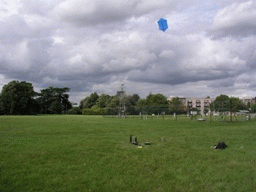
The red kite is now a commonly-seen bird of prey in the skies of the south-east, but a specially designed artificial blue kite promises a new way to make weather measurements.
Writing in the Review of Scientific Instruments, scientists at the University of Reading's Department of Meteorology describe a high-tech kite developed to measure wind speed. Kites have long been used to transport instruments up into the lower atmosphere, but rather than just offering a convenient "sky hook", the new approach uses the kite itself to detect the wind variations.
The wind speed varies the kite line's tension, which can be measured conveniently at the ground, rather than by carrying a sensor up on the kite aloft.
Kieran Walesby, who developed the instrumentation as part of his postgraduate research work at Reading, said: "This technique allows wind speeds above the ground to be measured without the need for a fixed instrument tower, and is therefore very portable."
The kite used in these experiments was specially built in the Department of Meteorology, and was combined with a tension-measuring system optimised to overcome temperature variations during long kite flights. The kite line tension is found by measuring the small distortions generated on a metal ring used to anchor the kite, using a set of miniature strain gauges.
Professor Giles Harrison, Professor of Atmospheric Physics who supervised the work, said: "Benjamin Franklin's 1752 experiment is a famous early example of using a kite to measure atmospheric properties. Our system reasserts the kite's value in atmospheric science, through offering an easily-implemented method for investigating lower atmosphere air flows, such as those which transport pollution."
Provided by University of Reading
-
Kites flying in high-altitude winds could provide clean electricity
Jun 24, 2009 |
not rated yet |
0
-
Airborne wind turbines to generate power from high winds (w/ Video)
Jun 04, 2010 |
not rated yet |
0
-
Invasive snail may damage diet of rare Everglades bird
Feb 04, 2010 |
not rated yet |
0
-
Deep Green underwater kite to generate electricity (w/ Video)
May 11, 2010 |
not rated yet |
0
-
Students test 'space postal service' during Foton mission
May 10, 2007 |
not rated yet |
0
-
Engineers build first sub-10-nm carbon nanotube transistor
Feb 01, 2012 |
4.9 / 5 (31) |
30
-
Something old, something new: Evolution and the structural divergence of duplicate genes
Jan 31, 2012 |
4.6 / 5 (7) |
1
-
The hidden nanoworld of ice crystals: Revealing the dynamic behavior of quasi-liquid layers
Jan 30, 2012 |
5 / 5 (3) |
1
-
Stock market network reveals investor clustering
Jan 27, 2012 |
3.9 / 5 (23) |
8
-
Of microchemistry and molecules: Electronic microfluidic device synthesizes biocompatible probes
Jan 26, 2012 |
5 / 5 (1) |
0
-
Discrepancy between oxygen and carbon-dioxide levels
Feb 09, 2012
-
where gems are found in the world
Feb 09, 2012
-
Wind Waves in Reservoir ~ Wind run-up and Wind set-up
Feb 08, 2012
-
Balance of oxygen in the atmosphere
Feb 01, 2012
-
The case for a methanol-based economy
Jan 30, 2012
-
Weather in a rotating cylinder
Jan 25, 2012
- More from Physics Forums - Earth
More news stories
Could Venus be shifting gear?
(PhysOrg.com) -- ESAs Venus Express spacecraft has discovered that our cloud-covered neighbour spins a little slower than previously measured. Peering through the dense atmosphere in the infrared, the ...
Space & Earth / Space Exploration
21 hours ago |
5 / 5 (7) |
8
|
Mars Science Laboratory computer issue resolved
(PhysOrg.com) -- Engineers have found the root cause of a computer reset that occurred two months ago on NASA's Mars Science Laboratory and have determined how to correct it.
Space & Earth / Space Exploration
22 hours ago |
4.7 / 5 (6) |
4
|
Two new moons for Jupiter
Advances in technology have lead to the discovery of new planets outside of our Solar System, and now even new moons in our own backyard.
Space & Earth / Space Exploration
21 hours ago |
4 / 5 (1) |
7
NASA sees wide-eyed cyclone Jasmine
Cyclone Jasmine's eye has opened wider on NASA satellite imagery, as it moves through the Southern Pacific Ocean.
Space & Earth / Earth Sciences
13 hours ago |
3.5 / 5 (2) |
2
Clam fields found at deep, low-temperature Mariana vents
(PhysOrg.com) -- Scientists have marveled at the unusual life forms thriving at high temperature hydrothermal vents of the deep ocean.
Space & Earth / Earth Sciences
21 hours ago |
4.3 / 5 (3) |
0
|
Anonymous knocks CIA website offline (Update)
The website of the Central Intelligence Agency was inaccessible on Friday after the hacker group Anonymous claimed to have knocked it offline.
New error-correcting codes guarantee the fastest possible rate of data transmission
Error-correcting codes are one of the triumphs of the digital age. Theyre a way of encoding information so that it can be transmitted across a communication channel such as an optical fiber o ...
Small modular reactor design could be a 'SUPERSTAR'
(PhysOrg.com) -- Though most of today's nuclear reactors are cooled by water, we've long known that there are alternatives; in fact, the world's first nuclear-powered electricity in 1951 came from a reactor ...
New power source discovered
(PhysOrg.com) -- Researchers at the Massachusetts Institute of Technology (MIT) and RMIT University have made a breakthrough in energy storage and power generation.
The power of estrogen -- male snakes attract other males
A new study has shown that boosting the estrogen levels of male garter snakes causes them to secrete the same pheromones that females use to attract suitors, and turned the males into just about the sexiest ...
Advanced power-grid model finds low-cost, low-carbon future in West
(PhysOrg.com) -- The least expensive way for the Western U.S. to reduce greenhouse gas emissions enough to help prevent the worst consequences of global warming is to replace coal with renewable and other ...