Raytheon unveils Scorpion helmet technology
July 23, 2010 By JANE WARDELL , AP Business Writer
Raytheon unveils Scorpion helmet technology (AP)

Enlarge

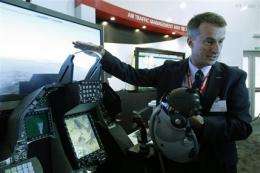
Todd A. Lovell, Avionics Department Manager at Raytheon Inc. speaks to the Associated Press about their pilot helmet display technology at the Farnborough International Airshow, Farnborough, Thursday, July 22, 2010. (AP Photo/Sang Tan)

(AP) -- As the desert landscape unfolds ahead, the jet fighter pilot glances to his right. Spotting an enemy target, a sensor attached to his helmet relays the information straight back to his flight controls, allowing him to fire immediately without turning his aircraft.

U.S. defense company Raytheon Inc. is giving the first glimpse of its Scorpion helmet technology for F-16 and A-10 combat jets on a simulator at the Farnborough International Airshow after this week announcing a $12.6 million contract with the U.S. Air Force.

Raytheon is marketing the technology, which transmits data on a single-eye monocle attached to an existing helmet, as a more advanced but also cost-effective alternative to current full visor offerings from its competitors - reflecting belt-tightening in the defense aerospace sector amid large cuts to national military budgets.

The monocle is both cheaper to produce than a full visor, and reduces operational costs because it is interchangeable between standard existing helmets. That means a unit can be equipped to full capacity by purchasing a smaller number of monocles that can be shared, instead of having to buy more expensive visor helmets to fit every pilot.

The monocle also improves on existing helmet vision technology by adding both color and night capability to a pilot's field of vision, allowing him to cue up weapons and access data from both on-board and remote sensors. The small size of the unit means that there's no noticeable extra weight on the pilot's head during long missions.

"On the modern battlefield, there is way more data out there than most people can use. If you are just trying to see it all through your eyes and read it in bits and bites, you're never going to understand it," said Todd A. Lovell, Avionics Department Manager at Raytheon, as he gives a demonstration of the Scorpion technology. "So the key to the modern technology is to take all that data and turn it into useful information that the pilot can recognize very quickly and act upon it."

That includes deploying weapons. Unlike pilots using a fixed display who must turn the nose of the plane to line up a shot, the helmet vision sends coordinates sighted by the wearer directly to the weapons system - leaving pilots simply to confirm a decision to fire by joystick.

"If I get a symbol, I don't have to turn my plane all the way over there to get a sensor locked on it," says Lovell. "It reduces the amount of time and energy the pilot has to spend in acquiring a target, making sure he has the right target, and then taking a shot."

Raytheon revealed at Farnborough that it has won a contract for an initial integration and qualification of the helmet-mounted system for F-16 and A-10 aircraft flown by the U.S. Air Force and Air National Guard.

The contract, won against competition from U.S., European and Israeli companies, is part of a program with five one-year production options worth up to $50 million. Beyond the 1,000 F-16 fighters flown by the U.S. Air Force, Raytheon hopes to capture the market for the estimated 4,000 F-16 aircraft operated by foreign air forces.

Raytheon had also put in a tender to the Air National Guard for its central pedestal display for F-16s, an interactive display that allows the to switch through different screens of information, including a moving map. Tender results are due in September.

Cuts to defense budgets have been the talk of the weeklong air show outside London - almost overshadowing some $29 billion worth of commercial plane sales as the global economy recovers from recession.

British Defense Secretary Liam Fox used his appearance at the biennial event to warn the industry to lower costs or see programs slashed.

And while analysts note that British and U.S. plans to withdraw troops from Afghanistan within the next five years could be good news for companies like France's Thales and its unmanned Watchkeeper drone, the implications for other defense companies is less certain.

Raytheon is confident its offering adds necessary benefits, add Col. Paul Mancini, chief of the Air National Guard's Operational Requirements Division, agrees.

Mancini, who has flown F-16s in Afghanistan, says the addition of color was crucial to "separate things out and interpret them."

"It turns the whole world into a display," he says. "In the F-16, I have my small 4x4 displays. You spend a lot of time looking at this display and trying to do the mental gymnastics to convert what am I looking at and what does that mean, how does that translate to the world around me. With the helmet-mounted display, the whole world is my display."

©2010 The Associated Press. All rights reserved. This material may not be published, broadcast, rewritten or redistributed.

4.6 /5 (10 votes)  

Filter


Move the slider to adjust rank threshold, so that you can hide some of the comments.


Display comments: newest first

Branden520
Jul 23, 2010

Rank: not rated yet
I saw the original prototype for this thing or at least something similar and I'm glad they went to a monocle. The original I saw had two large sapphire lens that were mounted from the helmet on two booms about 6" from the pilot's face. Looked like a fly's eyes contraption.

Can I get one for night driving and GPS?
plasticpower
Jul 23, 2010

Rank: not rated yet
I thought the Russians had this on their fighter jets for years, since like 1985 in one way or another? How is this new?
NotAsleep
Jul 27, 2010

Rank: not rated yet
It's not new technology, per se. What makes it innovative is that it's using effectively the same interface as the old system while adding the "look, shoot, kill" capability at a fraction of the price of other options.

Also, adding this to an A-10 is ridiculous... my guess is they budgeted for duct tape and zip ties to hold everything in place
Rank 4.6 /5 (10 votes)
Related Stories
Relevant PhysicsForums posts
  • Calling function with no input argument
    created9 hours ago
  • Force free body diagram problem on gym equipment
    created10 hours ago
  • Empirical data regarding shower heads and water
    created18 hours ago
  • feed hold button on CNC lathe
    createdFeb 09, 2012
  • RFAC in Fortran
    createdFeb 09, 2012
  • dynamics 2/32
    createdFeb 08, 2012
  • More from Physics Forums - General Engineering

More news stories

Google users warned of threat to smartphone wallets

Users of Google smartphone wallets were being warned on Friday that there is a way to crack pass codes intended to thwart thieves from going on illicit shopping sprees.

Technology / Internet

created 2 hours ago | popularity 5 / 5 (1) | comments 0

Anonymous knocks CIA website offline (Update)

The website of the Central Intelligence Agency was inaccessible on Friday after the hacker group Anonymous claimed to have knocked it offline.

Technology / Internet

created 4 hours ago | popularity 5 / 5 (6) | comments 10

New error-correcting codes guarantee the fastest possible rate of data transmission

Error-correcting codes are one of the triumphs of the digital age. They’re a way of encoding information so that it can be transmitted across a communication channel — such as an optical fiber o ...

Technology / Computer Sciences

created 12 hours ago | popularity 5 / 5 (4) | comments 5 | with audio podcast

New power source discovered

(PhysOrg.com) -- Researchers at the Massachusetts Institute of Technology (MIT) and RMIT University have made a breakthrough in energy storage and power generation.

Technology / Energy & Green Tech

created 11 hours ago | popularity 4.8 / 5 (19) | comments 7 | with audio podcast

Small modular reactor design could be a 'SUPERSTAR'

(PhysOrg.com) -- Though most of today's nuclear reactors are cooled by water, we've long known that there are alternatives; in fact, the world's first nuclear-powered electricity in 1951 came from a reactor ...

Technology / Energy & Green Tech

created 12 hours ago | popularity 4.2 / 5 (10) | comments 20 | with audio podcast


Complex wiring of the nervous system may rely on a just a handful of genes and proteins

Researchers at the Salk Institute have discovered a startling feature of early brain development that helps to explain how complex neuron wiring patterns are programmed using just a handful of critical genes. ...

Putting the squeeze on planets outside our solar system

(PhysOrg.com) -- Using high-powered lasers, scientists at Lawrence Livermore National Laboratory and collaborators discovered that molten magnesium silicate undergoes a phase change in the liquid state, abruptly ...

NASA sees wide-eyed cyclone Jasmine

Cyclone Jasmine's eye has opened wider on NASA satellite imagery, as it moves through the Southern Pacific Ocean.

The power of estrogen -- male snakes attract other males

A new study has shown that boosting the estrogen levels of male garter snakes causes them to secrete the same pheromones that females use to attract suitors, and turned the males into just about the sexiest ...

NASA sees Giovanna reach cyclone strength, threaten Madagascar

Tropical Storm 12S built up steam and became a cyclone on February 10, 2012 as NASA's Terra satellite passed overhead. Residents of east-central Madagascar should prepare for this cyclone to make landfall ...

Humans may have helped the decline of African rainforests 3000 years ago

(PhysOrg.com) -- Large areas of rainforests in Central Africa mysteriously disappeared over three thousand years ago, to be replaced by savannas. The prevailing theory has been that the cause was a change ...