Fermilab experiments narrow allowed mass range for Higgs boson
July 26, 2010
Fermilab experiments narrow allowed mass range for Higgs boson

Enlarge

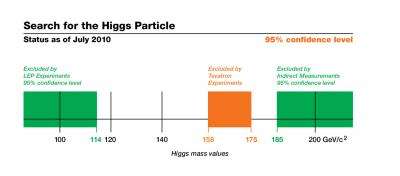
Scientists from the CDF and DZero collaborations at DOE's Fermilab have combined Tevatron data from their two experiments to increase the sensitivity for their search for the Higgs boson. While no Higgs boson has been found yet, the results announced today exclude a mass for the Higgs between 158 and 175 GeV/c2 with 95 percent probability. Earlier experiments at the Large Electron-Positron Collider at CERN excluded a Higgs boson with a mass of less than 114 GeV/c2 at 95 percent probability. Calculations of quantum effects involving the Higgs boson require its mass to be less than 185 GeV/c2. The Fermilab experimenters will test more and more of the available mass range for the Higgs as their experiments record more collision data and as they continue to refine their experimental analyses.

(PhysOrg.com) -- New constraints on the elusive Higgs particle are more stringent than ever before. Scientists of the CDF and DZero collider experiments at the U.S. Department of Energy's Fermilab revealed their latest Higgs search results today at the International Conference on High Energy Physics, held in Paris from July 22-28. Their results rule out a significant fraction of the allowed mass range established by earlier experiments.

The Fermilab experiments now exclude a Higgs particle with a between 158 and 175 GeV/c2. Searches by previous experiments and constraints due to the of and Forces indicate that the Higgs particle should have a mass between 114 and 185 GeV/c2. (For comparison: 100 GeV/c2 is equivalent to 107 times the mass of a proton.) The new Fermilab result rules out about a quarter of the expected Higgs mass range.

"Fermilab has pushed the productivity of the Tevatron collider to new heights," said Dennis Kovar, DOE Associate Director of Science for . "Thanks to the extraordinary performance of Fermilab's Tevatron collider, CDF and DZero collaborators from around the world are producing exciting results and are making immense progress on the search for the Higgs particle."

At the ICHEP conference, CDF and DZero scientists are giving more than 40 talks on searches for exotic particles and dark matter candidates, discoveries of new decay channels of known particles and precision measurements of numerous particle properties. Together, the two collaborations present about 150 results.

The Higgs particle is the last not-yet-observed piece of the known as the Standard Model of Particles and Forces. According to the Standard Model, the Higgs boson explains why some particles have mass and others do not.
Fermilab experiments narrow allowed mass range for Higgs boson
Enlarge

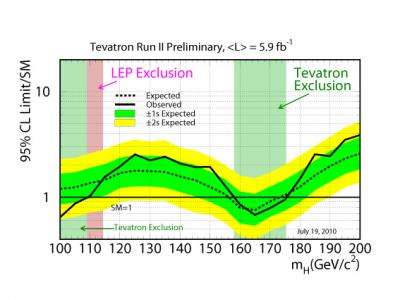
Observed and expected exclusion limits for a Standard Model Higgs boson at the 95-percent confidence level for the combined CDF and DZero analyses. The limits are expressed as multiples of the SM prediction for test masses chosen every 5 GeV/c2 in the range of 100 to 200 GeV/c2. The points are joined by straight lines for better readability. The yellow and green bands indicate the 68- and 95-percent probability regions, in the absence of a signal. The CDF and DZero data exclude a Higgs boson between 158 and 175 GeV/c2 at the 95-percent confidence level and show that the Tevatron experiments are beginning to be sensitive to a low-mass Higgs boson.

"We are close to completely ruling out a Higgs boson with a large mass," said DZero cospokesperson Dmitri Denisov, one of 500 scientists from 19 countries working on the DZero experiment. "Three years ago, we would not have thought that this would be possible. With more data coming in, our experiments are beginning to be sensitive to a low-mass Higgs boson."

Robert Roser, cospokesperson for the 550 physicists from 13 countries of the CDF collaboration, also credited the great work of the CDF and DZero analysis groups for the stringent Higgs exclusion results.

"The new Higgs search results benefited from the wealth of Tevatron collision data and the smart search algorithms developed by lots of bright people, including hundreds of graduate students," Roser said. "The CDF and DZero analysis groups have gained a better understanding of collisions that can mimic a Higgs signal; improved the sensitivity of their detectors to particle signals; and included new Higgs decay channels in the overall analysis."

To obtain the latest Higgs search result, the CDF and DZero analysis groups separately sifted through more than 500,000 billion proton-antiproton collisions that the Tevatron has delivered to each experiment since 2001. After the two groups obtained their independent Higgs search results, they combined their results to produce the joint exclusion limits.

"Our latest result is based on about twice as much data as a year and a half ago," said DZero cospokesperson Stefan Soldner-Rembold, of the University of Manchester. "As we continue to collect and analyze data, the Tevatron experiments will either exclude the Standard Model Higgs boson in the entire allowed mass range or see first hints of its existence."
Fermilab experiments narrow allowed mass range for Higgs boson
Enlarge

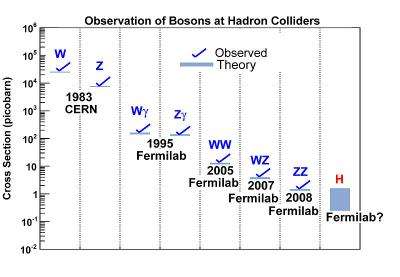
In the last 15 years, the CDF and DZero experiments at Fermilab have discovered increasingly rare combinations of the electroweak force carriers — gamma, W and Z — emerging from proton-antiproton collisions at the Tevatron. With the Tevatron producing a record number of particle collisions, the CDF and DZero experiments might be able to catch a glimpse of the Higgs particle. The uncertainty in the predicted cross section for the Higgs boson reflects the range of Higgs masses not yet excluded by experiment.

The observation of the Higgs particle is also one of the goals of the Large Hadron Collider experiments at the European laboratory CERN, which record proton-proton collisions that have 3.5 times the energy of Tevatron collisions. But for rare subatomic processes such as the production of a Higgs particle with a low mass, extra energy is less important than a large number of collisions produced.

"With the Tevatron cranking out more and more collisions, we have a good chance of catching a glimpse of the ," said CDF cospokesperson Giovanni Punzi, of the University of Pisa and the National Institute of Nuclear Physics (INFN) in Italy. "It will be fascinating to see what Mother Nature has in her cards for us. We might find out that the Higgs properties are different from what we expect, revealing new insights into the origin of matter."

Provided by Fermilab (news : web)

4.7 /5 (24 votes)  

Filter


Move the slider to adjust rank threshold, so that you can hide some of the comments.


Display comments: newest first

Mohitwa
Jul 26, 2010

Rank: 4 / 5 (6)
Somehow, my gut-feel says that all this talk of Higgs Boson even in theory is, a bit of a Hog-wash and at best a zero-order approximation to the real stuff involving some Quantum Gravity effects. Logic/History to back my gut feel goes as follows:

1. Anything to do with mass and not factoring Gravitational Physics, seems at best a wishful attempt to stretch the rubber-band of current methods of QFT and Gauge Field Theories in flat space-time, a bit too far.
2. Another eerie feeling I have is that an unexpected/null result on the Higgs Boson at LHC etc. (like the famous Michelson-Morley Exp over a century ago) will force a major overhaul of the approach and a radical theory for attacking the problems at the frontiers of Theoretical Physics today. Recall how radical Einstein's relativity was in its time... "A leap of faith: Time dilation", but elegantly simple... just hold the velocity of light constant and everything fell in place... NO ETHER, NO artificial Lorentz-Fitzgerald contract
trekgeek1
Jul 26, 2010

Rank: 1 / 5 (1)
Isn't this Boson supposed to give mass to other particles? Strange that it itself has mass that it must bestow upon itself. I'm not well versed in this subject, please correct my assumptions if needed.
kraisar
Jul 26, 2010

Rank: 3 / 5 (2)
It isn't all that surprising. Fields can interact with themselves after all. From what I recall the mass of particles is supposed to come about from how they interact or couple to the Higgs field, and there can indeed be a self-interacting term (think the electron can and does have a self-interaction).
fmfbrestel
Jul 27, 2010

Rank: not rated yet
"Physicists sometimes use a fixed level of confidence to allow new findings to count as discoveries, said Maricic. That's usually quite high -- at 99.999943 percent." -- From another article on the physics main page.

So, they have "limited" the mass of the Higgs from a few ranges with 95% certainty, and to discover something, you need 99.999943% certainty. Thats what... 5 orders of magnitude less certain then standard reliability?? reports like this, and then their inevitable refutation a few weeks or months later, is exactly why so many people do not have faith in science. This is NOT news.
Nanowill
Jul 27, 2010

Rank: 1 / 5 (1)
The whole Higgs particle idea is wrong. The notion of mass derives from the effect of gravity, which arises from curved metric fields that localize EM energy to form particles. For A = alpha ~1/137,

me=2A^2/3.M(1-(A^5/3)/2+(A^10/3)/4)= 0.5109989MeV/c^2

mp=[M/A(1-A)](1+(A^4/3)/2-(A^10/3)/4 = 938.27202MeV/c^2
Same quantum mass M for both particles,
M = 6.792130736MeV. Check it out! Pure Physics.

Google; 'Rethinking Physics' for theoretical details.
Have a great day!
dirk_bruere
Jul 27, 2010

Rank: 5 / 5 (3)
So, the headline should read: "Higgs still not found"
Rank 4.7 /5 (24 votes)
Relevant PhysicsForums posts
  • Rubber production is likely to gradually reduce
    created1 hour ago
  • Help! Physics Momentum/Impulse problem!
    created2 hours ago
  • Gauss' law cubes, how to prove
    created3 hours ago
  • A grandfather pulls his granddaughter, whose mass is 20.5 kg
    created5 hours ago
  • what is significance of torque
    created5 hours ago
  • Difference between volume displaced fluid and volume of the object
    created6 hours ago
  • More from Physics Forums - General Physics

More news stories

Explained: Sigma

It's a question that arises with virtually every major new finding in science or medicine: What makes a result reliable enough to be taken seriously? The answer has to do with statistical significance -- but ...

Physics / General Physics

created 19 hours ago | popularity 5 / 5 (11) | comments 30

Borexino Collaboration succeeds in spotting pep neutrinos emitted from the sun

(PhysOrg.com) -- To learn more about how the sun works, scientists study particles that are emitted from it into space due to thermonuclear reactions that occur inside; by applying known physics principles, ...

Physics / General Physics

created 19 hours ago | popularity 4.6 / 5 (7) | comments 0 | with audio podcast report

Physics research suggests new pathways for cancer progression

Observing that certain cancer cells may exhibit greater flexibility than normal cells, some scientists believe that this capability promotes rapid tumor growth. Now computer simulations developed by Boston University Biomedical ...

Physics / General Physics

created 17 hours ago | popularity 5 / 5 (1) | comments 0

Quantum physicist explains $100K offer for proof scaled-up quantum computing is impossible

(PhysOrg.com) -- MIT researcher Scott Aaronson has certainly riled the physics community with his offer this past Friday, of $100,000 to anyone who can prove that scaled-up quantum computing is impossible. ...

Physics / Quantum Physics

created Feb 08, 2012 | popularity 4.1 / 5 (11) | comments 32 | with audio podcast weblog

Physicists 'record' magnetic breakthrough

An international team of scientists has demonstrated a revolutionary new way of magnetic recording which will allow information to be processed hundreds of times faster than by current hard drive technology.

Physics / General Physics

created Feb 07, 2012 | popularity 4.5 / 5 (39) | comments 14 | with audio podcast


'Dark plasmons' transmit energy

Microscopic channels of gold nanoparticles have the ability to transmit electromagnetic energy that starts as light and propagates via "dark plasmons," according to researchers at Rice University.

FDA-approved drug rapidly clears amyloid from the brain, reverses Alzheimer's symptoms in mice

Neuroscientists at Case Western Reserve University School of Medicine have made a dramatic breakthrough in their efforts to find a cure for Alzheimer's disease. The researchers' findings, published in the journal Science, show t ...

Hydrogen from acidic water: Researchers develop potential low cost alternative to platinum for splitting water

A technique for creating a new molecule that structurally and chemically replicates the active part of the widely used industrial catalyst molybdenite has been developed by researchers with the Lawrence Berkeley ...

Ultraviolet protection molecule in plants yields its secrets

Lying around in the sun all day is hazardous not just for humans but also for plants, which have no means of escape. Ultraviolet (UV) radiation from the sun can damage proteins and DNA inside cells, leading ...

Soraa LED light may dim 50-watt halogen rivals

(PhysOrg.com) -- Soraa, a Fremont, California company founded in 2008, this week launched its first product, a light that uses LEDS (light emitting diodes). The "Soraa LED MR16 lamp" is the "perfect" replacement ...

Anyone can learn to be more inventive, cognitive researcher says

There will always be a wild and unpredictable quality to creativity and invention, says Anthony McCaffrey, a cognitive psychology researcher at the University of Massachusetts Amherst, because an "Aha moment" is rare and ...