Converging weather patterns caused last winter's huge snows
July 26, 2010
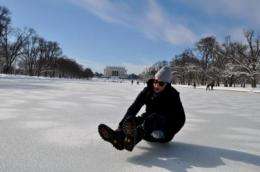
Unusually cold weather turned the Lincoln Memorial Reflecting Pool into an ice rink. Credit: FamousDC.com.
The memory of last winter's blizzards may be fading in this summer's searing heat, but scientists studying them have detected a perfect storm of converging weather patterns that had little relation to climate change. The extraordinarily cold, snowy weather that hit parts of the U.S. East Coast and Europe was the result of a collision of two periodic weather patterns in the Atlantic and Pacific Oceans, a new study in the journal Geophysical Research Letters finds.
It was the snowiest winter on record for Washington D.C., Baltimore and Philadelphia, where more than six feet of snow fell over each. After a blizzard shut down the nation's capital, skeptics of global warming used the frozen landscape to suggest that manmade climate change did not exist, with the family of conservative senator James Inhofe posing next to an igloo labeled "Al Gore's new home."
After analyzing 60 years of snowfall measurements, a team of scientists at Columbia University's Lamont-Doherty Earth Observatory found that the anomalous winter was caused by two colliding weather events. El Niño, the cyclic warming of the tropical Pacific, brought wet weather to the southeastern U.S. at the same time that a strong negative phase in a pressure cycle called the North Atlantic Oscillation pushed frigid air from the arctic down the East Coast and across northwest Europe. End result: more snow.
Using a different dataset, climate scientists at the National Oceanic and Atmospheric Administration came to a similar conclusion in a report released in March.
"Snowy winters will happen regardless of climate change," said Richard Seager, a climate scientist at Lamont-Doherty and lead author of the study. "A negative North Atlantic Oscillation this particular winter made the air colder over the eastern U.S., causing more precipitation to fall as snow. El Niño brought even more precipitation—which also fell as snow."
In spite of last winter's snow, the decade 2000-2009 was the warmest on record, with 2009 tying a cluster of other recent years as the second warmest single year. Earth's climate has warmed 0.8°C (1.5°F) on average since modern record keeping began, and this past June was the warmest ever recorded.
While the heavy snow on the East Coast and northwest Europe dominated headlines this winter, the Great Lakes and western Canada actually saw less snow than usual—typical for an El Niño year, said Seager. Warm and dry weather in the Pacific Northwest forced the organizers of the 2010 Winter Olympic Games in Vancouver to lug in snow by truck and helicopter to use on ski and snowboarding slopes. The arctic also saw warmer weather than usual, but fewer journalists were there to take notes.
"If Fox News had been based in Greenland they might have had a different story," said Seager.
While El Niño can now be predicted months in advance by monitoring slowly evolving conditions in the tropical Pacific Ocean, the North Atlantic Oscillation— the difference in air pressure between the Icelandic and Azores regions—is a mostly atmospheric phenomenon, very chaotic and difficult to anticipate, said Yochanan Kushnir, a climate scientist at Lamont-Doherty and co-author of the study.
The last time the North Atlantic experienced a strong negative phase, in the winter of 1995-1996, the East Coast was also hammered with above average snowfall. This winter, the North Atlantic Oscillation was even more negative--a state that happens less than 1 percent of the time, said Kushnir.
"The events of last winter remind us that the North Atlantic Oscillation, known mostly for its impact on European and Mediterranean winters, is also playing a potent role in its backyard in North America," he said.
David Robinson, a climate scientist at Rutgers University who was not involved in the research, said the study fills an important role in educating the public about the difference between freak weather events and human-induced climate change.
"When the public experiences abnormal weather, they want to know what's causing it," he said. "This paper explains what happened, and why global warming was not really involved. It helps build credibility in climate science."
More information: "Northern hemisphere winter snow anomalies: ENSO, NAO and the winter of 2009/10," Geophysical Research Letters.
-
Scientist Forecasts Above Average Mountain Moisture
Nov 04, 2005 |
not rated yet |
0
-
El Nino To Affect Weather In Colorado And Western U.S.
Dec 01, 2006 |
not rated yet |
0
-
El Nino Could Play A Role In Colorado's Winter Weather, Scientist Says
Nov 17, 2009 |
not rated yet |
0
-
Canada reports mildest winter on record
Mar 20, 2010 |
not rated yet |
0
-
Winter forecast: Warmer West, North; cooler South
Oct 15, 2009 |
not rated yet |
0
-
Engineers build first sub-10-nm carbon nanotube transistor
Feb 01, 2012 |
4.9 / 5 (30) |
30
-
Something old, something new: Evolution and the structural divergence of duplicate genes
Jan 31, 2012 |
4.6 / 5 (7) |
1
-
The hidden nanoworld of ice crystals: Revealing the dynamic behavior of quasi-liquid layers
Jan 30, 2012 |
5 / 5 (3) |
1
-
Stock market network reveals investor clustering
Jan 27, 2012 |
3.9 / 5 (23) |
8
-
Of microchemistry and molecules: Electronic microfluidic device synthesizes biocompatible probes
Jan 26, 2012 |
5 / 5 (1) |
0
-
Discrepancy between oxygen and carbon-dioxide levels
7 hours ago
-
where gems are found in the world
11 hours ago
-
Wind Waves in Reservoir ~ Wind run-up and Wind set-up
Feb 08, 2012
-
Balance of oxygen in the atmosphere
Feb 01, 2012
-
The case for a methanol-based economy
Jan 30, 2012
-
Weather in a rotating cylinder
Jan 25, 2012
- More from Physics Forums - Earth
More news stories
Humans may have helped the decline of African rainforests 3000 years ago
(PhysOrg.com) -- Large areas of rainforests in Central Africa mysteriously disappeared over three thousand years ago, to be replaced by savannas. The prevailing theory has been that the cause was a change ...
New views show old NASA Mars landers
(PhysOrg.com) -- The High Resolution Imaging Science Experiment (HiRISE) camera on NASA's Mars Reconnaissance Orbiter recorded a scene on Jan. 29, 2012, that includes the first color image from orbit showing ...
Space & Earth / Space Exploration
21 hours ago |
4.9 / 5 (7) |
9
|
Black holes and star formation
(PhysOrg.com) -- It has long been recognized that galaxy mergers or even close interactions can play a vital role in shaping the morphology of galaxies. One way they can do so, it is thought, is by triggering ...
20 hours ago |
4.1 / 5 (7) |
5
|
Deconstructing a mystery: What caused Snowmaggedon?
In the quiet after the storms, streets and cars had all but disappeared under piles of snow. The U.S. Postal Service suspended service for the first time in 30 years. Snow plows struggled to push the evidence ...
Space & Earth / Earth Sciences
13 hours ago |
4.7 / 5 (3) |
1
|
Ocean microbe communities changing, but long-term environmental impact is unclear
As oceans warm due to climate change, water layers will mix less and affect the microbes and plankton that pump carbon out of the atmosphere but researchers say it's still unclear whether these processes ...
Space & Earth / Earth Sciences
15 hours ago |
5 / 5 (2) |
2
|
Japan scientist makes 'Avatar' robot
A Japanese-developed robot that mimics the movements of its human controller is bringing the Hollywood blockbuster "Avatar" one step closer to reality.
Fighting crimes against biodiversity: How to catch a killer weed
Invasive species which have the potential to destroy biodiversity and influence global change could be tracked and controlled in the same way as wanted criminals, according to new research from Queen Mary, University of London.
Metastatic breast cancer hitches a free ride from the immune system
Inflammatory breast cancer (IBC) is the most lethal form of breast cancer . It spreads easily through the lymphatic and blood vessels, forming metastasis which can lead to multi-organ failure. New research published in BioMed ...
A novel method for simultaneously measuring blood pressure and arterial stiffness
Arterial stiffness due to is a major contributor to cardiovascular disease but is very difficult to measure. It also can influence blood pressure readings since these rely on the time taken for arteries to return to normal ...
India's global pharmacy role threatened by EU pact
(AP) -- Efforts by India and the European Union to strengthen trade are threatening India's ability to deliver lifesaving medicines to the world's poorest, analysts say as the two sides push through protracted ...
US video game sales fall 34 percent in January
(AP) -- U.S. retail sales of video game hardware, software and accessories fell 34 percent in January from a year earlier to $751 million due to the lack of new game titles, according to market researcher NPD Group.
Jul 26, 2010
Rank: 2 / 5 (1)
Jul 26, 2010
Rank: 5 / 5 (1)
we are in a closed system, and so negative energy drives the system from its more fixed constant of the sun.
when the sun is warmer, all are warmer, and the cycles slow. they pull less water as far.
when the sun is colder its like making a bigger hole to dump heat in, and it all speeds up. there is less time to dump the water and weather becomes more severe in the north.
the key difference is that in the south, people suffer serious cold not warm... as in peru.
the danger can be seen as evident in that the cultyure does not remember such cold and has no natural way to deal with it...
if this was something more common historically, their culture would be more prepared and so the damage to people would be less.